
 By Islam Baraka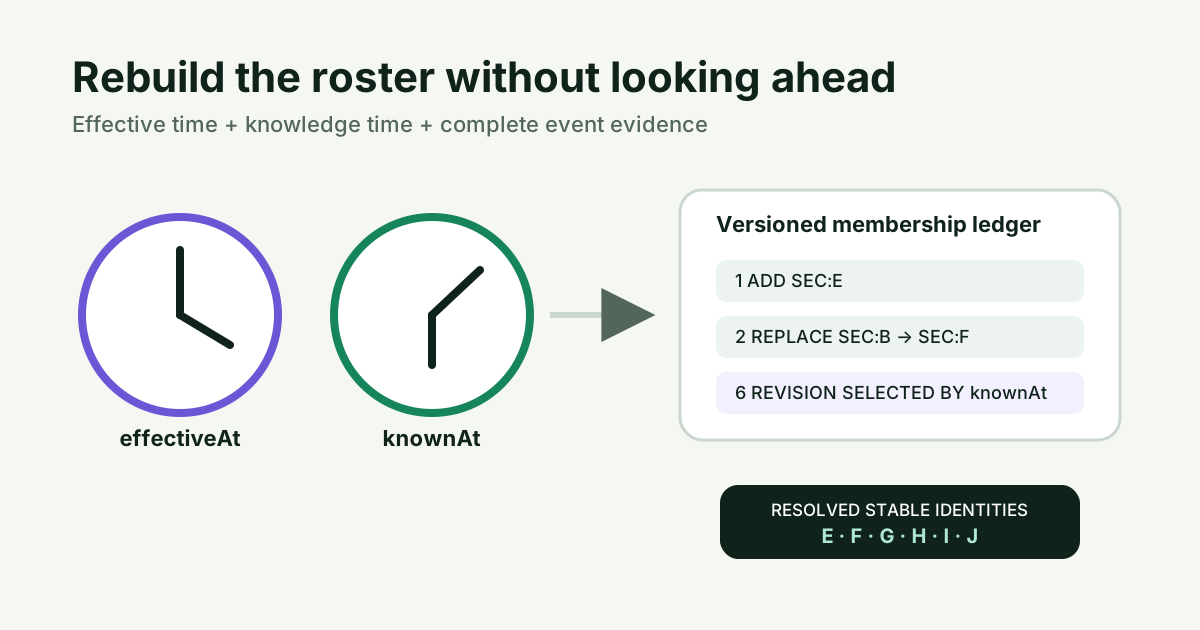
The governed definitions this build depends on. Read them first if a term is unfamiliar.
- PrimaryUniverse MembershipUniverse membership is an effective-dated assertion that a security belongs to a defined eligible set for a specified interval.
- PrerequisiteSecurityA security is a financial instrument representing an investment or financing interest that can be identified and transferred under applicable rules.
- PrerequisiteStable Security IdentifierA stable security identifier is a governed key intended to preserve instrument identity across changes in mutable labels such as ticker or name.
- ImportantAvailability TimeAvailability time is the earliest evidenced instant at which information was usable by a specified system or decision process.
- ImportantData LineageData lineage records where data came from, how it was transformed, and which entities, activities, and agents affected it.
- ImportantEffective TimeEffective time is the instant or interval boundary from which a rule, status, or fact applies in its modeled business domain.
- ImportantPoint-in-Time DatasetA point-in-time dataset can reconstruct what information was valid and available to a specified user or system at a historical decision time.
- ImportantPoint-in-Time Issue UniverseA point-in-time issue universe is the eligible security set established using information valid for the session being calculated.
- ImportantPublication TimePublication time is when a source officially released or disseminated information.
- ImportantSecurity MasterA security master is a governed reference-data system that organizes instruments, issuers, identifiers, listings, currencies, statuses, and effective dates.
- ImportantSeries IdentitySeries identity is the complete key and semantic contract that states what a sequence of observations represents.
- ImportantUniverse PartitionA universe partition assigns every eligible issue to exactly one declared classification bucket.
A historical backtest needs the roster that existed then—not the names that survived until today. But “existed then” is only half the requirement. The simulation may also use only the evidence its system had received by that moment in the research timeline.
Historical constituent reconstruction therefore answers:
Which stable security identities belonged to this index at effective instant
t, using only evidence available by knowledge instantk?
That second clock prevents a later correction from quietly rewriting an earlier backtest.
Why one date is not enough
Suppose a provider announces an addition for next month. A later notice identifies the deletion, and a still later correction changes one security identity. The effective date can remain constant while the knowable roster changes across announcement versions.
The two clocks have different jobs:
effectiveAtasks when membership applies;knownAtlimits which snapshots and notice revisions the simulated system may select.
An announcement timestamp is also not automatically your availableAt. The latter records when your own research system could actually use the artifact.
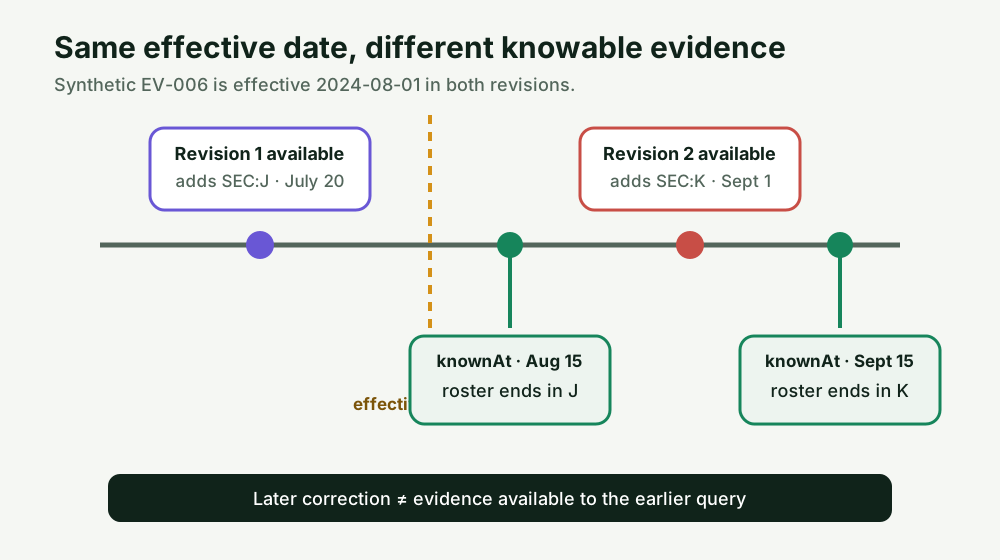
The key takeaway is simple: a revision published after knownAt must remain excluded even when it describes an earlier effective date.
What the algorithm reconstructs
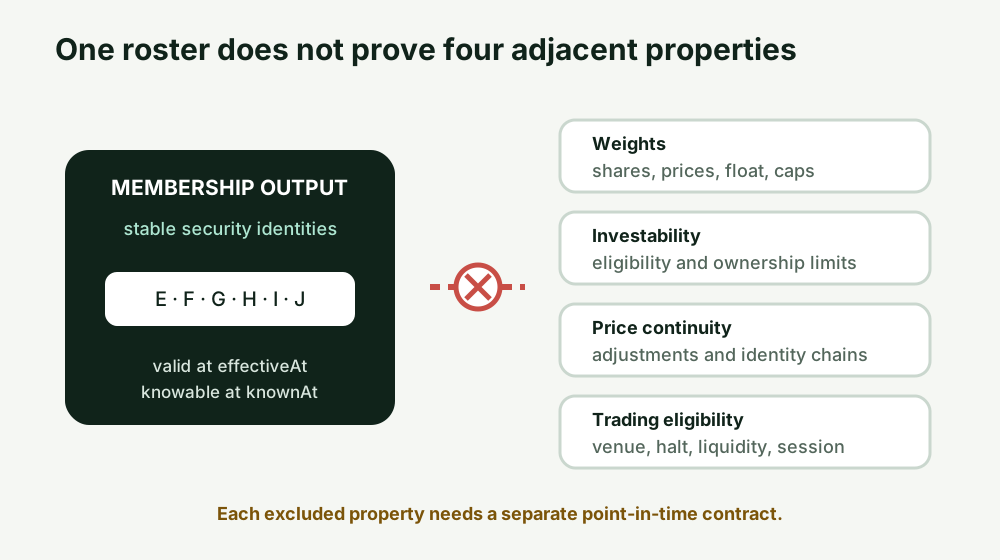
The output is membership. It does not infer:
- constituent weights;
- free-float or other investability factors;
- trading eligibility or liquidity;
- a continuous price series;
- index levels, returns, or divisors.
Those objects can share timestamps and identifiers, but they require their own evidence and rules.
The evidence contract
Every input instant is a calendar-valid UTC ISO 8601 value ending in Z. Every index and security uses a stable identity, not a display ticker.
A base snapshot contains a versioned roster, effective and available times, and lastSequence: the last ledger position already reflected in that roster. An event version contains:
- an immutable
eventId, sequence, type, effective instant, and same-instant order; - announcement and local availability instants;
- a contiguous revision number;
activeorcancelledstatus;- explicit
addanddeleteoperations; - a source lineage identifier.
The implementation recognizes addition, deletion, replacement, rebalance, reconstitution, and corporate-action membership events. A rebalance may carry no membership changes: weights are outside this contract.
Four honest outcomes
The resolver refuses to manufacture certainty:
| Status | Meaning |
|---|---|
resolved | one roster follows from the eligible evidence |
incomplete | no eligible base exists or a ledger sequence is missing |
ambiguous | evidence overlaps, conflicts, or requests an impossible state transition |
unsupported | a relevant event type has no implemented semantics |
The diagram's important branch is not the happy path. It is the refusal to turn missing or conflicting evidence into a plausible-looking list.
Replay rule
For event i, let M_(i-1) be the current member set, D_i its deletions, and A_i its additions:
Before applying the formula, every deletion must already be present, and every addition must be absent after deletion processing. Within one event, deletions run before additions. Across events, order is deterministic by effective instant, declared same-instant order, sequence, and event identity.
Membership intervals are half-open. If a replacement is effective at 2024-03-01T00:00:00Z, the deleted security's interval ends there and the addition's begins there.
Synthetic worked example
The shared fixture starts with four synthetic securities. It then records six membership sequences: an addition, a replacement, a membership-neutral rebalance, a corporate-action replacement, a reconstitution, and another addition. Revision 1 of the last event adds SEC:J; revision 2 later corrects it to SEC:K.
For effective 2024-08-15T00:00:00Z and knowledge 2024-08-15T12:00:00Z, revision 2 is not yet available. The roster is:
SEC:E, SEC:F, SEC:G, SEC:H, SEC:I, SEC:J
Keeping the effective instant fixed but moving knowledge to 2024-09-15T12:00:00Z selects revision 2:
SEC:E, SEC:F, SEC:G, SEC:H, SEC:I, SEC:K
These identities and dates are entirely synthetic. The comparison demonstrates revision selection; it is not a historical index claim.
Try the same sequence in the guided playground. Choose a scenario, use Step to advance one evidence transition, and compare the current roster with excluded later evidence.
A bounded historical illustration
Official S&P Dow Jones Indices releases provide a useful chronology without requiring an invented price or weight:
- On 2020-11-16, S&P DJI said Tesla would enter the S&P 500 before the 2020-12-21 open, but the replaced company would be named later.
- On 2020-11-30, it said Tesla would be added at full float-adjusted market-cap weight, while the replacement name was still pending.
- On 2020-12-11, it identified Apartment Investment and Management (AIV) as the replaced S&P 500 constituent.
The November 16 release, November 30 release, and December 11 release establish only that public announcement sequence. They do not prove this package's synthetic availableAt times, historical weights, security-master mappings, or any vendor's roster output.
This is exactly why a real-data implementation needs immutable notice artifacts, retrieval timestamps, stable identity mappings, revision links, effective boundaries, and licensing records. Without that evidence, mark the reconstruction incomplete.
Corrections and cancellations
Revisions are selected independently for each event identity. The highest revision available by knownAt wins. A cancellation consumes its sequence but performs no membership operation. This lets the audit explain that an event was known and withdrawn without creating a false ledger gap.
A later revision never mutates the earlier query. Re-running the earlier knownAt must reproduce the earlier roster.
Same-instant events and conflicts
Two changes can share an effective timestamp. effectiveOrder records an explicit order when the source establishes one. If different event identities target the same security at the same instant and order, the resolver returns ambiguous. It does not choose whichever row arrived first in a file.
Likewise, two event identities claiming the same sequence are competing evidence, not a tie to break alphabetically.
Implementation and tests
The Python implementation and TypeScript implementation share one fixture. Both validate the complete input before selection and leave the caller's input unchanged.
The parity suites test:
- early and late knowledge cutoffs;
- later corrections and cancellations;
- half-open boundaries;
- unavailable bases and sequence gaps;
- overlapping snapshots and duplicate sequences;
- same-instant conflicts;
- add/delete state violations;
- unsupported event types;
- strict UTC timestamps and revision invariants.
Passing these tests establishes definition and implementation agreement. It does not prove that a proprietary historical constituent feed is complete or licensed.
Practical checklist
Before trusting a reconstructed roster, verify:
- Is the index identity stable and unambiguous?
- Does the base snapshot reflect a known ledger sequence?
- Is every security mapped to a point-in-time stable identity?
- Are effective, announcement, and local availability instants separate?
- Are revisions contiguous, immutable in identity, and availability-ordered?
- Are sequence gaps, overlaps, and cancellations explicit?
- Are weights, investability, tradability, and price continuity handled elsewhere?
- Can the exact query be replayed from retained evidence?
Summary
A defensible historical universe is not a dated copy of today's list. It is a bitemporal replay from an eligible base through a complete, versioned event ledger. When the evidence cannot define one roster, the correct result is incomplete, ambiguous, or unsupported—not a silent guess.
Next, Survivorship-Bias Guard shows how a research pipeline enforces this point-in-time universe at every observation.
Primary references
The complete source roles and limitations are recorded in REFERENCES.md. All calculations and interactive values are synthetic.
Rendered from the canonical Mermaid sources linked by this article.
Bitemporal reconstruction flow
This diagram shows where the effective and knowledge clocks enter the resolver.
Takeaway: only evidence available by knownAt can reach replay, and only one complete ledger can emit a roster.
Resolution state lifecycle
This state diagram emphasizes that failure states are outputs, not exceptions to hide.
Takeaway: non-resolved evidence never produces a guessed membership list.
ReferencesPrimary sources and evidence notesExpand the source trail, evidence role, and limitations behind the engineering choices.
Expand the source trail, evidence role, and limitations behind the engineering choices.
S01 — Tesla Set to Join S&P 500
- Organization: S&P Dow Jones Indices / S&P Global
- Source type: Official provider press release
- Publication date: 2020-11-16
- Version: Archived release
- URL: https://press.spglobal.com/2020-11-16-Tesla-Set-to-Join-S-P-500
- Accessed: 2026-07-22
- Jurisdiction: United States / global index users
- Supports: Tesla addition effective before the 2020-12-21 open; the replacement company was not yet named.
- Limitations: Does not establish local ingestion time, final replacement, historical prices, or a complete constituent file.
S02 — S&P DJI Announces Implementation of Tesla’s Addition to S&P 500
- Organization: S&P Dow Jones Indices / S&P Global
- Source type: Official provider press release
- Publication date: 2020-11-30
- Version: Archived release
- URL: https://press.spglobal.com/2020-11-30-S-P-Dow-Jones-Indices-Announces-Implementation-of-Teslas-Addition-to-S-P-500
- Accessed: 2026-07-22
- Jurisdiction: United States / global index users
- Supports: Full float-adjusted-market-cap implementation before the 2020-12-21 open; replacement still to be announced after 2020-12-11 close.
- Limitations: Weighting language is contextual only; this package does not calculate or reproduce the historical weight.
S03 — Tesla Set to Join S&P 500 & 100; Apartment Income REIT to Join S&P MidCap 400
- Organization: S&P Dow Jones Indices / S&P Global
- Source type: Official provider press release PDF
- Publication date: 2020-12-11
- Version: Archived provider announcement
- URL: https://www.spglobal.com/spdji/en/documents/indexnews/announcements/20201211-1277389/1277389_tes15aircaivspindnkn4.pdf
- Accessed: 2026-07-22
- Jurisdiction: United States / global index users
- Supports: Tesla replaced Apartment Investment and Management (AIV) in the S&P 500 before the 2020-12-21 open.
- Limitations: Tickers are descriptive public labels, not the stable identity contract used by the implementation.
S04 — FTSE Russell Corporate Actions and Events Guide
- Organization: FTSE Russell / LSEG
- Source type: Official index methodology guide
- Publication date: 2025-10
- Version: 6.8
- URL: https://www.lseg.com/content/dam/ftse-russell/en_us/documents/policy-documents/corporate-actions-and-events-guide.pdf
- Accessed: 2026-07-22
- Jurisdiction: Index series that explicitly reference the guide
- Supports: Corporate actions and events can create provider-defined constituent maintenance treatments.
- Limitations: Rules are product-specific and must not be universalized; this source does not support the synthetic fixture.
S05 — Subscribe to FTSE Russell index data
- Organization: FTSE Russell / LSEG
- Source type: Official data-product description
- Publication date: Current page
- Version: Accessed 2026-07-22
- URL: https://www.lseg.com/en/ftse-russell/index-resources/indices-subscribe-data
- Accessed: 2026-07-22
- Jurisdiction: Global
- Supports: Historical constituent-level datasets, completed and pending index change calendars, and corporate-action calendars are distinct data products.
- Limitations: Product description is not redistribution permission and does not provide the package's synthetic records.
Evidence boundary
S01–S03 support only the named Tesla/AIV announcement chronology. S04–S05 support only general operational context. Every calculated roster, sequence, local availableAt, interval, and diagnostic in this package is synthetic. No private FMP result, API credential, historical vendor output, or inferred provider weight is published.
Full dependency-light reference implementations in both supported languages.
/** Bitemporal historical constituent reconstruction for D02-F04-A01. */
const UTC = /^\d{4}-\d{2}-\d{2}T\d{2}:\d{2}:\d{2}(?:\.\d{1,6})?Z$/;
const SUPPORTED = new Set(["add", "delete", "replace", "rebalance", "reconstitution", "corporate_action"]);

const textValue = (value: unknown, name: string): string => {
  if (typeof value !== "string" || value.trim() === "") throw new TypeError(`${name} must be a non-empty string`);
  return value;
};
const instant = (value: unknown, name: string): number => {
  const valueText = textValue(value, name);
  if (!UTC.test(valueText)) throw new RangeError(`${name} must be a strict UTC ISO 8601 instant ending in Z`);
  const parsed = Date.parse(valueText);
  if (!Number.isFinite(parsed)) throw new RangeError(`${name} is not a calendar-valid instant`);
  const [, year, month, day, hour, minute, second] = valueText.match(/^(\d{4})-(\d{2})-(\d{2})T(\d{2}):(\d{2}):(\d{2})/)!.map(Number);
  const d = new Date(parsed);
  if (d.getUTCFullYear() !== year || d.getUTCMonth() + 1 !== month || d.getUTCDate() !== day || d.getUTCHours() !== hour || d.getUTCMinutes() !== minute || d.getUTCSeconds() !== second) {
    throw new RangeError(`${name} is not a calendar-valid instant`);
  }
  return parsed;
};
const positiveInt = (value: unknown, name: string): number => {
  if (!Number.isSafeInteger(value) || (value as number) < 1) throw new TypeError(`${name} must be a positive safe integer`);
  return value as number;
};
const nonnegativeInt = (value: unknown, name: string): number => {
  if (!Number.isSafeInteger(value) || (value as number) < 0) throw new TypeError(`${name} must be a non-negative safe integer`);
  return value as number;
};
const textList = (value: unknown, name: string, allowEmpty = false): string[] => {
  if (!Array.isArray(value) || (!allowEmpty && value.length === 0)) throw new TypeError(`${name} must be ${allowEmpty ? "a" : "a non-empty"} list`);
  const checked = value.map((item) => textValue(item, `${name}[]`));
  if (new Set(checked).size !== checked.length) throw new RangeError(`${name} must not contain duplicates`);
  return checked;
};

type Change = { action: "add" | "delete"; securityId: string };
type Snapshot = { snapshotId: string; revision: number; effectiveAt: string; effectiveInstant: number; availableAt: string; availableInstant: number; lastSequence: number; status: "active" | "cancelled"; securityIds: string[]; sourceId: string };
type EventVersion = { eventId: string; revision: number; sequence: number; eventType: string; effectiveOrder: number; effectiveAt: string; effectiveInstant: number; announcedAt: string; announcedInstant: number; availableAt: string; availableInstant: number; status: "active" | "cancelled"; changes: Change[]; sourceId: string };

const emptyResult = (status: string, indexId: string, effectiveAt: string, knownAt: string, diagnostics: string[], extra: Record<string, unknown> = {}) => ({
  status, indexId, effectiveAt, knownAt, securityIds: [], membershipIntervals: [], appliedEventVersions: [], cancelledEventIds: [], diagnostics, ...extra,
});

function validateSnapshots(raw: unknown, indexId: string): Snapshot[] {
  if (!Array.isArray(raw) || raw.length === 0) throw new TypeError("snapshots must be a non-empty list");
  const snapshots = raw.map((item: any, i): Snapshot => {
    if (!item || typeof item !== "object" || Array.isArray(item)) throw new TypeError(`snapshots[${i}] must be an object`);
    const p = `snapshots[${i}]`;
    if (textValue(item.indexId, `${p}.indexId`) !== indexId) throw new RangeError(`${p}.indexId does not match indexId`);
    const status = textValue(item.status, `${p}.status`);
    if (status !== "active" && status !== "cancelled") throw new RangeError(`${p}.status must be active or cancelled`);
    const effectiveAt = textValue(item.effectiveAt, `${p}.effectiveAt`);
    const availableAt = textValue(item.availableAt, `${p}.availableAt`);
    return { snapshotId: textValue(item.snapshotId, `${p}.snapshotId`), revision: positiveInt(item.revision, `${p}.revision`), effectiveAt, effectiveInstant: instant(effectiveAt, `${p}.effectiveAt`), availableAt, availableInstant: instant(availableAt, `${p}.availableAt`), lastSequence: nonnegativeInt(item.lastSequence, `${p}.lastSequence`), status, securityIds: textList(item.securityIds, `${p}.securityIds`, true), sourceId: textValue(item.sourceId, `${p}.sourceId`) };
  });
  for (const snapshotId of [...new Set(snapshots.map((s) => s.snapshotId))]) {
    const versions = snapshots.filter((s) => s.snapshotId === snapshotId).sort((a, b) => a.revision - b.revision);
    if (versions.some((v, i) => v.revision !== i + 1)) throw new RangeError(`snapshot ${snapshotId} revisions must be contiguous from 1`);
    if (new Set(versions.map((v) => `${v.effectiveAt}|${v.lastSequence}`)).size !== 1) throw new RangeError(`snapshot ${snapshotId} changes immutable anchor fields`);
    if (versions.some((v, i) => i > 0 && v.availableInstant <= versions[i - 1].availableInstant)) throw new RangeError(`snapshot ${snapshotId} availability must increase with revision`);
  }
  return snapshots;
}

function validateEvents(raw: unknown, indexId: string): EventVersion[] {
  if (!Array.isArray(raw)) throw new TypeError("events must be a list");
  const events = raw.map((item: any, i): EventVersion => {
    if (!item || typeof item !== "object" || Array.isArray(item)) throw new TypeError(`events[${i}] must be an object`);
    const p = `events[${i}]`;
    if (textValue(item.indexId, `${p}.indexId`) !== indexId) throw new RangeError(`${p}.indexId does not match indexId`);
    const status = textValue(item.status, `${p}.status`);
    if (status !== "active" && status !== "cancelled") throw new RangeError(`${p}.status must be active or cancelled`);
    const announcedAt = textValue(item.announcedAt, `${p}.announcedAt`); const announcedInstant = instant(announcedAt, `${p}.announcedAt`);
    const availableAt = textValue(item.availableAt, `${p}.availableAt`); const availableInstant = instant(availableAt, `${p}.availableAt`);
    if (availableInstant < announcedInstant) throw new RangeError(`${p}.availableAt cannot precede announcedAt`);
    if (!Array.isArray(item.changes)) throw new TypeError(`${p}.changes must be a list`);
    const changes = item.changes.map((c: any, j): Change => {
      if (!c || typeof c !== "object" || Array.isArray(c)) throw new TypeError(`${p}.changes[${j}] must be an object`);
      const action = textValue(c.action, `${p}.changes[${j}].action`);
      if (action !== "add" && action !== "delete") throw new RangeError(`${p}.changes[${j}].action must be add or delete`);
      return { action, securityId: textValue(c.securityId, `${p}.changes[${j}].securityId`) };
    });
    if (new Set(changes.map((c) => c.securityId)).size !== changes.length) throw new RangeError(`${p}.changes may target each stable securityId only once`);
    if (status === "cancelled" && changes.length) throw new RangeError(`${p}.changes must be empty for a cancellation`);
    const effectiveAt = textValue(item.effectiveAt, `${p}.effectiveAt`);
    const eventType = textValue(item.eventType, `${p}.eventType`);
    if (status === "active" && SUPPORTED.has(eventType)) {
      const adds = changes.filter((c) => c.action === "add").length, deletes = changes.filter((c) => c.action === "delete").length;
      const validShape: Record<string, boolean> = { add: adds === 1 && deletes === 0, delete: adds === 0 && deletes === 1, replace: adds === 1 && deletes === 1, rebalance: adds === 0 && deletes === 0, reconstitution: adds + deletes > 0, corporate_action: adds + deletes > 0 };
      if (!validShape[eventType]) throw new RangeError(`${p}.changes does not match eventType ${eventType}`);
    }
    return { eventId: textValue(item.eventId, `${p}.eventId`), revision: positiveInt(item.revision, `${p}.revision`), sequence: positiveInt(item.sequence, `${p}.sequence`), eventType, effectiveOrder: nonnegativeInt(item.effectiveOrder, `${p}.effectiveOrder`), effectiveAt, effectiveInstant: instant(effectiveAt, `${p}.effectiveAt`), announcedAt, announcedInstant, availableAt, availableInstant, status, changes, sourceId: textValue(item.sourceId, `${p}.sourceId`) };
  });
  for (const eventId of [...new Set(events.map((e) => e.eventId))]) {
    const versions = events.filter((e) => e.eventId === eventId).sort((a, b) => a.revision - b.revision);
    if (versions.some((v, i) => v.revision !== i + 1)) throw new RangeError(`event ${eventId} revisions must be contiguous from 1`);
    if (new Set(versions.map((v) => `${v.sequence}|${v.eventType}|${v.effectiveAt}|${v.effectiveOrder}`)).size !== 1) throw new RangeError(`event ${eventId} changes immutable identity fields`);
    if (versions.some((v, i) => i > 0 && v.availableInstant <= versions[i - 1].availableInstant)) throw new RangeError(`event ${eventId} availability must increase with revision`);
  }
  return events;
}

export function calculate(data: any) {
  if (!data || typeof data !== "object" || Array.isArray(data)) throw new TypeError("data must be an object");
  const indexId = textValue(data.indexId, "indexId"); const effectiveAt = textValue(data.effectiveAt, "effectiveAt"); const knownAt = textValue(data.knownAt, "knownAt");
  const effective = instant(effectiveAt, "effectiveAt"); const known = instant(knownAt, "knownAt");
  const snapshots = validateSnapshots(data.snapshots, indexId); const events = validateEvents(data.events, indexId);
  const eligibleSnapshots: Snapshot[] = [];
  for (const snapshotId of [...new Set(snapshots.map((s) => s.snapshotId))].sort()) {
    const eligible = snapshots.filter((s) => s.snapshotId === snapshotId && s.availableInstant <= known).sort((a, b) => b.revision - a.revision);
    if (eligible.length && eligible[0].status === "active" && eligible[0].effectiveInstant <= effective) eligibleSnapshots.push(eligible[0]);
  }
  if (!eligibleSnapshots.length) return emptyResult("incomplete", indexId, effectiveAt, knownAt, ["no active base snapshot was available by knownAt and effective by effectiveAt"]);
  const chronologicalAnchors = [...eligibleSnapshots].sort((a, b) => a.effectiveInstant - b.effectiveInstant || a.snapshotId.localeCompare(b.snapshotId)); let highestSequence = -1;
  for (const candidate of chronologicalAnchors) { if (candidate.lastSequence < highestSequence) return emptyResult("ambiguous", indexId, effectiveAt, knownAt, [`base snapshot ${candidate.snapshotId} regresses lastSequence relative to an earlier eligible snapshot`]); highestSequence = Math.max(highestSequence, candidate.lastSequence); }
  const anchorTime = Math.max(...eligibleSnapshots.map((s) => s.effectiveInstant)); const anchors = eligibleSnapshots.filter((s) => s.effectiveInstant === anchorTime);
  if (anchors.length !== 1) return emptyResult("ambiguous", indexId, effectiveAt, knownAt, ["multiple active base snapshots overlap at the latest effective instant"]);
  const anchor = anchors[0]; const selected: EventVersion[] = []; const cancelled: string[] = [];
  for (const eventId of [...new Set(events.map((e) => e.eventId))].sort()) {
    const all = events.filter((e) => e.eventId === eventId);
    const eligible = all.filter((e) => e.availableInstant <= known).sort((a, b) => b.revision - a.revision);
    if (eligible.length && eligible[0].sequence > anchor.lastSequence && eligible[0].effectiveInstant <= effective) { selected.push(eligible[0]); if (eligible[0].status === "cancelled") cancelled.push(eventId); }
  }
  const anchorConflict = selected.filter((e) => e.effectiveInstant <= anchor.effectiveInstant).map((e) => e.eventId).sort()[0];
  if (anchorConflict) return { ...emptyResult("ambiguous", indexId, effectiveAt, knownAt, [`event ${anchorConflict} is effective at or before the base snapshot but claims a later sequence`]), baseSnapshotId: anchor.snapshotId, baseRevision: anchor.revision };
  const active = selected.filter((e) => e.status === "active"); const unsupported = active.filter((e) => !SUPPORTED.has(e.eventType)).map((e) => e.eventId).sort();
  if (unsupported.length) return { ...emptyResult("unsupported", indexId, effectiveAt, knownAt, ["unsupported event types are present"], { unsupportedEventIds: unsupported }), baseSnapshotId: anchor.snapshotId, baseRevision: anchor.revision };
  const bySequence = new Map<number, EventVersion[]>(); selected.forEach((e) => bySequence.set(e.sequence, [...(bySequence.get(e.sequence) ?? []), e]));
  const duplicate = [...bySequence].filter(([, values]) => values.length > 1).map(([sequence]) => sequence).sort((a, b) => a - b)[0];
  if (duplicate !== undefined) return { ...emptyResult("ambiguous", indexId, effectiveAt, knownAt, [`multiple event identities claim sequence ${duplicate}`]), baseSnapshotId: anchor.snapshotId, baseRevision: anchor.revision };
  const relevantSequences = [...bySequence.keys()].sort((a, b) => a - b);
  if (relevantSequences.length) { const missing: number[] = []; for (let n = anchor.lastSequence + 1; n <= relevantSequences.at(-1)!; n++) if (!bySequence.has(n)) missing.push(n); if (missing.length) return { ...emptyResult("incomplete", indexId, effectiveAt, knownAt, [`event sequence gap at ${missing.join(", ")}; no gap was filled`]), baseSnapshotId: anchor.snapshotId, baseRevision: anchor.revision }; }
  const slots = new Map<string, Set<string>>(); active.forEach((e) => e.changes.forEach((c) => { const key = `${e.effectiveAt}|${e.effectiveOrder}|${c.securityId}`; slots.set(key, new Set([...(slots.get(key) ?? []), e.eventId])); }));
  const conflict = [...slots].filter(([, ids]) => ids.size > 1).map(([key]) => key).sort()[0];
  if (conflict) { const [at, order, securityId] = conflict.split("|"); return { ...emptyResult("ambiguous", indexId, effectiveAt, knownAt, [`conflicting same-instant evidence for ${securityId} at ${at}, order ${order}`]), baseSnapshotId: anchor.snapshotId, baseRevision: anchor.revision }; }
  const open = new Map(anchor.securityIds.map((id) => [id, anchor.effectiveAt])); const closed: any[] = []; const applied: string[] = [];
  const ordered = active.sort((a, b) => a.effectiveInstant - b.effectiveInstant || a.effectiveOrder - b.effectiveOrder || a.sequence - b.sequence || a.eventId.localeCompare(b.eventId));
  for (const event of ordered) {
    for (const change of event.changes.filter((c) => c.action === "delete").sort((a, b) => a.securityId.localeCompare(b.securityId))) { if (!open.has(change.securityId)) return { ...emptyResult("ambiguous", indexId, effectiveAt, knownAt, [`event ${event.eventId} deletes absent security ${change.securityId}`]), baseSnapshotId: anchor.snapshotId, baseRevision: anchor.revision }; closed.push({ securityId: change.securityId, validFrom: open.get(change.securityId), validTo: event.effectiveAt }); open.delete(change.securityId); }
    for (const change of event.changes.filter((c) => c.action === "add").sort((a, b) => a.securityId.localeCompare(b.securityId))) { if (open.has(change.securityId)) return { ...emptyResult("ambiguous", indexId, effectiveAt, knownAt, [`event ${event.eventId} adds existing security ${change.securityId}`]), baseSnapshotId: anchor.snapshotId, baseRevision: anchor.revision }; open.set(change.securityId, event.effectiveAt); }
    applied.push(`${event.eventId}@${event.revision}`);
  }
  const intervals = [...closed, ...[...open].map(([securityId, validFrom]) => ({ securityId, validFrom, validTo: null }))].sort((a, b) => a.securityId.localeCompare(b.securityId) || a.validFrom.localeCompare(b.validFrom) || (a.validTo ?? "").localeCompare(b.validTo ?? ""));
  return { status: "resolved", indexId, effectiveAt, knownAt, baseSnapshotId: anchor.snapshotId, baseRevision: anchor.revision, securityIds: [...open.keys()].sort(), membershipIntervals: intervals, appliedEventVersions: applied, cancelledEventIds: cancelled.sort(), diagnostics: [] };
}
The embedded lab now expands to its full document height, keeping the article as the only scroll surface.