
 By Islam Baraka
The governed definitions this build depends on. Read them first if a term is unfamiliar.
- PrimaryIndex ReconstitutionIndex reconstitution rebuilds or materially refreshes index membership according to eligibility and selection rules.
- PrerequisitePoint-in-Time DatasetA point-in-time dataset can reconstruct what information was valid and available to a specified user or system at a historical decision time.
- PrerequisiteUniverse MembershipUniverse membership is an effective-dated assertion that a security belongs to a defined eligible set for a specified interval.
- ImportantBenchmarkA benchmark is a governed reference value or series used to measure, price, allocate, or compare financial activity.
- ImportantBuffer RuleA buffer rule reduces unnecessary index changes by applying retention zones or different entry and exit thresholds.
- ImportantCorporate ActionA corporate action is an issuer or security event that changes rights, quantities, cash flows, identity, or trading terms.
- ImportantEligibility RuleAn eligibility rule is a test that determines whether an instrument can enter or remain in a defined universe or index.
- ImportantIndex ConstituentAn index constituent is an instrument included in an index for a specified effective interval.
- ImportantIndex MethodologyAn index methodology is the governed rule set defining an index's objective, selection, weighting, calculation, maintenance, and review.
- ImportantIndex RebalancingIndex rebalancing changes constituent quantities, factors, or target weights according to a scheduled or event-driven methodology.
- ImportantIndex ReviewAn index review is a governed evaluation of constituents, data, factors, or methodology according to a declared schedule and process.
- ImportantIndex TurnoverIndex turnover measures the amount of constituent weight or notional that changes between two portfolio states under a declared convention.
Reconstitution Algorithm helps practitioners trust what an index level means and helps builders rebuild membership from ranked candidates while controlling unnecessary turnover. The useful outcome is not merely a smooth chart—it is a value whose inputs, methodology version, time boundary, calculation, and invariant can all be audited.
Why this matters
Indices sit beneath funds, derivatives, mandates, performance reports, and market commentary. Yet the same securities can produce different valid indices because weighting, dividends, taxes, FX, capping, rebalancing, and governance differ. A benchmark engineer must therefore preserve both the market observation and the rule that transformed it.

The diagram keeps the headline outcome below the title and learning promise, then gives the numerical marks their own stage. Nothing crosses the text region, and every shape represents canonical output rather than decoration.
Intuition before notation
Think of the index as a versioned calculation ledger. First freeze what was eligible and knowable. Then validate units and constraints. Only then calculate the level, weights, return, or membership state. Finally recompute the invariant independently. If continuity, feasibility, weight sum, or timing fails, publication stops.
Contract and formula
The canonical relationship is:
| Symbol | Meaning | Unit and timing |
|---|---|---|
| Published index or strategy level | Index points at timestamp | |
| Divisor or scale state | Effective at the same calculation boundary | |
| Methodology-defined numerator | Base currency value | |
| Price, index shares, factor, and FX | Aligned point-in-time constituent state | |
| Weight and return | Decimal fraction using the declared return variant |
The shared fixture defines any additional topic-specific fields. Values must be finite; denominators and index levels must remain positive; factors, caps, and tax rates must satisfy their declared bounds; and arrays must align.
Step-by-step method
- Freeze the constituent or time-series state at the decision cutoff.
- Retain methodology version, source timestamp, currency, calendar, and return variant.
- Validate dimensions, bounds, ordering, and constraint feasibility.
- Run
reconstitutionusing only current and prior state. - Recompute continuity, weight sum, positive level, or selection constraints.
- Publish the result with diagnostics—or reject it with a specific reason.
Worked numerical example
The canonical fixture returns:
{
  "selectedIds": [
    "A",
    "B",
    "C",
    "D",
    "F"
  ],
  "additions": [
    "C"
  ],
  "deletions": [],
  "targetCount": 5
}
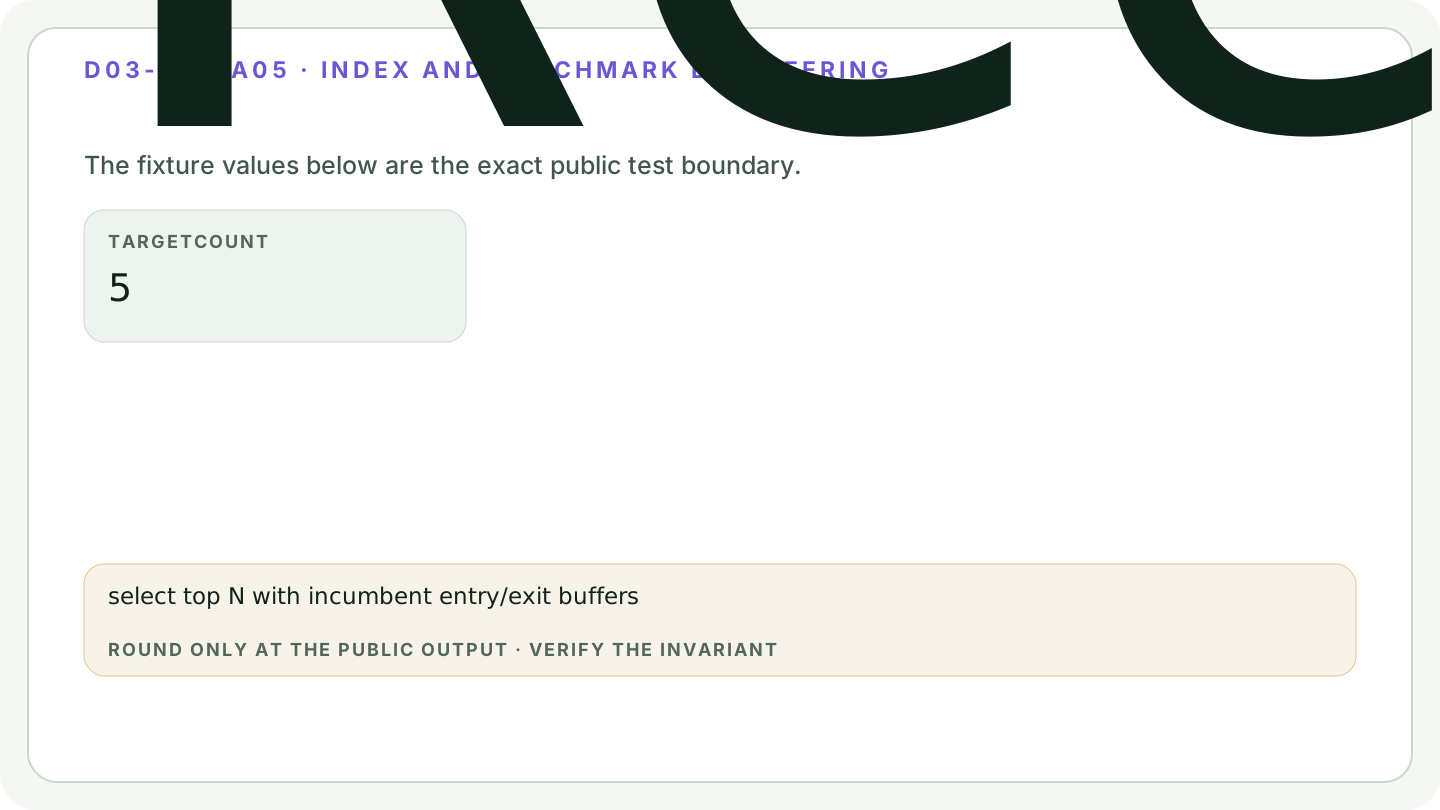
Those are the exact rounded values asserted by both implementations. Rounding occurs only at the public boundary so iterative state and recursive levels do not accumulate display precision as calculation error.
Explore the methodology state
Open the guided light playground. It retains the full synthetic dataset and starts at a populated state. Choose the boundary scenario, change the constraint, step across the effective line, inspect the audit rows, then choose the rejected state. Reset always returns to the same observation and parameter.
The lab teaches one decision: what changed, why the rule changed state, and whether an output may be published. It does not imply that the illustrated method will outperform an alternative.
Implementation walkthrough
The Python implementation and TypeScript implementation expose the same calculate contract. A shared domain engine centralizes validated matrix, weight, capping, return, and rounding primitives, while each topic wrapper fixes the catalog calculation kind. The shared JSON fixture prevents language-specific examples from drifting.
The implementation deliberately favors explicit loops and diagnostics. Production administrators may use decimal arithmetic, distributed price engines, solver libraries, and exception workflows, but they should preserve the same visible invariants.
Compare nearby variants
| Maintenance layer | Input evidence | Decision | Required audit output |
|---|---|---|---|
| Eligibility | Security attributes | Include or reject | Every rejection reason |
| Liquidity | Point-in-time trading history | Pass threshold | Window, median, missing months |
| Reconstitution | Frozen ranks and incumbency | Select membership | Adds, deletes, buffers |
| Rebalancing | Target and current weights | Trade to target | Index shares and turnover |
| Replication cost | Trade, spread, impact scenario | Estimate cost | Assumptions and sensitivities |
The table shows why a nearby method cannot be substituted silently. A different tax assumption, cap sequence, covariance constraint, or review buffer changes the index definition even when the final numbers appear close.
Testing and validation
Topic tests verify canonical output, invalid-input rejection, input immutability, JSON finiteness, and cross-language parity. Domain checks additionally validate all package files, Mermaid source, SVG XML and bounds, data density, lab controls, keyboard behavior, deterministic reset, reduced motion, responsive layouts, embedded article behavior, links, and production builds.
Passing those checks establishes definition-level correctness for the educational convention. It does not establish tracking capacity, market impact, predictive value, administrator authorization, or compliance with every jurisdiction.
Failure modes
The central guard is to freeze the review universe and scores before applying deterministic buffers. Common failures include stale divisor or FX state, infeasible caps, singular covariance, missing dividends, future review data, mismatched calendars, excessive rounding, silent corrections, and exceptional corporate events handled with the wrong provider rule.
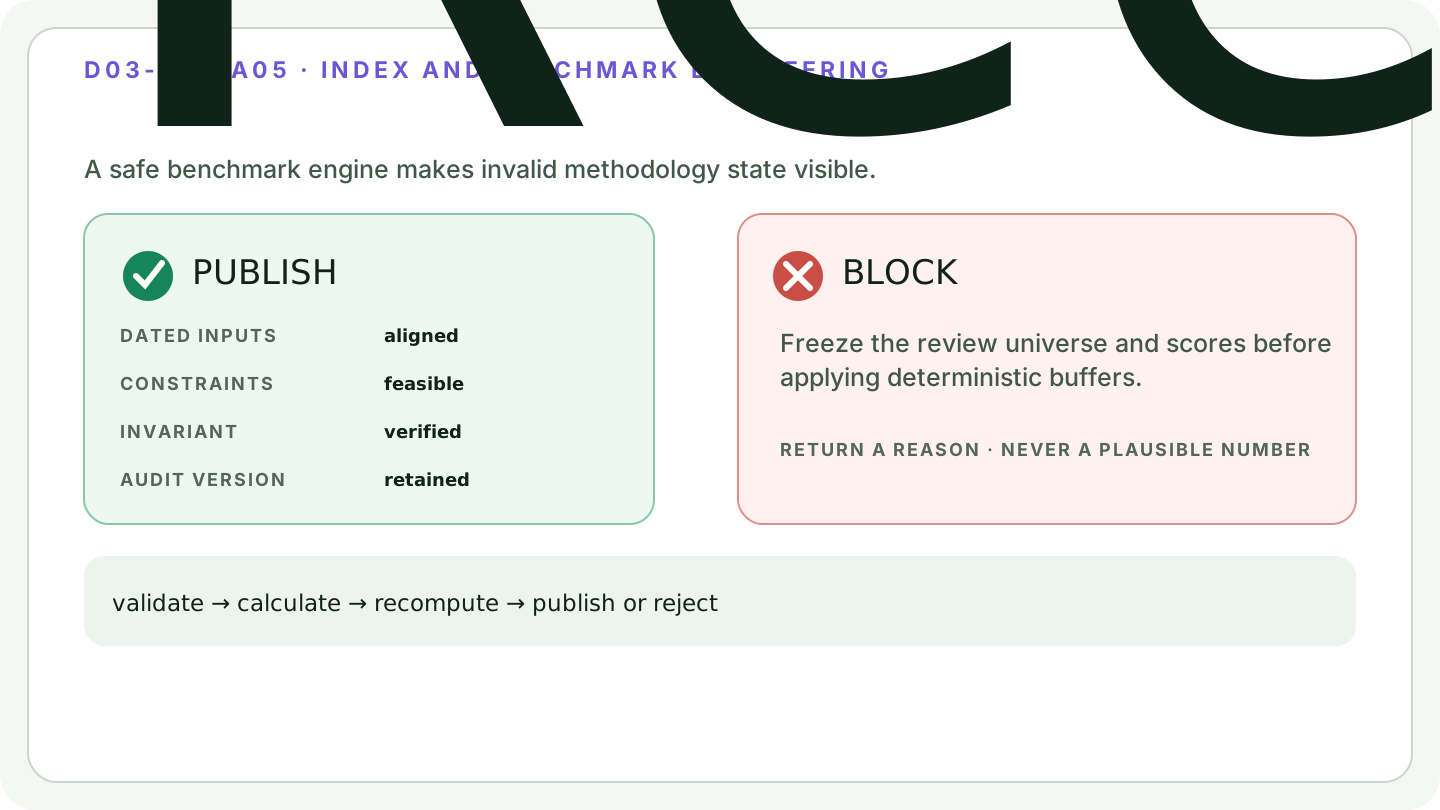
A rejected calculation should retain the raw inputs, methodology version, failed invariant, and time of decision. That evidence is more valuable than a plausible number with unknown provenance.
Evidence, governance, and scope
This topic belongs to Governance and Maintenance. The S&P DJI policies, MSCI methodology library, IOSCO Principles, and EU Benchmark Regulation frame reproducible maintenance and governance. Benchmark governance also requires transparent methodology quality, conflicts management, change procedures, complaints, auditability, and cessation planning. The package uses synthetic data and does not reproduce a branded provider index.
Summary and next topic
You can now calculate, implement, and audit Reconstitution Algorithm. Freeze dated state, make constraints explicit, recompute the invariant, and block unsafe output. Continue with Rebalancing Algorithm to extend the benchmark-engineering chain.
Asset map
| Asset | Article placement | Video scene | Source | Static fallback | Status |
|---|---|---|---|---|---|
| Methodology overview | Opening | 1–2 | visuals/static/article-hero.svg | Same asset | Ready |
| Calculation flow | Intuition | 3 | visuals/mermaid/calculation-flow.md | Article steps | Ready |
| Canonical values | Worked example | 5 | visuals/static/worked-example.svg | Fixture JSON | Ready |
| Guided lab | Exploration | 4–7 | visuals/animated/playground.html | Worked-example SVG | Ready |
| Failure guard | Failure modes | 7 | visuals/static/failure-guard.svg | Text rejection rule | Ready |
Full source records are in ../REFERENCES.md, and the canonical factual package is ../README.md.
Rendered from the canonical Mermaid sources linked by this article.
Reconstitution Algorithm calculation flow
This diagram separates the dated methodology state from calculation and invariant checks.
Takeaway: reconstitution is publishable only after feasibility and post-calculation invariants agree.
Reconstitution Algorithm methodology state
This state machine makes review, calculation, exception, and publication boundaries visible.
Takeaway: Freeze the review universe and scores before applying deterministic buffers; a revision creates a new version instead of silently overwriting history.
References13 primary sources and evidence notesExpand the source trail, evidence role, and limitations behind the engineering choices.
Expand the source trail, evidence role, and limitations behind the engineering choices.
Accessed 2026-07-21. Examples and datasets are synthetic; no vendor index levels or constituent data are redistributed.
R1 — S&P Dow Jones Indices Index Mathematics Methodology
- Organization or authors: S&P Dow Jones Indices
- Source type: Official index mathematics methodology
- Publication or effective date: 2026 accessed edition
- URL or DOI: https://www.spglobal.com/spdji/en/documents/methodologies/methodology-index-math.pdf
- Accessed: 2026-07-21
- Jurisdiction: Global
- Supports: Divisors, price and capitalization weighting, capping, return variants, currency, strategy, risk-control, decrement, and index-of-indices mathematics
- Limitations: Provider conventions are authoritative for S&P DJI indices, not universal defaults
R2 — S&P DJI Equity Indices Policies & Practices
- Organization or authors: S&P Dow Jones Indices
- Source type: Official operations and maintenance methodology
- Publication or effective date: March 2026
- URL or DOI: https://www.spglobal.com/spdji/en/documents/methodologies/methodology-sp-equity-indices-policies-practices.pdf
- Accessed: 2026-07-21
- Jurisdiction: Global
- Supports: Data hierarchy, corporate actions, additions, deletions, reviews, discretion, announcements, and recalculation
- Limitations: Operational judgment and product rules still require the applicable index methodology
R3 — FTSE Russell Capping Methodology
- Organization or authors: FTSE Russell, LSEG
- Source type: Official capping guide
- Publication or effective date: Version 5.0, January 2026
- URL or DOI: https://www.lseg.com/content/dam/ftse-russell/en_us/documents/policy-documents/capping-methodology-guide.pdf
- Accessed: 2026-07-21
- Jurisdiction: Global
- Supports: Single-level and multi-level capping, fast entrants, and corporate-event maintenance
- Limitations: Targets and sequencing depend on the named FTSE Russell index
R4 — FTSE Russell Index Policy and Methodology Library
- Organization or authors: FTSE Russell, LSEG
- Source type: Official methodology library
- Publication or effective date: Current accessed edition
- URL or DOI: https://www.lseg.com/en/ftse-russell/governance/index-policy-and-methodology
- Accessed: 2026-07-21
- Jurisdiction: Global
- Supports: Calculation, liquidity, free float, review, governance, and recalculation source hierarchy
- Limitations: The library links multiple documents whose effective dates must be checked separately
R5 — MSCI Global Investable Market Indexes Methodology Library
- Organization or authors: MSCI
- Source type: Official methodology library
- Publication or effective date: May 2026 calculation and GIMI editions
- URL or DOI: https://www.msci.com/eqb/gimi/stdindex/methodology.html
- Accessed: 2026-07-21
- Jurisdiction: Global
- Supports: Investability, free float, size and liquidity segmentation, reviews, corporate events, and index calculation
- Limitations: MSCI data and branded production calculations can require licenses
R6 — MSCI Minimum Volatility Indexes Methodology
- Organization or authors: MSCI
- Source type: Official minimum-volatility methodology page
- Publication or effective date: June 2026 accessed edition
- URL or DOI: https://www.msci.com/msci-minimum-volatility-indexes
- Accessed: 2026-07-21
- Jurisdiction: Global
- Supports: Optimization-based minimum-volatility construction and constraints
- Limitations: The educational implementation demonstrates the mathematical core and does not reproduce proprietary production constraints
R7 — S&P Risk Control 2.0 Indices Methodology
- Organization or authors: S&P Dow Jones Indices
- Source type: Official strategy-index methodology
- Publication or effective date: 2025 accessed edition
- URL or DOI: https://www.spglobal.com/spdji/en/documents/methodologies/methodology-sp-risk-control-2-indices.pdf
- Accessed: 2026-07-21
- Jurisdiction: Global
- Supports: Volatility-target exposure, dampening assets, rebalancing, and realized-volatility state
- Limitations: This package uses a transparent cash implementation, not every Risk Control 2.0 variant
R8 — Principles for Financial Benchmarks
- Organization or authors: International Organization of Securities Commissions
- Source type: International benchmark-governance principles
- Publication or effective date: Final report FR07/13, July 2013
- URL or DOI: https://www.iosco.org/library/pubdocs/pdf/ioscopd415.pdf
- Accessed: 2026-07-21
- Jurisdiction: Global
- Supports: Governance, methodology quality, accountability, conflicts, changes, and cessation
- Limitations: Principles are not a substitute for applicable law or administrator procedures
R9 — Regulation (EU) 2016/1011
- Organization or authors: European Union
- Source type: Official consolidated regulation
- Publication or effective date: Consolidated 1 January 2026
- URL or DOI: https://eur-lex.europa.eu/eli/reg/2016/1011
- Accessed: 2026-07-21
- Jurisdiction: European Union
- Supports: Accuracy, integrity, administration, input data, methodology, and use of regulated benchmarks
- Limitations: Legal applicability depends on benchmark type, administrator, use, and jurisdiction
R10 — Portfolio Selection
- Organization or authors: Harry Markowitz
- Source type: Original peer-reviewed paper
- Publication or effective date: 1952
- URL or DOI: https://doi.org/10.1111/j.1540-6261.1952.tb01525.x
- Accessed: 2026-07-21
- Jurisdiction: General
- Supports: Mean-variance foundations used by the minimum-variance topic
- Limitations: Index-provider constraints and estimation choices are later implementation layers
R11 — On the Properties of Equally-Weighted Risk Contributions Portfolios
- Organization or authors: Sébastien Maillard, Thierry Roncalli, and Jérôme Teïletche
- Source type: Original peer-reviewed research
- Publication or effective date: 2010
- URL or DOI: https://doi.org/10.3905/jpm.2010.36.4.060
- Accessed: 2026-07-21
- Jurisdiction: General
- Supports: Equal-risk-contribution definition and portfolio properties
- Limitations: Convergence and covariance estimation remain implementation choices
R12 — Fundamental Indexation
- Organization or authors: Robert Arnott, Jason Hsu, and Philip Moore
- Source type: Original peer-reviewed research
- Publication or effective date: 2005
- URL or DOI: https://www.researchaffiliates.com/documents/FAJ_Mar_Apr_2005_Fundamental_Indexation.pdf
- Accessed: 2026-07-21
- Jurisdiction: General
- Supports: Economic-scale weighting independent of current market price
- Limitations: Metric selection, normalization, and data lags must be declared
R13 — FTSE Currency Hedging Methodology Overview
- Organization or authors: FTSE Russell, LSEG
- Source type: Official methodology overview
- Publication or effective date: 2023
- URL or DOI: https://www.lseg.com/content/dam/ftse-russell/en_us/documents/other/ftse-currency-hedging-methodology-cut-sheet.pdf
- Accessed: 2026-07-21
- Jurisdiction: Global
- Supports: Currency exposure aggregation, hedge ratios, forward rolls, and quote conventions
- Limitations: Production rates and calendars require licensed data and the full applicable calculation guide
Full dependency-light reference implementations in both supported languages.
/** Reconstitution Algorithm (D03-F06-A05) reference implementation. */
import { calculateIndexTopic } from "../../../../shared/typescript/indexEngine.ts";

const KIND = "reconstitution";

export function calculate(data) {
  if (data === null || typeof data !== "object" || Array.isArray(data)) throw new TypeError("data must be an object");
  return calculateIndexTopic(KIND, structuredClone(data));
}
The embedded lab now expands to its full document height, keeping the article as the only scroll surface.