
 By Islam Baraka
Calculate every binary signal, show its evidence, and aggregate the original 0-to-9 F-Score without converting it into a universal quality rating.
The decision this tutorial makes visible
Piotroski F-Score matters because a compact score can organize a review queue, but only when its accounting definitions, original estimation population, availability clock, and interpretation boundary remain visible.
The precise question is: Which of nine year-over-year profitability, leverage/liquidity, and operating-efficiency signals are favorable under Piotroski's original high-book-to-market research design?
A practitioner needs to know what the diagnostic does and does not justify. A builder needs a contract that can be reproduced from the same point-in-time inputs in Python, TypeScript, a visual, and a browser lab.
Intuition before notation
Nine small directional tests make conflicting fundamentals visible; the integer total never explains which signal passed unless the vector is retained.
The result depends on the declared algorithm scope, input clocks, units, equality and rounding policies, and unsupported-state treatment. Change one of those and the output represents a different decision even when its field name is unchanged.
Scope and nearby methods
Original 2000 nine-signal score using beginning-asset-scaled profitability and turnover comparisons plus explicit equity issuance.
| Variant | Definition | Best use | Main limitation |
|---|---|---|---|
| Original nine-signal score | Paper's profitability, funding, and efficiency signals | High-book-to-market fundamental screening | Empirical context is narrow |
| Vendor F-score | Provider-specific mappings | Operational screen | Tags and averaging differ |
| Continuous composite | Weighted continuous ratios | Custom research | No longer Piotroski's F-Score |
What is sourced, selected, synthetic, and derived
| Role | Material claim | Evidence | Boundary |
|---|---|---|---|
| Sourced fact | Defines nine binary signals and a 0-to-9 aggregate score in a high-book-to-market research design. | S1 original or explicitly limited reproduction | The score's construction does not guarantee returns and its original empirical population was not all firms. |
| Implementation choice | Original 2000 nine-signal score using beginning-asset-scaled profitability and turnover comparisons plus explicit equity issuance. | Frozen definition contract, code, fixtures, and parity tests | Nearby coefficient sets and variants remain separate. |
| Synthetic teaching input | All company records, periods, peer samples, scenarios, and outputs are repository-authored synthetic data. | datasets/canonical-input.json and scenario-results.json | No value is an observed issuer or provider record. |
| Author-derived calculation | The synthetic company passes all nine strict tests, so the named signal vector reconciles to F = 9. The result demonstrates mechanics, not a return forecast. | Formula, expected-output.json, independent checks, and Python/TypeScript parity | Arithmetic fidelity does not validate prediction or company conclusions. |
| Scope boundary | The output does not establish a current issuer conclusion, audit finding, rating, default forecast, investment return, or causal claim. | No empirical current-population or advisory claim is tested | Use as a documented screen or research measure only. |
The authoritative sources support only the exact facts named in the claim ledger. They do not certify the synthetic numbers in this tutorial. The repository fixture is deliberately invented for auditability, and the displayed output is author-derived under the selected implementation choice.
Formula, symbols, and numerical policy
F = I(ROA>0)+I(CFO>0)+I(ROA_t>ROA_t-1)+I(CFO>NI)+I(LEV_t<LEV_t-1)+I(CR_t>CR_t-1)+I(no issue)+I(GM_t>GM_t-1)+I(AT_t>AT_t-1)
| Symbol | Meaning | Unit | Policy |
|---|---|---|---|
| I | Indicator function | 0 or 1 | Strict direction tests |
| ROA | Net income / beginning assets | ratio | Package convention |
| CFO | Operating cash flow | currency | Compared with net income |
| AT | Sales / beginning assets | times | Current versus prior |
- Use full floating-point precision and round only for display.
- Ratios are dimensionless unless a days or currency-scale contract is explicit.
- Reject missing, nonfinite, boolean-as-number, zero-denominator, invalid-log, singular-regression, mixed-period, or unsupported records.
- Keep the raw index, transformation, contribution vector, threshold policy, and diagnostic state together.
Read the formula in the same order as the algorithm. Validate identity, ordering, units, and supported state first. Apply the selected equality, cutoff, and estimation rules second. Calculate with unrounded numeric values. Round only at the declared presentation boundary, and preserve null as a diagnostic rather than coercing it to zero.
Build the algorithm
- Align current and prior annual statements.
- Calculate four profitability/cash signals.
- Calculate three leverage/liquidity/funding signals.
- Calculate two efficiency signals and sum the nine booleans.
Production-minded operational checklist
- Confirm model variant and original population
- Map every accounting input and clock
- Reconcile score contributions
- Treat the output as a review screen, not a conclusion
Stop when a required line item, filing clock, unit scale, original-population condition, or estimation sample is unavailable; do not manufacture precision from a familiar score name.
Worked synthetic example
The canonical fixture is synthetic teaching data, not an observed issuer, filing, audit case, or market outcome. Its primary author-derived output,
f_score, is the nine named binary signals, F = 9, and a strong-signals teaching band. The complete input and output
are in datasets/canonical-input.json and datasets/expected-output.json.
The synthetic company passes all nine strict tests, so the named signal vector reconciles to F = 9. The result demonstrates mechanics, not a return forecast.
Counterfactual checkpoint
One-driver stress. Move one declared accounting driver while holding the remaining synthetic record fixed. The output changes because The score is a weighted mapping of the frozen inputs, not an independent fact.
The structured result retains state and diagnostics in addition to the primary number. That makes the calculation independently reviewable and prevents an incomplete, rejected, unsupported, or retrospective result from being mistaken for an unqualified conclusion.
Boundary and counterexample workbook
The playground computes every scenario at 61 deterministic parameter states.
The table uses the declared focus step and states whether that focus reproduces
the canonical fixture. The full state ledger and compressed transition
segments are in datasets/scenario-results.json.
| Scenario | Review focus | Purpose | State | Primary output | Diagnostic | Decision segments |
|---|---|---|---|---|---|---|
| Canonical net-income signal | Step 30 · canonical fixture | Driver: net_income. Sweep current net income and recompute ROA and cash-versus-income signals. Predict: Will the integer score change only when a strict signal flips? | calculated | 9/9 signals | calculated · strong-signals · piotroski-2000-nine-signal | 1 |
| Operating-cash-flow signal | Step 30 · canonical fixture | Driver: operating_cash_flow. Sweep CFO around the current net-income comparison. Predict: When does CFO become positive and exceed net income? | calculated | 9/9 signals | calculated · strong-signals · piotroski-2000-nine-signal | 1 |
| Long-term-debt signal | Step 30 · canonical fixture | Driver: long_term_debt. Sweep current long-term debt against the prior debt ratio. Predict: Will lower leverage earn the binary signal? | calculated | 9/9 signals | calculated · strong-signals · piotroski-2000-nine-signal | 1 |
| Current-ratio signal | Step 30 · canonical fixture | Driver: current_assets. Sweep current assets while current liabilities remain fixed. Predict: Will the current ratio improve strictly over the prior period? | calculated | 9/9 signals | calculated · strong-signals · piotroski-2000-nine-signal | 1 |
| Beginning-asset denominator | Step 30 · canonical fixture | Driver: beginning_total_assets. Sweep beginning assets to expose ROA and turnover denominator effects. Predict: Which strict comparisons change when the denominator moves? | calculated | 9/9 signals | calculated · strong-signals · piotroski-2000-nine-signal | 1 |
| Gross-margin signal | Step 30 · canonical fixture | Driver: gross_profit. Sweep gross profit against the prior gross-profit margin. Predict: Will a higher current margin add exactly one point? | calculated | 9/9 signals | calculated · strong-signals · piotroski-2000-nine-signal | 1 |
| Asset-turnover signal | Step 30 · canonical fixture | Driver: sales. Sweep current sales against prior sales and beginning assets. Predict: Will higher turnover flip the ninth signal without changing the others? | calculated | 9/9 signals | calculated · strong-signals · piotroski-2000-nine-signal | 1 |
These rows are not backtest observations. They are controlled counterexamples that expose how one driver changes the state, output, or reason code while the rest of the contract stays fixed.
Visualize the boundary

Open this SVG at full size, or use the guided playground to compare the seven topic-specific canonical, boundary, policy, and failure scenarios.
The Mermaid flow answers where the selected calculation sits in the processing sequence. The SVG keeps the formula, output, decision boundary, and invariant visible together. The lab lets the reader step through the same structured states without changing the underlying definition.
Implementation walkthrough
The Python and TypeScript references begin with the same validation contract, reject malformed and unsupported state before calculation, preserve declared ordering and rounding policies, and return structured diagnostics rather than one context-free number.
The main implementation branches are:
- signal condition strictly passes — Assign one, because Original directional rule.
- condition equals boundary — Assign zero, because No strict improvement.
- F <=2 or F>=8 — Expose extreme teaching band, because Paper discusses weak/strong extreme portfolios.
Neither reference silently fetches data, mutates caller-owned inputs outside the declared engine behavior, guesses hidden state, or substitutes a provider default. Shared JSON fixtures make value, null, state, and reason-code drift visible across languages.
Testing and validation
Definition tests compare every canonical field, reject malformed state, and exercise the material boundary. Family validation recomputes every playground state from the reference function. Independent arithmetic is recorded beside the fixture rather than inferred only from implementation output.
The audit must preserve these invariants:
- F is an integer from zero through nine and equals the displayed signal sum.
- Equality on a directional improvement test scores zero.
- The aggregate cannot hide the underlying signal vector.
- The output retains named predictors/components, raw score, screen or residual interpretation, and method identifier.
Passing checks proves the selected equation, mapping, scenario, and language parity. It does not validate out-of-sample classification performance.
Failure modes and misuse
- The model can be stale, population-specific, industry-sensitive, and affected by accounting classification or business-model changes.
- A threshold crossing is a screen for further review, not bankruptcy, fraud, audit, rating, or valuation evidence by itself.
- Implementation fidelity does not prove predictive accuracy, causality, market usefulness, or suitability for a current jurisdiction.
Debugging order
When a result looks surprising, inspect the state in this order:
- Confirm the exact model variant and coefficients.
- Confirm filing availability and accounting mapping.
- Confirm units, scale, signs, periods, logs, and denominators.
- Reconcile each contribution or regression residual before interpreting the aggregate.
Evidence and historical boundary
Historical decision: not useful. A named issuer is not useful for the canonical arithmetic because a defensible case would require the exact filing version available at the decision date, a line-item mapping ledger, restatement and corporate-action treatment, model-population eligibility, coefficient provenance, and independently reproducible arithmetic. Original research samples establish model history; synthetic records isolate mechanics without alleging distress or misstatement by a real company.
The primary sources are Piotroski (2000), SEC financial-statement guide, IFRS Conceptual Framework. They support the source roles listed in the research ledger, not a redistributable historical observation, a current issuer conclusion, audit finding, rating, default forecast, investment return, or causal claim
Summary and next topic
You can now calculate, audit, and bound Piotroski F-Score before continuing to Beneish M-Score. The learning flow is: Altman Z-Score → Piotroski F-Score → Beneish M-Score. Carry the result forward only with its scope, clock, state, and evidence label.
Deep visual atlas
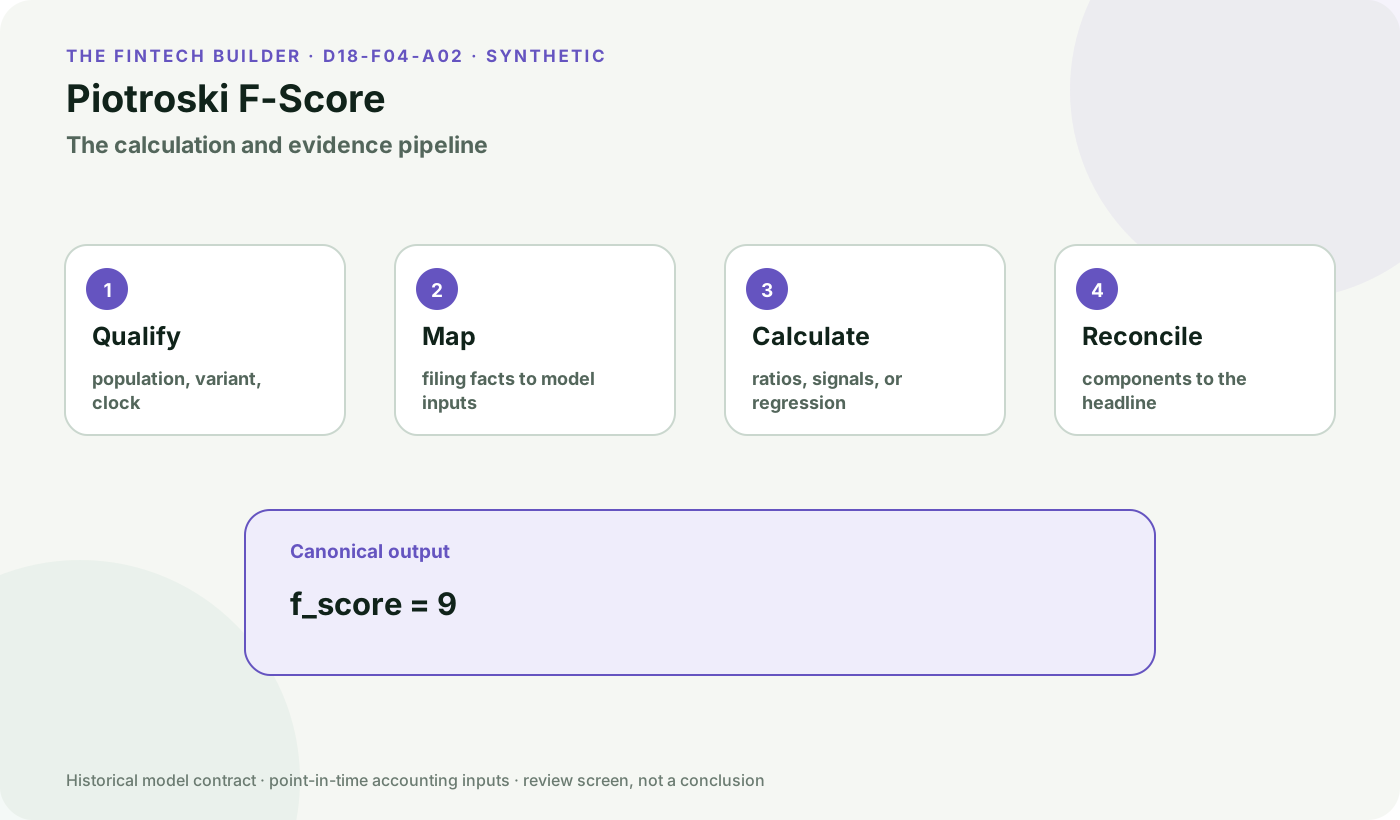
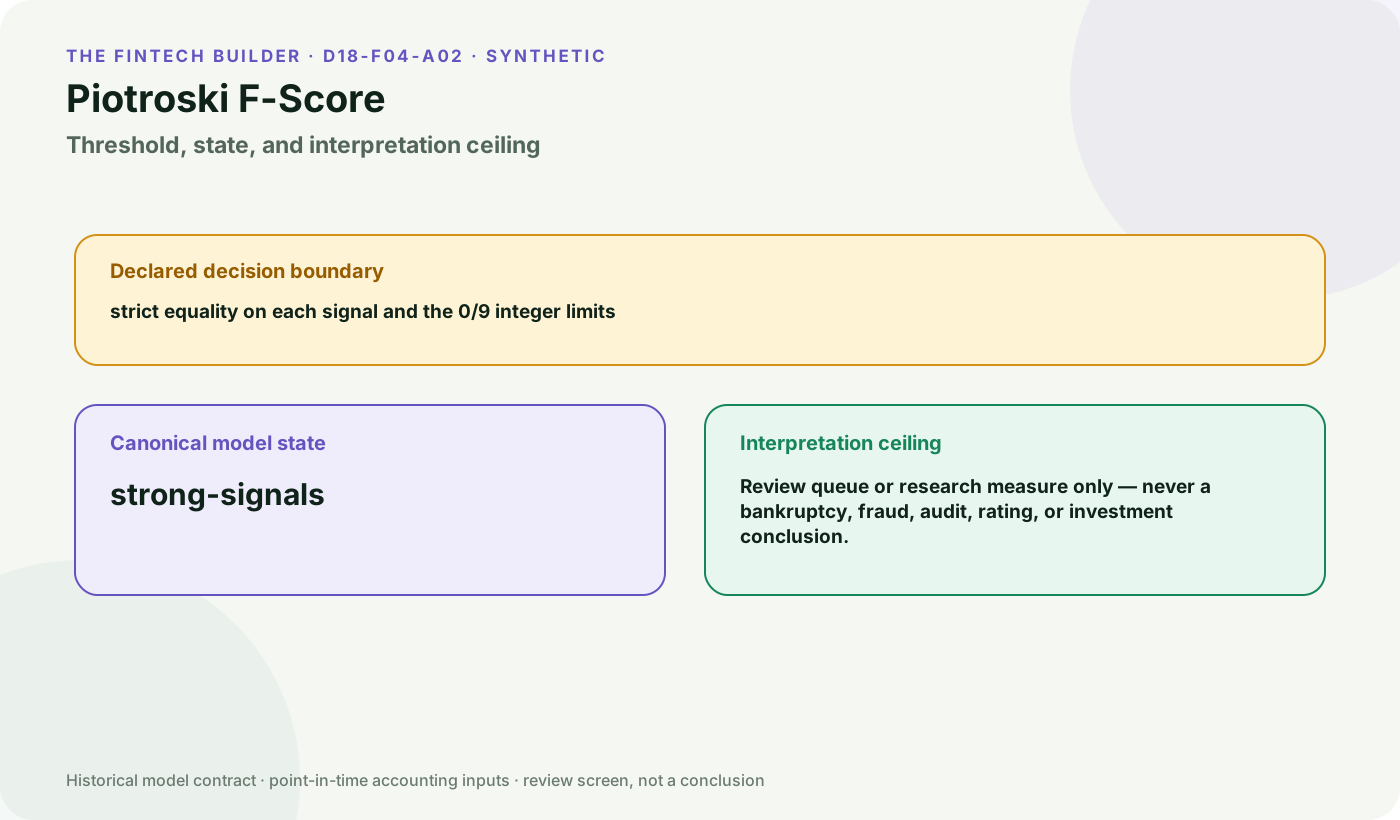
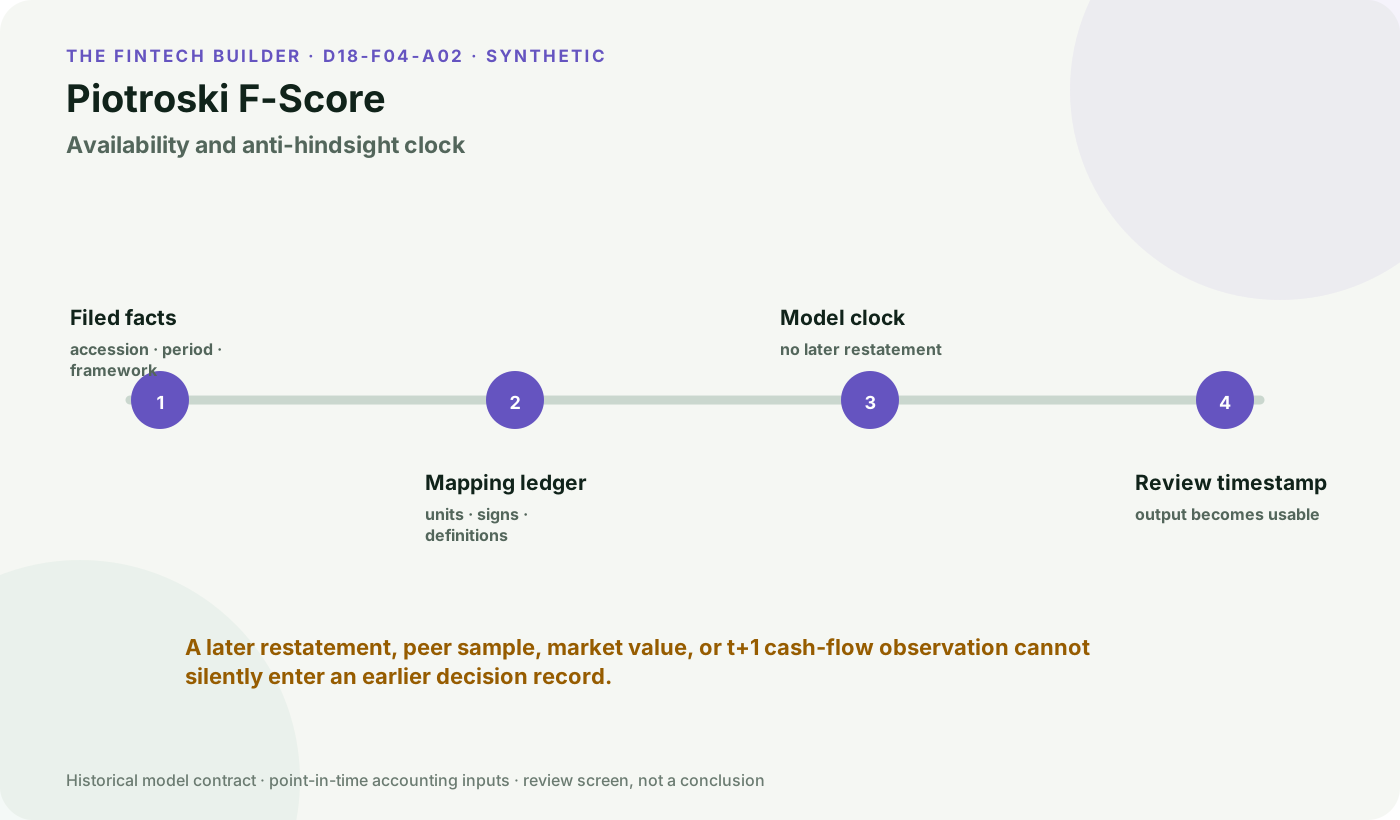
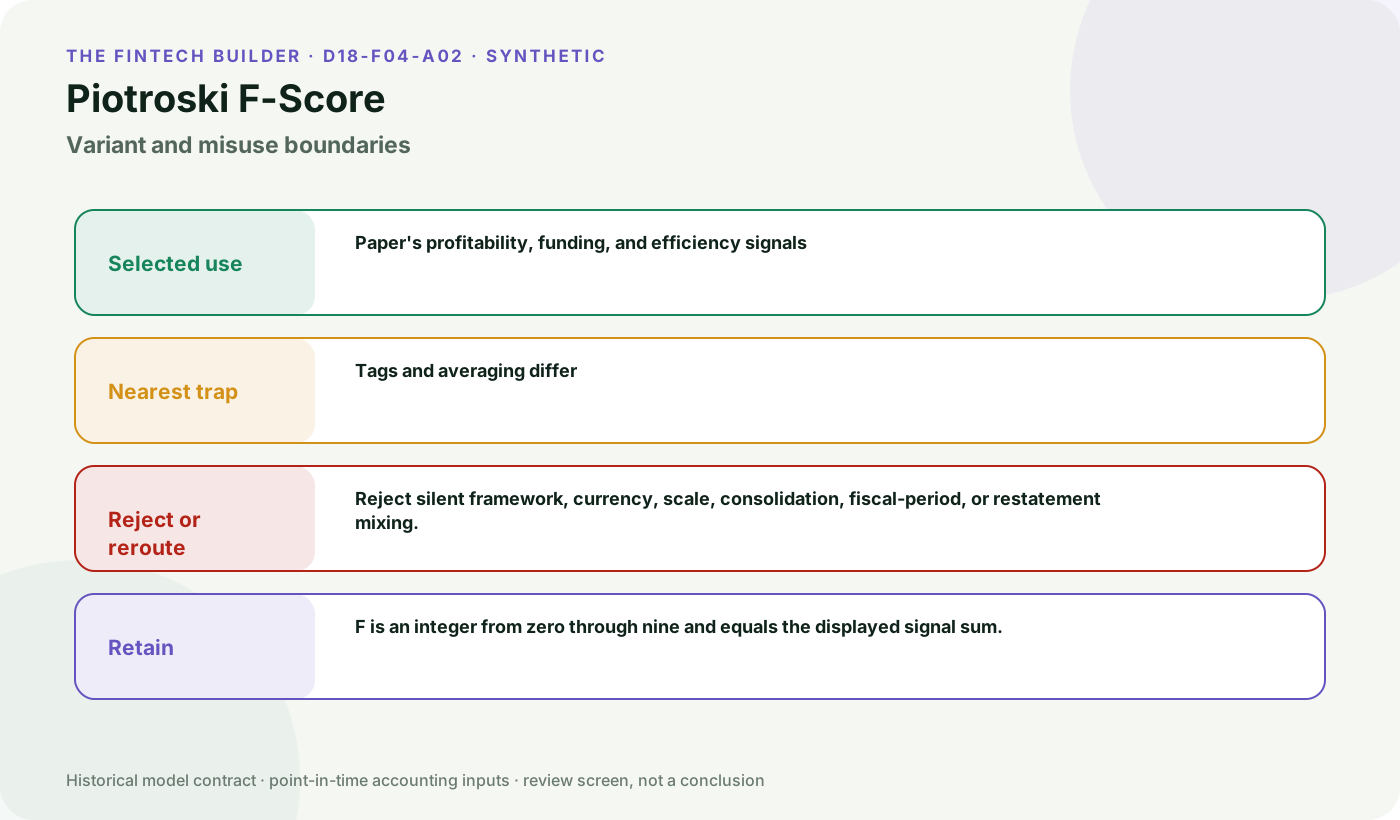
Use the anatomy to reconstruct the score, the threshold map to preserve equality and interpretation, the clock to prevent hindsight, and the boundary map to stop variant drift.
Use the accounting studio
- Read the prediction prompt and name the direction before moving the state slider.
- Check the driver under test and compare the scenario base with the current state.
- Reconcile the visible intermediate (nine binary cells grouped by profitability, funding, and efficiency) to the headline.
- Apply the boundary and evidence clock: strict equality on each signal and the 0/9 integer limits.
| Visual | Question it answers | Studio handoff |
|---|---|---|
| Model anatomy | What is the calculation order? | Start with Qualify → Map → Calculate → Reconcile. |
| Threshold and interpretation | What does equality mean? | Move to the boundary scenario and read the interpretation ceiling. |
| Evidence clock | What was knowable at the decision time? | For A12, wait for future CFO; for A13, freeze the peer sample. |
| Variant boundaries | Which nearby model is not interchangeable? | Compare the active driver with the claim ledger before changing the model. |
Rendered from the canonical Mermaid sources linked by this article.
Piotroski F-Score calculation flow
This flow identifies the selected calculation stages and the structured output.
Takeaway: The useful object is the nine-cell evidence matrix, not only the integer total.
ReferencesPrimary sources and evidence notesExpand the source trail, evidence role, and limitations behind the engineering choices.
Expand the source trail, evidence role, and limitations behind the engineering choices.
S1 — Value Investing: The Use of Historical Financial Statement Information to Separate Winners from Losers
- Organization or authors: Joseph D. Piotroski
- Source type: Original peer-reviewed paper
- Publication or effective date: 2000
- Version: Original publication or cited edition
- URL or DOI: https://doi.org/10.2307/2672906
- Accessed: 2026-08-06
- Jurisdiction: U.S. high-book-to-market firms in the original study
- Supports: Defines nine binary signals and a 0-to-9 aggregate score in a high-book-to-market research design.
- Limitations: The score's construction does not guarantee returns and its original empirical population was not all firms.
S2 — Beginners' Guide to Financial Statements
- Organization or authors: U.S. Securities and Exchange Commission
- Source type: Official regulator publication
- Publication or effective date: 2007-02-05
- Version: Original publication or cited edition
- URL or DOI: https://www.sec.gov/about/reports-publications/investor-publications/beginners-guide-financial-statements
- Accessed: 2026-08-06
- Jurisdiction: United States public-company reporting
- Supports: Balance sheets describe a point in time, income and cash-flow statements describe a period, and the notes are integral to interpretation.
- Limitations: It does not prescribe any score, line-item mapping, coefficient, cutoff, or empirical conclusion.
S3 — Conceptual Framework for Financial Reporting
- Organization or authors: International Accounting Standards Board
- Source type: Official accounting framework
- Publication or effective date: 2021 issued compilation
- Version: Original publication or cited edition
- URL or DOI: https://www.ifrs.org/content/dam/ifrs/publications/pdf-standards/english/2021/issued/part-a/conceptual-framework-for-financial-reporting.pdf
- Accessed: 2026-08-06
- Jurisdiction: IFRS reporting
- Supports: Financial-statement elements and measurement are framework-dependent and must be interpreted with presentation and disclosure context.
- Limitations: It does not endorse legacy distress or earnings-quality coefficient sets.
Evidence boundary
The original research source establishes the named historical model and research context. It does not certify this synthetic fixture, a current population calibration, or a company conclusion. SEC/IFRS sources establish statement context only.
Full dependency-light reference implementations in both supported languages.
/** Canonical TypeScript reference for D18-F04 Quality and Distress. */

type RecordValue = Record<string, unknown>;

function objectValue(data: RecordValue, name: string): RecordValue {
  const value = data[name];
  if (!value || typeof value !== "object" || Array.isArray(value)) throw new TypeError(`${name} must be an object`);
  return value as RecordValue;
}

function numberValue(data: RecordValue, name: string): number {
  const value = data[name];
  if (typeof value !== "number" || !Number.isFinite(value)) throw new TypeError(`${name} must be a finite number`);
  return value;
}

function positive(data: RecordValue, name: string): number {
  const value = numberValue(data, name);
  if (value <= 0) throw new RangeError(`${name} must be positive`);
  return value;
}

function nonnegative(data: RecordValue, name: string): number {
  const value = numberValue(data, name);
  if (value < 0) throw new RangeError(`${name} must be nonnegative`);
  return value;
}

function booleanValue(data: RecordValue, name: string): boolean {
  const value = data[name];
  if (typeof value !== "boolean") throw new TypeError(`${name} must be a boolean`);
  return value;
}

function ratio(numerator: number, denominator: number, name: string): number {
  if (denominator === 0) throw new RangeError(`${name} denominator must be nonzero`);
  return numerator / denominator;
}

function logistic(index: number): number {
  if (index >= 0) { const z = Math.exp(-index); return 1 / (1 + z); }
  const z = Math.exp(index); return z / (1 + z);
}

function normalCdf(value: number): number {
  const sign = value < 0 ? -1 : 1;
  const x = Math.abs(value) / Math.sqrt(2);
  const t = 1 / (1 + 0.3275911 * x);
  const polynomial = (((((1.061405429 * t - 1.453152027) * t) + 1.421413741) * t - 0.284496736) * t + 0.254829592) * t;
  const erfValue = sign * (1 - polynomial * Math.exp(-x * x));
  return 0.5 * (1 + erfValue);
}

function sum(values: Record<string, number>): number { return Object.values(values).reduce((a, b) => a + b, 0); }

function altman(data: RecordValue): RecordValue {
  const assets = positive(data, "total_assets"), liabilities = positive(data, "total_liabilities");
  const ratios = {
    working_capital_to_assets: numberValue(data, "working_capital") / assets,
    retained_earnings_to_assets: numberValue(data, "retained_earnings") / assets,
    ebit_to_assets: numberValue(data, "ebit") / assets,
    market_equity_to_liabilities: nonnegative(data, "market_value_equity") / liabilities,
    sales_to_assets: numberValue(data, "sales") / assets,
  };
  const contributions = {
    working_capital: 1.2 * ratios.working_capital_to_assets,
    retained_earnings: 1.4 * ratios.retained_earnings_to_assets,
    ebit: 3.3 * ratios.ebit_to_assets,
    market_equity: 0.6 * ratios.market_equity_to_liabilities,
    sales: ratios.sales_to_assets,
  };
  const score = sum(contributions);
  const zone = score < 1.81 ? "distress-zone" : score > 2.99 ? "safe-zone" : "grey-zone";
  return {state:"calculated",method:"altman-1968-public-manufacturer",ratios,contributions,z_score:score,zone,threshold_policy:"distress<1.81; grey=1.81..2.99; safe>2.99"};
}

function piotroski(data: RecordValue): RecordValue {
  const beginAssets=positive(data,"beginning_total_assets"), priorBeginAssets=positive(data,"prior_beginning_total_assets");
  const currentAssets=positive(data,"current_assets"), currentLiabilities=positive(data,"current_liabilities");
  const priorCurrentAssets=positive(data,"prior_current_assets"), priorCurrentLiabilities=positive(data,"prior_current_liabilities");
  const sales=positive(data,"sales"), priorSales=positive(data,"prior_sales");
  const netIncome=numberValue(data,"net_income"), priorNetIncome=numberValue(data,"prior_net_income"), cfo=numberValue(data,"operating_cash_flow");
  const roa=netIncome/beginAssets, priorRoa=priorNetIncome/priorBeginAssets;
  const signals = {
    positive_roa: +(roa>0), positive_cfo: +(cfo>0), improving_roa: +(roa>priorRoa), cash_exceeds_income: +(cfo>netIncome),
    lower_leverage: +(numberValue(data,"long_term_debt")/beginAssets < numberValue(data,"prior_long_term_debt")/priorBeginAssets),
    higher_current_ratio: +(currentAssets/currentLiabilities > priorCurrentAssets/priorCurrentLiabilities),
    no_equity_issue: +(nonnegative(data,"equity_issued")===0),
    higher_gross_margin: +(numberValue(data,"gross_profit")/sales > numberValue(data,"prior_gross_profit")/priorSales),
    higher_asset_turnover: +(sales/beginAssets > priorSales/priorBeginAssets),
  };
  const score=sum(signals), band=score<=2?"weak-signals":score>=8?"strong-signals":"mixed-signals";
  return {state:"calculated",method:"piotroski-2000-nine-signal",signals,f_score:score,band,signal_count:9};
}

function beneish(data: RecordValue): RecordValue {
  const sales=positive(data,"sales"), priorSales=positive(data,"prior_sales");
  const receivables=nonnegative(data,"receivables"), priorReceivables=nonnegative(data,"prior_receivables");
  const grossMargin=(sales-numberValue(data,"cost_of_goods_sold"))/sales;
  const priorGrossMargin=(priorSales-numberValue(data,"prior_cost_of_goods_sold"))/priorSales;
  if (grossMargin===0 || priorGrossMargin===0) throw new RangeError("gross margins must be nonzero");
  const assets=positive(data,"total_assets"), priorAssets=positive(data,"prior_total_assets");
  const currentAssetQuality=1-(numberValue(data,"current_assets")+numberValue(data,"net_ppe")+numberValue(data,"securities"))/assets;
  const priorAssetQuality=1-(numberValue(data,"prior_current_assets")+numberValue(data,"prior_net_ppe")+numberValue(data,"prior_securities"))/priorAssets;
  if (priorAssetQuality===0) throw new RangeError("prior asset-quality denominator must be nonzero");
  const depreciationRate=ratio(numberValue(data,"depreciation"),numberValue(data,"net_ppe")+numberValue(data,"depreciation"),"depreciation rate");
  const priorDepreciationRate=ratio(numberValue(data,"prior_depreciation"),numberValue(data,"prior_net_ppe")+numberValue(data,"prior_depreciation"),"prior depreciation rate");
  const indices={
    dsri:ratio(receivables/sales,priorReceivables/priorSales,"DSRI"), gmi:priorGrossMargin/grossMargin,
    aqi:currentAssetQuality/priorAssetQuality, sgi:sales/priorSales, depi:priorDepreciationRate/depreciationRate,
    sgai:ratio(numberValue(data,"sga_expense")/sales,numberValue(data,"prior_sga_expense")/priorSales,"SGAI"),
    lvgi:ratio((numberValue(data,"current_liabilities")+numberValue(data,"long_term_debt"))/assets,(numberValue(data,"prior_current_liabilities")+numberValue(data,"prior_long_term_debt"))/priorAssets,"LVGI"),
    tata:(numberValue(data,"income_from_continuing_operations")-numberValue(data,"operating_cash_flow"))/assets,
  };
  const contributions={intercept:-4.84,dsri:.92*indices.dsri,gmi:.528*indices.gmi,aqi:.404*indices.aqi,sgi:.892*indices.sgi,depi:.115*indices.depi,sgai:-.172*indices.sgai,tata:4.679*indices.tata,lvgi:-.327*indices.lvgi};
  const score=sum(contributions);
  return {state:"calculated",method:"beneish-1999-eight-variable",indices,contributions,m_score:score,screen:score>-1.78?"above-screening-cutoff":"below-screening-cutoff",cutoff:-1.78};
}

function sloan(data: RecordValue): RecordValue {
  const avgAssets=positive(data,"average_total_assets");
  const deltaCa=numberValue(data,"current_assets")-numberValue(data,"prior_current_assets");
  const deltaCash=numberValue(data,"cash")-numberValue(data,"prior_cash");
  const deltaCl=numberValue(data,"current_liabilities")-numberValue(data,"prior_current_liabilities");
  const deltaStd=numberValue(data,"short_term_debt")-numberValue(data,"prior_short_term_debt");
  const deltaTax=numberValue(data,"taxes_payable")-numberValue(data,"prior_taxes_payable");
  const depreciation=nonnegative(data,"depreciation_and_amortization");
  const accrualAmount=(deltaCa-deltaCash)-(deltaCl-deltaStd-deltaTax)-depreciation, measure=accrualAmount/avgAssets;
  return {state:"calculated",method:"sloan-1996-balance-sheet-accrual",delta_current_assets:deltaCa,delta_cash:deltaCash,delta_current_liabilities:deltaCl,delta_short_term_debt:deltaStd,delta_taxes_payable:deltaTax,depreciation_and_amortization:depreciation,accrual_amount:accrualAmount,accrual_measure:measure,absolute_accrual_measure:Math.abs(measure),interpretation:measure<0?"income-decreasing-accrual":measure>0?"income-increasing-accrual":"zero-net-accrual"};
}

function ohlson(data: RecordValue): RecordValue {
  const assets=positive(data,"total_assets"), priceIndex=positive(data,"price_level_index"), liabilities=positive(data,"total_liabilities");
  const currentAssets=positive(data,"current_assets"), currentLiabilities=nonnegative(data,"current_liabilities");
  const netIncome=numberValue(data,"net_income"), priorIncome=numberValue(data,"prior_net_income"), chinDenominator=Math.abs(netIncome)+Math.abs(priorIncome);
  if (chinDenominator===0) throw new RangeError("current and prior net income cannot both be zero");
  const variables={size:Math.log(assets/priceIndex),tlta:liabilities/assets,wcta:numberValue(data,"working_capital")/assets,clca:currentLiabilities/currentAssets,oeneg:+(liabilities>assets),nita:netIncome/assets,futl:numberValue(data,"funds_from_operations")/liabilities,intwo:+(netIncome<0&&priorIncome<0),chin:(netIncome-priorIncome)/chinDenominator};
  const score=-1.32-.407*variables.size+6.03*variables.tlta-1.43*variables.wcta+.0757*variables.clca-1.72*variables.oeneg-2.37*variables.nita-1.83*variables.futl+.285*variables.intwo-.521*variables.chin;
  const probability=logistic(score);
  return {state:"calculated",method:"ohlson-1980-model-1",variables,o_score:score,logistic_probability:probability,screen:probability>.038?"above-original-cutoff":"below-original-cutoff",cutoff_probability:.038};
}

function zmijewski(data: RecordValue): RecordValue {
  const assets=positive(data,"total_assets"), liabilities=nonnegative(data,"total_liabilities"), currentLiabilities=positive(data,"current_liabilities");
  const variables={roa:numberValue(data,"net_income")/assets,leverage:liabilities/assets,current_ratio:numberValue(data,"current_assets")/currentLiabilities};
  const score=-4.336-4.513*variables.roa+5.679*variables.leverage+.004*variables.current_ratio, probability=normalCdf(score);
  return {state:"calculated",method:"zmijewski-1984-probit",variables,x_score:score,probit_probability:probability,screen:score>0?"distress-side":"non-distress-side",index_cutoff:0};
}

function springate(data: RecordValue): RecordValue {
  const assets=positive(data,"total_assets"), currentLiabilities=positive(data,"current_liabilities");
  const ratios={working_capital_to_assets:numberValue(data,"working_capital")/assets,ebit_to_assets:numberValue(data,"ebit")/assets,ebt_to_current_liabilities:numberValue(data,"ebt")/currentLiabilities,sales_to_assets:numberValue(data,"sales")/assets};
  const score=1.03*ratios.working_capital_to_assets+3.07*ratios.ebit_to_assets+.66*ratios.ebt_to_current_liabilities+.4*ratios.sales_to_assets;
  return {state:"calculated",method:"springate-1978-four-ratio",ratios,s_score:score,screen:score<.862?"distress-side":"non-distress-side",cutoff:.862};
}

function taffler(data: RecordValue): RecordValue {
  const currentLiabilities=positive(data,"current_liabilities"), liabilities=positive(data,"total_liabilities"), assets=positive(data,"total_assets"), dailyExpenses=positive(data,"daily_operating_expenses");
  const ratios={pbt_to_current_liabilities:numberValue(data,"profit_before_tax")/currentLiabilities,current_assets_to_total_liabilities:numberValue(data,"current_assets")/liabilities,current_liabilities_to_total_assets:currentLiabilities/assets,no_credit_interval_days:(numberValue(data,"quick_assets")-currentLiabilities)/dailyExpenses};
  const score=3.2+12.18*ratios.pbt_to_current_liabilities+2.5*ratios.current_assets_to_total_liabilities-10.68*ratios.current_liabilities_to_total_assets+.0289*ratios.no_credit_interval_days;
  return {state:"calculated",method:"taffler-1983-uk-industrial-transformed",ratios,z_score:score,screen:score<0?"distress-side":"non-distress-side",index_cutoff:0};
}

function fulmer(data: RecordValue): RecordValue {
  const assets=positive(data,"total_assets"), debt=positive(data,"total_debt"), equity=positive(data,"equity"), interest=positive(data,"interest_expense"), tangible=positive(data,"tangible_assets_usd_thousands"), ebit=numberValue(data,"ebit");
  if (ebit/interest<=0) throw new RangeError("EBIT/interest must be positive for the logarithm");
  const variables={retained_earnings_to_assets:numberValue(data,"retained_earnings")/assets,sales_to_assets:numberValue(data,"sales")/assets,ebt_to_equity:numberValue(data,"ebt")/equity,operating_cash_flow_to_debt:numberValue(data,"operating_cash_flow")/debt,debt_to_assets:debt/assets,current_liabilities_to_assets:numberValue(data,"current_liabilities")/assets,log10_tangible_assets_usd_thousands:Math.log10(tangible),working_capital_to_debt:numberValue(data,"working_capital")/debt,log10_ebit_interest:Math.log10(ebit/interest)};
  const score=5.528*variables.retained_earnings_to_assets+.212*variables.sales_to_assets+.073*variables.ebt_to_equity+1.270*variables.operating_cash_flow_to_debt-.120*variables.debt_to_assets+2.335*variables.current_liabilities_to_assets+.575*variables.log10_tangible_assets_usd_thousands+1.083*variables.working_capital_to_debt+.894*variables.log10_ebit_interest-6.075;
  return {state:"calculated",method:"fulmer-1984-small-firm-nine-factor",variables,h_score:score,screen:score<0?"distress-side":"non-distress-side",index_cutoff:0,scale_policy:"tangible assets expressed in USD thousands before log10"};
}

function grover(data: RecordValue): RecordValue {
  const assets=positive(data,"total_assets");
  const variables={working_capital_to_assets:numberValue(data,"working_capital")/assets,ebit_to_assets:numberValue(data,"ebit")/assets,roa:numberValue(data,"net_income")/assets};
  const score=1.650*variables.working_capital_to_assets+3.404*variables.ebit_to_assets-.016*variables.roa+.057;
  const zone=score<=-.02?"distress-zone":score>=.01?"non-distress-zone":"grey-zone";
  return {state:"calculated",method:"grover-2001-reported-reestimation",variables,g_score:score,zone,threshold_policy:"distress<=-0.02; grey=(-0.02,0.01); non-distress>=0.01"};
}

function noa(row: RecordValue): number {
  return numberValue(row,"total_assets")-numberValue(row,"cash")-numberValue(row,"investments_and_advances")+numberValue(row,"investments_at_equity")-numberValue(row,"total_liabilities")-numberValue(row,"preferred_stock");
}

function dechowF(data: RecordValue): RecordValue {
  const current=objectValue(data,"current"), prior=objectValue(data,"prior"), prior2=objectValue(data,"prior2");
  const avgAssets=(positive(current,"total_assets")+positive(prior,"total_assets"))/2;
  const priorAvgAssets=(positive(prior,"total_assets")+positive(prior2,"total_assets"))/2;
  const currentCashSales=numberValue(current,"sales")-(numberValue(current,"receivables")-numberValue(prior,"receivables"));
  const priorCashSales=numberValue(prior,"sales")-(numberValue(prior,"receivables")-numberValue(prior2,"receivables"));
  if (priorCashSales===0) throw new RangeError("prior cash sales must be nonzero");
  const variables={
    rsst_accruals:(noa(current)-noa(prior))/avgAssets,
    change_receivables:(numberValue(current,"receivables")-numberValue(prior,"receivables"))/avgAssets,
    change_inventory:(numberValue(current,"inventory")-numberValue(prior,"inventory"))/avgAssets,
    soft_assets:(numberValue(current,"total_assets")-numberValue(current,"net_ppe")-numberValue(current,"cash"))/numberValue(current,"total_assets"),
    change_cash_sales:currentCashSales/priorCashSales-1,
    change_roa:numberValue(current,"net_income")/avgAssets-numberValue(prior,"net_income")/priorAvgAssets,
    actual_issuance:+booleanValue(data,"issued_equity_or_long_term_debt"),
  };
  const logit=-7.893+.790*variables.rsst_accruals+2.518*variables.change_receivables+1.191*variables.change_inventory+1.979*variables.soft_assets+.171*variables.change_cash_sales-.932*variables.change_roa+1.029*variables.actual_issuance;
  const probability=logistic(logit), score=probability/.0037;
  const band=score<=1?"at-or-below-baseline":score<1.85?"above-baseline":score<2.45?"substantial":"high-screen";
  return {state:"calculated",method:"dechow-et-al-2011-model-1",variables,logit,misstatement_probability:probability,f_score:score,band,unconditional_probability:.0037};
}

function solve(matrix: number[][], vector: number[]): number[] {
  const n=vector.length, augmented=matrix.map((row,index)=>[...row,vector[index]]);
  for(let col=0;col<n;col++){
    let pivot=col;
    for(let row=col+1;row<n;row++) if(Math.abs(augmented[row][col])>Math.abs(augmented[pivot][col])) pivot=row;
    if(Math.abs(augmented[pivot][col])<1e-12) throw new RangeError("regression design matrix is singular");
    [augmented[col],augmented[pivot]]=[augmented[pivot],augmented[col]];
    const scale=augmented[col][col]; augmented[col]=augmented[col].map(value=>value/scale);
    for(let row=0;row<n;row++) if(row!==col){
      const factor=augmented[row][col];
      augmented[row]=augmented[row].map((left,index)=>left-factor*augmented[col][index]);
    }
  }
  return augmented.map(row=>row[row.length-1]);
}

function ols(x: number[][], y: number[]): [number[],number[]] {
  if(!x.length||x.length!==y.length) throw new RangeError("regression requires aligned observations");
  const width=x[0].length;
  if(x.length<=width||x.some(row=>row.length!==width)) throw new RangeError("regression requires more aligned observations than predictors");
  const xtx=Array.from({length:width},(_,i)=>Array.from({length:width},(_,j)=>x.reduce((total,row)=>total+row[i]*row[j],0)));
  const xty=Array.from({length:width},(_,i)=>x.reduce((total,row,index)=>total+row[i]*y[index],0));
  const beta=solve(xtx,xty);
  const residuals=y.map((target,index)=>target-beta.reduce((total,coefficient,j)=>total+coefficient*x[index][j],0));
  return [beta,residuals];
}

function dechowDichev(data: RecordValue): RecordValue {
  const raw=data.observations;
  if(!Array.isArray(raw)||raw.length<7||raw.some(row=>!row||typeof row!=="object"||Array.isArray(row))) throw new RangeError("observations must contain at least seven period records");
  const rows=raw as RecordValue[], cfo=rows.map(row=>numberValue(row,"cfo_scaled")), accruals=rows.map(row=>numberValue(row,"working_capital_accrual_scaled")), periods=rows.map(row=>String(row.period??""));
  if(periods.some(period=>!period)||new Set(periods).size!==periods.length) throw new RangeError("period labels must be unique and nonempty");
  const x=rows.slice(1,-1).map((_,offset)=>{const index=offset+1;return [1,cfo[index-1],cfo[index],cfo[index+1]];});
  const y=accruals.slice(1,-1), [beta,residuals]=ols(x,y), df=residuals.length-beta.length;
  const residualStd=Math.sqrt(residuals.reduce((total,value)=>total+value*value,0)/df), fitted=y.map((target,index)=>target-residuals[index]);
  return {state:"calculated",method:"dechow-dichev-2002-firm-specific",coefficients:{intercept:beta[0],cfo_t_minus_1:beta[1],cfo_t:beta[2],cfo_t_plus_1:beta[3]},estimation_periods:periods.slice(1,-1),fitted_accruals:fitted,residuals,accrual_quality:residualStd,interpretation:"higher residual dispersion means lower accrual quality",available_after_period:periods[periods.length-1]};
}

function modifiedJones(data: RecordValue): RecordValue {
  const raw=data.industry_year_sample, targetId=data.target_id;
  if(!Array.isArray(raw)||raw.length<5||raw.some(row=>!row||typeof row!=="object"||Array.isArray(row))) throw new RangeError("industry_year_sample must contain at least five records");
  if(typeof targetId!=="string"||!targetId) throw new TypeError("target_id must be a nonempty string");
  const rows=raw as RecordValue[], ids=rows.map(row=>row.entity_id);
  if(new Set(ids).size!==ids.length||!ids.includes(targetId)) throw new RangeError("entity IDs must be unique and include target_id");
  const design=(row:RecordValue):number[]=>{const priorAssets=positive(row,"prior_total_assets");return [1/priorAssets,(numberValue(row,"revenue_change")-numberValue(row,"receivables_change"))/priorAssets,numberValue(row,"net_ppe")/priorAssets];};
  const peers=rows.filter(row=>row.entity_id!==targetId), x=peers.map(design), y=peers.map(row=>numberValue(row,"total_accruals")/positive(row,"prior_total_assets"));
  const [beta,residuals]=ols(x,y), target=rows.find(row=>row.entity_id===targetId) as RecordValue, targetX=design(target);
  const scaledTotal=numberValue(target,"total_accruals")/positive(target,"prior_total_assets"), nondiscretionary=beta.reduce((total,coefficient,index)=>total+coefficient*targetX[index],0), discretionary=scaledTotal-nondiscretionary;
  return {state:"calculated",method:"modified-jones-1995-peer-estimation",target_id:targetId,estimation_count:peers.length,coefficients:{inverse_assets:beta[0],revenue_less_receivables:beta[1],net_ppe:beta[2]},peer_residuals:residuals,scaled_total_accruals:scaledTotal,nondiscretionary_accruals:nondiscretionary,discretionary_accruals:discretionary,absolute_discretionary_accruals:Math.abs(discretionary),interpretation:"signed residual; no universal manipulation cutoff"};
}

const calculators: Record<string,(data:RecordValue)=>RecordValue> = {
  "D18-F04-A01":altman,"D18-F04-A02":piotroski,"D18-F04-A03":beneish,"D18-F04-A04":sloan,
  "D18-F04-A05":ohlson,"D18-F04-A06":zmijewski,"D18-F04-A07":springate,"D18-F04-A08":taffler,
  "D18-F04-A09":fulmer,"D18-F04-A10":grover,"D18-F04-A11":dechowF,"D18-F04-A12":dechowDichev,"D18-F04-A13":modifiedJones,
};

export function calculate(topicId: string, data: RecordValue): RecordValue {
  if(!data||typeof data!=="object"||Array.isArray(data)) throw new TypeError("data must be an object");
  const calculator=calculators[topicId];
  if(!calculator) throw new RangeError(`unsupported topic_id: ${topicId}`);
  return calculator(data);
}

// --- per-topic entry points
//
// One narrow export per topic. Each binds a single id and delegates to the
// dispatcher above, which still holds the arithmetic — so these change no
// behaviour and exist because a published subpath must be its own function
// rather than a shared `calculate(topicId, …)`.

/** Altman Z-Score — D18-F04-A01. */
export function altmanZScore(data: RecordValue): RecordValue {
  return calculate("D18-F04-A01", data);
}

/** Piotroski F-Score — D18-F04-A02. */
export function piotroskiFScore(data: RecordValue): RecordValue {
  return calculate("D18-F04-A02", data);
}

/** Beneish M-Score — D18-F04-A03. */
export function beneishMScore(data: RecordValue): RecordValue {
  return calculate("D18-F04-A03", data);
}

/** Sloan Accrual Measure — D18-F04-A04. */
export function sloanAccrualMeasure(data: RecordValue): RecordValue {
  return calculate("D18-F04-A04", data);
}

/** Ohlson O-Score — D18-F04-A05. */
export function ohlsonOScore(data: RecordValue): RecordValue {
  return calculate("D18-F04-A05", data);
}

/** Zmijewski X-Score — D18-F04-A06. */
export function zmijewskiXScore(data: RecordValue): RecordValue {
  return calculate("D18-F04-A06", data);
}

/** Springate S-Score — D18-F04-A07. */
export function springateSScore(data: RecordValue): RecordValue {
  return calculate("D18-F04-A07", data);
}

/** Taffler Z-Score — D18-F04-A08. */
export function tafflerZScore(data: RecordValue): RecordValue {
  return calculate("D18-F04-A08", data);
}

/** Fulmer H-Score — D18-F04-A09. */
export function fulmerHScore(data: RecordValue): RecordValue {
  return calculate("D18-F04-A09", data);
}

/** Grover G-Score — D18-F04-A10. */
export function groverGScore(data: RecordValue): RecordValue {
  return calculate("D18-F04-A10", data);
}

/** Dechow F-Score for Misstatement Risk — D18-F04-A11. */
export function dechowFScoreForMisstatementRisk(data: RecordValue): RecordValue {
  return calculate("D18-F04-A11", data);
}

/** Dechow-Dichev Accrual Quality — D18-F04-A12. */
export function dechowDichevAccrualQuality(data: RecordValue): RecordValue {
  return calculate("D18-F04-A12", data);
}

/** Modified Jones Discretionary Accrual Model — D18-F04-A13. */
export function modifiedJonesDiscretionaryAccrualModel(data: RecordValue): RecordValue {
  return calculate("D18-F04-A13", data);
}
The embedded lab now expands to its full document height, keeping the article as the only scroll surface.