
 By Islam Baraka
The governed definitions this build depends on. Read them first if a term is unfamiliar.
- PrimaryAverage Directional IndexAverage Directional Index is a Wilder-smoothed average of Directional Index values.
- PrerequisiteDirectional IndexDirectional Index is one hundred times the absolute difference between +DI and -DI divided by their sum.
- PrerequisiteInitial ADXInitial ADX is the arithmetic mean of the first n valid Directional Index observations used to seed ADX.
- PrerequisiteWilder Moving AverageWilder Moving Average is a recursively smoothed average commonly using alpha equal to one divided by the period.
- ImportantADX Recursive UpdateADX Recursive Update updates ADX by combining n minus one parts of the prior ADX with one current DX part.
- ImportantDirection-Agnostic Trend StrengthDirection-Agnostic Trend Strength describes the intensity or persistence of directional separation without retaining which direction leads.
- ImportantNegative Directional IndicatorNegative Directional Indicator is one hundred times smoothed negative directional movement divided by smoothed true range.
- ImportantPositive Directional IndicatorPositive Directional Indicator is one hundred times smoothed positive directional movement divided by smoothed true range.
- ImportantReady PointThe first eligible observation at which every state required for an indicator output has been initialized.
- ImportantWarm-Up PeriodThe initial span in which an indicator is accumulating enough eligible history to satisfy its declared initialization policy.
- ImportantWilder AlphaWilder Alpha is the smoothing constant one divided by the declared Wilder period.
DX can jump sharply from one bar to the next. ADX answers whether directional separation has persisted long enough to survive another Wilder smoothing stage.
ADX is Wilder's recursive average of DX. It smooths the magnitude of +DI/−DI separation and therefore describes directional organization without saying whether the dominant side is up or down. By the end of this tutorial, you will be able to calculate the line, audit its hidden state, reproduce its warm-up and boundary conventions, and explain why another platform can disagree.
Data note: every chart and number in this article uses deterministic synthetic teaching data. No historical return or investment-performance claim is made.
Start with the question the indicator actually answers
A trend system is useful only when its output has a precise meaning. The current package asks one bounded measurement question and refuses to turn a chart state into a forecast.
ADX is Wilder's recursive average of DX. It smooths the magnitude of +DI/−DI separation and therefore describes directional organization without saying whether the dominant side is up or down.

The map is the implementation checklist: validate the bar, calculate the intermediate state, apply the exact boundary rule, then publish an aligned output with its diagnostic evidence.
Formula and selected convention
After Directional Movement produces , seed ADX with the arithmetic mean of the first defined DX values:
Then update:
For period = 14, the first ADX appears at zero-based index 27. +DI and −DI
must be inspected separately to recover direction.
Defaults are teaching choices rather than universal laws:
| Parameter | Package default |
|---|---|
period | 14 |
Worked numerical example
For period 3 and first DX values 30, 60, and 45, the first ADX is 45. If the next DX is 75, the next ADX is (2×45+75)/3 = 55.
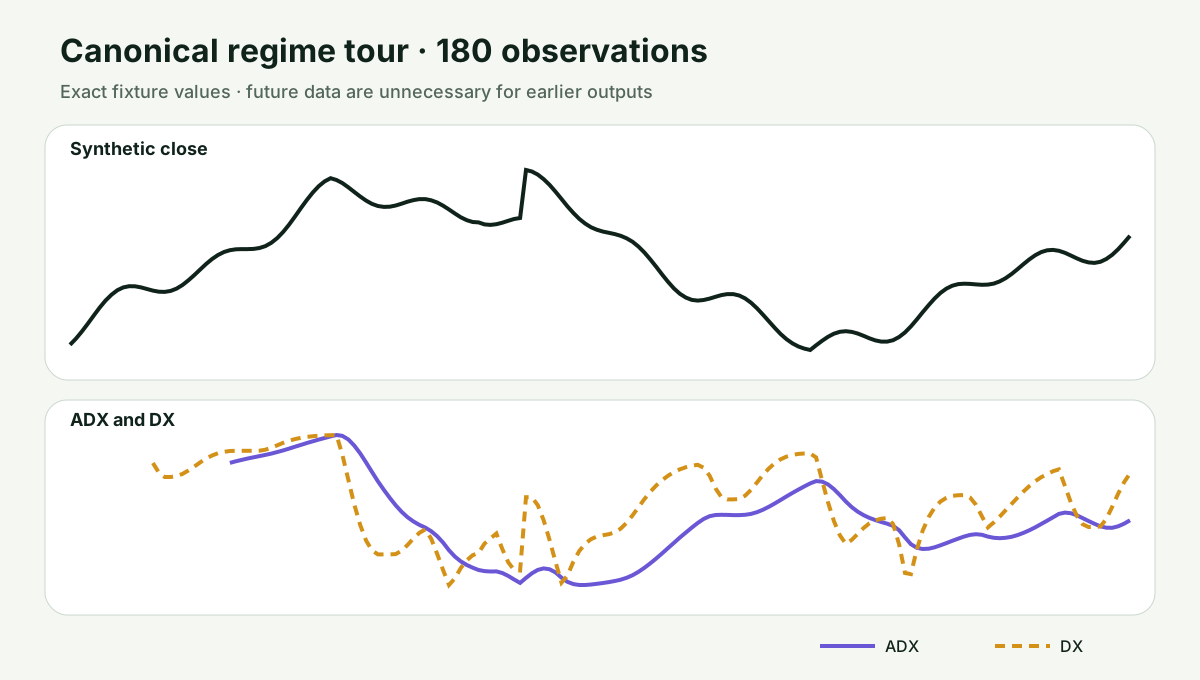
The hand result is deliberately small enough to recalculate without either implementation. The canonical fixture then extends the same rules across five long, topic-specific paths.
From data contract to executable state
Use finalized, chronological observations with one declared source field, session calendar, time zone, and adjustment basis. Reject non-finite values, malformed high/low geometry, and invalid parameters. Do not sort inside the numeric kernel, fill missing bars with zero, or splice adjusted and unadjusted history.
The implementation returns one aligned entry per input row. Warm-up stays
None in Python and null in TypeScript. A revision to historical input
invalidates the recursive or rolling suffix from the earliest changed row.
Implementation walkthrough
The Python and TypeScript files favor direct state variables over clever vectorization. That makes seed, tie, clamp, displacement, and reversal behavior reviewable. Both languages read the same fixture and preserve the same null, numeric, string, and boolean semantics.
Complexity is linear in the number of observations. The reference code is optimized for readability; a production streaming implementation can retain only the active rolling/recursive state after validating parity.
Reconcile a platform disagreement systematically
| Dimension | This package | Maintained-platform context | What to compare |
|---|---|---|---|
| ADX seed | Mean of first period DX values | Current TA-Lib documentation states the same rule | The first ADX index must be reconciled explicitly. |
| Direction | Not encoded by ADX | +DI/−DI carry direction | Similar ADX values can occur in opposite trends. |
| Thresholds | No canonical strength threshold | 20/25 are platform or practitioner conventions | Threshold labels must not be presented as mathematical facts. |
Start at the first row where the two outputs diverge. Compare source fields and parameters first, then the previous intermediate state, and only then the published line. This avoids treating a documented convention difference as a numerical defect.
Explore the exact state
Open the guided ADX playground. The initial state is already informative. Choose a scenario, scrub or step to a named checkpoint, compare the visible diagnostics, and inspect the last 12 published rows.
The lab uses 180 observations in each of five scenarios, not a tiny decorative sample. A recent-60, recent-120, or complete-history focus keeps the denser path readable. Reduced-motion Play advances one observation without starting a timer.
Use the five-scenario atlas
| Lesson | Scenario ID | What the controlled path isolates |
|---|---|---|
| Strengthening upward organization | strengthening-uptrend | Persistent positive directional separation raises DX and then ADX after its two-stage warm-up. |
| Strengthening downward organization | strengthening-downtrend | A declining path can produce ADX strength comparable with an advancing path, proving directionlessness. |
| Directionless strength comparison | directionless-pair | Alternating up and down phases keep +DI and −DI visible beside ADX so strength is never mistaken for direction. |
| Chop and ADX decay | chop-and-decay | Range-bound alternation weakens persistent DI separation and shows ADX decaying rather than flipping direction. |
| Seven-period ADX comparison | short-adx-sensitivity | A shorter period reduces warm-up and increases responsiveness without changing what ADX measures. |
Each path contains five checkpoints: first guided state, transition, boundary, platform reconciliation, and mature-state audit. These labels explain deterministic calculation state; they do not classify future market behavior.
A production debugging ladder
- Verify finalized input fields, chronological order, calendar, time zone, and adjustment basis.
- Verify parameter values and the first-ready index.
- Keep +DI and −DI beside DX and ADX so strength is never mistaken for direction.
- Compare the shared fixture at the first divergent row.
- Recalculate one checkpoint independently before changing code.
- Record the convention version with every persisted output.
Boundaries that cause real implementation drift
- ADX cannot identify uptrend versus downtrend; +DI and −DI carry that information.
- Thresholds such as 20 or 25 are conventions, not mathematical boundaries or guarantees.
- ADX has a long warm-up because Directional Movement is smoothed before DX is averaged.

The strongest reconciliation workflow compares the first valid index, a steady-state row, an equality boundary, a reversal or reset, and the complete aligned suffix—not merely the last visible chart point.
Compare the family question, not the chart color
Directional Movement exposes raw and normalized directional components. ADX is a second-stage smoother of DX and should not replace the component diagnostics.
Neighboring indicators can display a similar bullish/bearish state while measuring different inputs. Agreement is not independent confirmation when the systems reuse the same prices and smoothing primitives.
Testing proves calculation, not profitability
The release checks cover:
- all-five-scenario Python/TypeScript parity;
- exact first-ready behavior;
- invalid values and parameters;
- equality, zero, tie, displacement, clamp, or reversal semantics;
- SVG accessibility and fixture-derived values;
- deterministic playground controls and reduced motion;
- responsive reader and standalone rendering.
None of those checks estimates future returns. A strategy study would still need point-in-time constituents, execution clocks, fees, slippage, survivorship controls, and out-of-sample evaluation.
Historical-example decision
A named historical chart is not useful for this mechanism lesson. It would introduce vendor data, adjustment, identifier, session, licensing, and hindsight ambiguity without strengthening the arithmetic. The synthetic paths isolate the causal rule and can be redistributed with the package.
Common questions
Is ADX a prediction?
No. It is a deterministic transformation of observed bars under the selected convention.
Can I compare values across platforms?
Only after aligning the source field, price basis, windows, seed, boundary rules, and display displacement.
What should I log in production?
Log the parameters, first-ready index, current intermediate state, input revision identifier, and the exact convention version.
What is the next tutorial?
Continue to Ichimoku Cloud, which changes the trend-system question and makes a different state or normalization visible.
Rendered from the canonical Mermaid sources linked by this article.
ADX calculation flow
Takeaway: the displayed line is reproducible only when the hidden state and its boundary convention are preserved.
References5 primary sources and evidence notesExpand the source trail, evidence role, and limitations behind the engineering choices.
Expand the source trail, evidence role, and limitations behind the engineering choices.
Access date for web sources: 2026-07-26. Public artifacts use only deterministic synthetic data.
R1 — J. Welles Wilder, New Concepts in Technical Trading Systems
- Organization or authors: J. Welles Wilder
- Source type: Original or origin-attribution publication record
- Publication or effective date: See catalog record
- Version: Bibliographic record accessed 2026-07-26
- URL or DOI: https://books.google.com/books?vid=ISBN0894590278
- Accessed: 2026-07-26
- Jurisdiction: General technical analysis; no regulatory jurisdiction
- Evidence role: Origin and historical-definition context
- Supports: Authorship/origin and the conceptual purpose of the method.
- Limitations: The public record does not by itself freeze every modern platform seed, tie, plotting, or rounding convention.
- Publication decision: Cite for origin; use maintained documentation and the package contract for executable semantics.
R2 — TA-Lib ADX
- Organization or authors: TA-Lib project or TradingView, as identified by the linked page
- Source type: Maintained official technical documentation
- Publication or effective date: Current page
- Version: Page accessed 2026-07-26
- URL or DOI: https://ta-lib.org/functions/adx.html
- Accessed: 2026-07-26
- Jurisdiction: General technical analysis; platform applicability stated in the package
- Evidence role: Formula and maintained implementation-context evidence
- Supports: ADX is Wilder's recursive average of DX. It smooths the magnitude of +DI/−DI separation and therefore describes directional organization without saying whether the dominant side is up or down.
- Limitations: Documentation cannot establish predictive power, profitability, or universal platform parity.
- Publication decision: Publish formula facts with the package's selected conventions visibly separated.
R3 — Pinned TA-Lib ta_ADX.c implementation
- Organization or authors: TA-Lib project or TradingView
- Source type: Pinned maintained source or maintained calculation guide
- Publication or effective date: Repository commit or current guide
- Version: e203f7c436a9c21fd08246661971cfcb7ee37517
- URL or DOI: https://github.com/TA-Lib/ta-lib/blob/e203f7c436a9c21fd08246661971cfcb7ee37517/src/ta_func/ta_ADX.c
- Accessed: 2026-07-26
- Jurisdiction: General technical analysis
- Evidence role: Executable or platform-convention evidence
- Supports: Executable loop order, warm-up behavior, and maintained reference semantics used to compare the package convention.
- Limitations: Source parity is not claimed where this package explicitly selects a clearer seed or zero-state convention.
- Publication decision: Use to regression-check semantics; document intentional differences instead of implying universal equivalence.
R4 — Canonical synthetic fixture and independent arithmetic
- Organization or authors: The Fintech Builder
- Source type: Author-derived calculation from synthetic teaching inputs
- Publication or effective date: 2026-07-26
- Version: Fixture schema 2.0
- URL or DOI: datasets/adx-fixtures.json
- Accessed: 2026-07-26
- Jurisdiction: Not applicable
- Evidence role: Reproducibility and Python/TypeScript parity
- Supports: Published worked values, warm-up, equality, reset, and scenario behavior.
- Limitations: Synthetic observations prove calculation behavior only; they are not market evidence.
- Publication decision: Redistributable with the package; label every use synthetic.
R5 — TA-Lib DX function documentation
- Organization or authors: TA-Lib project or TradingView
- Source type: Maintained official technical documentation
- Publication or effective date: Current page
- Version: Page accessed 2026-07-26
- URL or DOI: https://ta-lib.org/functions/dx
- Accessed: 2026-07-26
- Jurisdiction: General technical analysis; platform applicability stated in the package
- Evidence role: Neighboring-function and platform-reconciliation evidence
- Supports: Upstream DX definition, zero-state note, and directional-strength context.
- Limitations: A maintained platform record documents its own convention and does not make the package convention universal.
- Publication decision: Use in the reconciliation matrix; retain package choices and intentional differences explicitly.
Full dependency-light reference implementations in both supported languages.
export type Numeric = number | null;

    function validateSeries(values: number[], name: string): void {
      if (!Array.isArray(values) || values.length === 0) throw new RangeError(`${name} must be a non-empty array`);
      if (values.some((value) => typeof value !== "number" || !Number.isFinite(value))) {
throw new TypeError(`${name} must contain only finite numbers`);
      }
    }

    function validateHL(high: number[], low: number[]): void {
      validateSeries(high, "high");
      validateSeries(low, "low");
      if (high.length !== low.length) throw new RangeError("high and low lengths must match");
      if (high.some((value, index) => value < low[index])) throw new RangeError("high must be >= low");
    }

    function validateHLC(high: number[], low: number[], close: number[]): void {
      validateHL(high, low);
      validateSeries(close, "close");
      if (close.length !== high.length) throw new RangeError("high, low, and close lengths must match");
      if (close.some((value, index) => value < low[index] || value > high[index])) {
throw new RangeError("close must lie inside each high-low range");
      }
    }
function directionalMovement(high: number[], low: number[], close: number[], period = 14) {
  validateHLC(high, low, close);
  if (!Number.isInteger(period) || period < 1) throw new RangeError("period must be a positive integer");
  const size = high.length;
  const true_range: Numeric[] = Array(size).fill(null);
  const plus_dm: Numeric[] = Array(size).fill(null);
  const minus_dm: Numeric[] = Array(size).fill(null);
  true_range[0] = high[0] - low[0]; plus_dm[0] = 0; minus_dm[0] = 0;
  for (let index = 1; index < size; index += 1) {
    const upMove = high[index] - high[index - 1];
    const downMove = low[index - 1] - low[index];
    plus_dm[index] = upMove > downMove && upMove > 0 ? upMove : 0;
    minus_dm[index] = downMove > upMove && downMove > 0 ? downMove : 0;
    true_range[index] = Math.max(high[index] - low[index], Math.abs(high[index] - close[index - 1]), Math.abs(low[index] - close[index - 1]));
  }
  const smoothed_tr: Numeric[] = Array(size).fill(null);
  const smoothed_plus_dm: Numeric[] = Array(size).fill(null);
  const smoothed_minus_dm: Numeric[] = Array(size).fill(null);
  const atr: Numeric[] = Array(size).fill(null);
  const plus_di: Numeric[] = Array(size).fill(null);
  const minus_di: Numeric[] = Array(size).fill(null);
  const dx: Numeric[] = Array(size).fill(null);
  if (size > period) {
    let smoothedTr = true_range.slice(1, period + 1).reduce<number>((sum, value) => sum + (value as number), 0);
    let smoothedPlus = plus_dm.slice(1, period + 1).reduce<number>((sum, value) => sum + (value as number), 0);
    let smoothedMinus = minus_dm.slice(1, period + 1).reduce<number>((sum, value) => sum + (value as number), 0);
    for (let index = period; index < size; index += 1) {
      if (index > period) {
        smoothedTr = smoothedTr - smoothedTr / period + (true_range[index] as number);
        smoothedPlus = smoothedPlus - smoothedPlus / period + (plus_dm[index] as number);
        smoothedMinus = smoothedMinus - smoothedMinus / period + (minus_dm[index] as number);
      }
      smoothed_tr[index] = smoothedTr; smoothed_plus_dm[index] = smoothedPlus; smoothed_minus_dm[index] = smoothedMinus;
      atr[index] = smoothedTr / period;
      const plus = smoothedTr === 0 ? 0 : (100 * smoothedPlus) / smoothedTr;
      const minus = smoothedTr === 0 ? 0 : (100 * smoothedMinus) / smoothedTr;
      plus_di[index] = plus; minus_di[index] = minus;
      dx[index] = plus + minus === 0 ? 0 : (100 * Math.abs(plus - minus)) / (plus + minus);
    }
  }
  return { true_range, plus_dm, minus_dm, smoothed_tr, smoothed_plus_dm, smoothed_minus_dm, atr, plus_di, minus_di, dx };
}
export function adx(high: number[], low: number[], close: number[], period = 14) {
  const movement = directionalMovement(high, low, close, period);
  const values: Numeric[] = Array(high.length).fill(null);
  const first = 2 * period - 1;
  if (high.length > first) {
    let previous = movement.dx.slice(period, first + 1).reduce<number>((sum, value) => sum + (value as number), 0) / period;
    values[first] = previous;
    for (let index = first + 1; index < high.length; index += 1) {
      previous = (previous * (period - 1) + (movement.dx[index] as number)) / period;
      values[index] = previous;
    }
  }
  return { plus_di: movement.plus_di, minus_di: movement.minus_di, dx: movement.dx, adx: values };
}
The embedded lab now expands to its full document height, keeping the article as the only scroll surface.