
 By Islam Baraka
Make the deceptively compact Gordon formula safe by freezing dividend timing and exposing the discount-growth spread.
The decision this tutorial makes visible
Gordon Growth Model is useful because it turns a set of explicit assumptions into a reconciled estimate while preserving the diagnostics needed to challenge that estimate.
The precise question is: What is a stable dividend stream worth when next-period dividend grows forever at one constant rate?
A practitioner needs to know what the diagnostic does and does not justify. A builder needs a contract that can be reproduced from the same point-in-time inputs in Python, TypeScript, a visual, and a browser lab.
Intuition before notation
The spread between required return and perpetual growth capitalizes next period's dividend; as that spread narrows, value sensitivity rises sharply.
The result depends on the declared algorithm scope, input clocks, units, equality and rounding policies, and unsupported-state treatment. Change one of those and the output represents a different decision even when its field name is unchanged.
Scope and nearby methods
Single-stage equity perpetuity using the next-period dividend D1, one constant cost of equity, and one perpetual growth rate from the valuation date onward.
| Variant | Definition | Best use | Main limitation |
|---|---|---|---|
| Canonical repository convention | Single-stage equity perpetuity using the next-period dividend D1, one constant cost of equity, and one perpetual growth rate from the valuation date onward. | Reproducible teaching and parity | One explicit convention, not a universal default |
| D0 convention | Grow the latest paid dividend once before applying the formula | When only D0 is supplied | Off-by-one risk |
| H-model | Fade growth linearly toward stability | Gradual transition | Adds transition assumptions |
What is sourced, selected, synthetic, and derived
| Role | Material claim | Evidence | Boundary |
|---|---|---|---|
| Original-method source | The stable-growth capitalization relationship underlying the Gordon growth model. | S1: Management Science 3(1), 102-110; DOI 10.1287/mnsc.3.1.102 | The original model is a stylized perpetuity; it does not establish that a security has reached a stable state. |
| Definition source | Equity value can be expressed as the present value of expected dividends; the Gordon model uses next-period dividend divided by cost of equity less stable growth. | S2: General DDM and Gordon growth model | Applicability depends on payout and growth assumptions; the source does not validate this package's synthetic numbers. |
| Implementation choice | Single-stage equity perpetuity using the next-period dividend D1, one constant cost of equity, and one perpetual growth rate from the valuation date onward. | Frozen family definition contract, code, fixtures, and parity checks | This is the repository convention, not the only accepted valuation variant. |
| Synthetic teaching input | Every financial amount, rate, date, and scenario state is repository-authored. | datasets/canonical-input.json and datasets/scenario-results.json | No value represents an observed issuer or provider record. |
| Author-derived calculation | The fixture produces value per share, the cost-of-equity-minus-growth spread, and the implied dividend capitalization multiple. | Expected output, examples, and independent validation | Arithmetic correctness does not validate forecasts, discount rates, or market performance. |
The authoritative sources support only the exact facts named in the claim ledger. They do not certify the synthetic numbers in this tutorial. The repository fixture is deliberately invented for auditability, and the displayed output is author-derived under the selected implementation choice.
Formula, symbols, and numerical policy
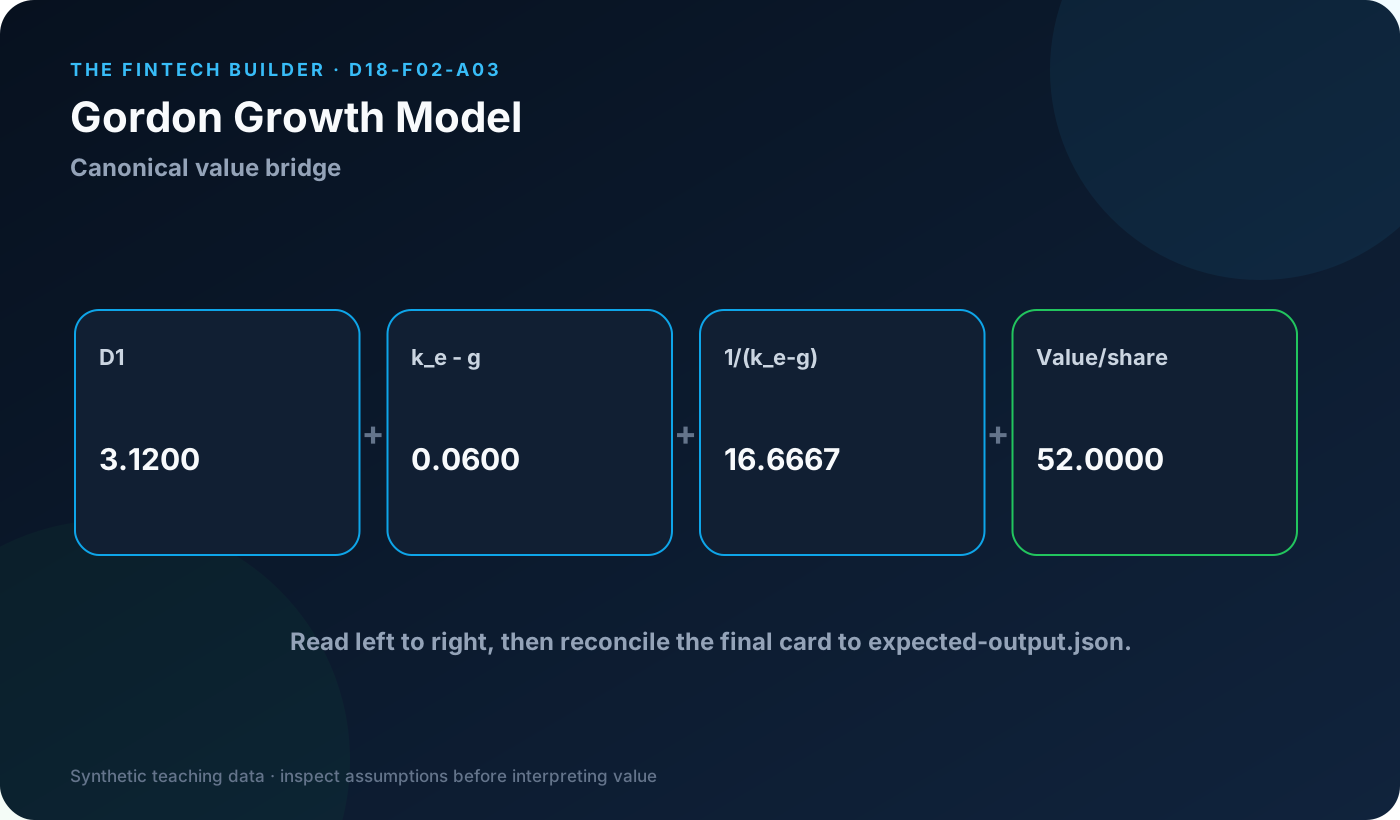
V0 = D1 / (k_e - g)
| Symbol | Meaning | Unit | Policy |
|---|---|---|---|
| D1 | Dividend one period after valuation | currency/share | Never substitute D0 without first growing it |
| k_e | Cost of equity | decimal/year | Constant |
| g | Perpetual dividend growth | decimal/year | Constant and below k_e |
- Calculate at full floating-point precision and round only for display.
- Periods and rates share one annual cadence unless an explicitly documented conversion is supplied.
- The dividend input is D1, not D0; perpetual_growth must be strictly below cost_of_equity, and the model is not used for a temporary high-growth stage.
- Reconcile all displayed components back to the headline value.
Read the formula in the same order as the algorithm. Validate identity, ordering, units, and supported state first. Apply the selected equality and window rules second. Calculate with unrounded numeric values. Round only at the declared presentation boundary, and preserve null as a diagnostic rather than coercing it to zero.
Build the algorithm
- Confirm the input is D1
- Validate stable-state applicability
- Compute k_e minus g
- Capitalize D1
- Stress the spread before interpreting value
Production-minded operational checklist
- Verify point-in-time statement availability and corporate-action/share-count basis.
- Match operating/equity cash flows to WACC/cost of equity.
- Stress discount and perpetual-growth assumptions rather than presenting one point estimate as truth.
- Reconcile independent arithmetic and Python/TypeScript output before publication.
The checklist is intentionally strict: an explicit rejection is safer than a plausible output built from stale, malformed, or unsupported state.
Worked synthetic example
The canonical fixture is synthetic teaching data, not an observed control
event, customer order, or broker execution. Its primary author-derived output,
intrinsic_value_per_share, is value per share, the cost-of-equity-minus-growth spread, and the implied dividend capitalization multiple. The complete input and output
are in datasets/canonical-input.json and datasets/expected-output.json.
The canonical synthetic fixture applies V0 = D1 / (k_e - g) and produces value per share, the cost-of-equity-minus-growth spread, and the implied dividend capitalization multiple. The expected JSON is generated from the frozen contract and checked independently across both language implementations.
Counterfactual checkpoint
Gordon Growth Model material-assumption change. Move the primary discount or growth driver while holding the other frozen inputs constant. The output changes because A valuation is only interpretable when the source of a changed result is visible.
The structured result retains state and diagnostics in addition to the primary number. That makes the calculation independently reviewable and prevents a partial, null, rejected, or venue-bounded outcome from being mistaken for an unqualified value.
Boundary and counterexample workbook
The playground computes every scenario at 61 deterministic parameter states.
The table uses the declared focus step and states whether that focus reproduces
the canonical fixture. The full state ledger and compressed transition
segments are in datasets/scenario-results.json.
| Scenario | Review focus | Purpose | State | Primary output | Diagnostic | Decision segments |
|---|---|---|---|---|---|---|
| Canonical cost-of-equity sweep | Step 30 · canonical fixture | Move cost of equity around 10%. | valued | value/share 52.00 | State valued; value/share 52.00; terminal/continuing share 0.0%. | 1 |
| Perpetual-growth sweep | Step 30 · comparison focus | Move stable growth over a bounded range. | valued | value/share 41.60 | State valued; value/share 41.60; terminal/continuing share 0.0%. | 1 |
| Next-dividend scale | Step 30 · comparison focus | Vary D1 directly. | valued | value/share 58.33 | State valued; value/share 58.33; terminal/continuing share 0.0%. | 1 |
| Zero growth | Step 30 · comparison focus | Capitalize a level perpetuity. | valued | value/share 31.20 | State valued; value/share 31.20; terminal/continuing share 0.0%. | 1 |
| Negative growth | Step 30 · comparison focus | Value a contracting perpetuity. | valued | value/share 24.00 | State valued; value/share 24.00; terminal/continuing share 0.0%. | 1 |
| Narrow spread | Step 30 · comparison focus | Expose nonlinear denominator sensitivity. | valued | value/share 122.35 | State valued; value/share 122.35; terminal/continuing share 0.0%. | 1 |
| Zero dividend | Step 30 · comparison focus | Return a valid zero value rather than an invalid state. | valued | value/share 0.00 | State valued; value/share 0.00; terminal/continuing share 0.0%. | 1 |
These rows are not backtest observations. They are controlled counterexamples that expose how one driver changes the state, output, or reason code while the rest of the contract stays fixed.
Visualize the boundary

Open this SVG at full size, or use the guided playground to compare the seven topic-specific canonical, boundary, policy, and failure scenarios.
The Mermaid flow answers where the selected calculation sits in the processing sequence. The SVG keeps the formula, output, decision boundary, and invariant visible together. The lab lets the reader step through the same structured states without changing the underlying definition.
Implementation walkthrough
The Python and TypeScript references begin with the same validation contract, reject malformed and unsupported state before calculation, preserve declared ordering and rounding policies, and return structured diagnostics rather than one context-free number.
The main implementation branches are:
- Input, timing, accounting, or claim contract fails — Reject, because A precise number would be misleading.
- Perpetual growth is greater than or equal to the matching discount rate — Reject, because The frozen stable-growth perpetuity is undefined or nonconvergent.
- Inputs are valid but sensitivity is extreme — Return value with diagnostics, because Fragility is information, not an excuse to hide output.
- All checks pass — Return structured valuation and audit trail, because The definition contract is satisfied.
Neither reference silently fetches data, mutates caller-owned inputs outside the declared engine behavior, guesses hidden state, or substitutes a provider default. Shared JSON fixtures make value, null, state, and reason-code drift visible across languages.
Testing and validation
Definition tests compare every canonical field, reject malformed state, and exercise the material boundary. Family validation recomputes every playground state from the reference function. Independent arithmetic is recorded beside the fixture rather than inferred only from implementation output.
The audit must preserve these invariants:
- Persist valuation date, currency, unit scale, claim level, forecast provenance, discount rate, growth rate, and adjustment basis.
- Return each period's opening balance where relevant, discount factor, undiscounted amount, and present value.
- Expose terminal or continuing value and its share of total value.
- Separate invalid input from a valid but economically fragile estimate.
Passing definition and parity checks proves that the implementation matches the selected contract. It does not prove production performance, universal applicability, or a later market outcome.
Failure modes and misuse
- One perpetual growth regime is unsuitable when current growth, payout, or risk is transitional.
- A mathematically valid narrow spread can produce an economically fragile estimate.
Debugging order
When a result looks surprising, inspect the state in this order:
- Confirm identifiers, scope, side, and decision clock.
- Confirm units, ordering, and point-in-time inputs.
- Confirm equality, rounding, null, and reset policies.
- Recalculate the invariant and declared scenario focus before changing code.
Evidence and historical boundary
Historical decision: Not useful for the canonical worked example. The learning obstacle is assumption architecture and reconciliation. A named security would add unverifiable author forecasts and could imply false authority unless every input were reconstructed point in time.
The primary sources are Gordon and Shapiro (1956), Damodaran DDM. They support the source roles listed in the research ledger, not a redistributable historical observation, a private participant decision, production conformance certification, execution-quality result, profitability claim, or prediction claim.
Summary and next topic
You can now calculate, reconcile, stress, and explain Gordon Growth Model without hiding its claim, timing, or terminal assumptions. The learning flow is: Dividend Discount Model → Gordon Growth Model → Residual-Income Model. Carry the result forward only with its scope, clock, state, and evidence label.
Choose the valuation model
The models answer different claim-level questions. The current row is not “best”; it is the method whose cash-flow or accounting anchor matches this tutorial's contract.
| Model | Claim valued | Anchor | Best fit | Primary failure mode | Here |
|---|---|---|---|---|---|
| FCFF DCF | Enterprise | Operating free cash flow | Businesses with forecastable operations and capital needs | Cash-flow/WACC mismatch or terminal dominance | Alternative |
| Dividend discount | Equity per share | Explicit distributions | Established dividend-paying issuers | Payout policy diverges from capacity to distribute | Alternative |
| Gordon growth | Equity per share | Next dividend in stable perpetuity | Already-stable payout streams | Using a transient growth rate forever | Current topic |
| Residual income | Equity per share | Book value plus excess earnings | Financial/accounting settings where book value is informative | Dirty-surplus or inconsistent accounting basis | Alternative |
| EVA | Enterprise | Invested capital plus value added | Operating performance and capital-allocation analysis | NOPAT/capital adjustment-basis inconsistency | Alternative |
Use the valuation studio
Open the guided valuation studio and use the same four-step loop each time:
- Predict: name the direction of the change and the component that should move most.
- Calculate: advance through Validate, Forecast, Discount, Continue, and Reconcile.
- Reconcile: match the readable schedule and bridge to the headline value.
- Interpret: describe sensitivity or fragility without converting the result into a market-price claim.
The scenario control retains all seven 61-state datasets, while the stage controls teach calculation order. Exact JSON remains available as a secondary audit surface.
Continue the learning path
Family map · Open the valuation studio · Evidence ledger · Previous: Dividend Discount Model · Next: Residual-Income Model
Deep visual atlas
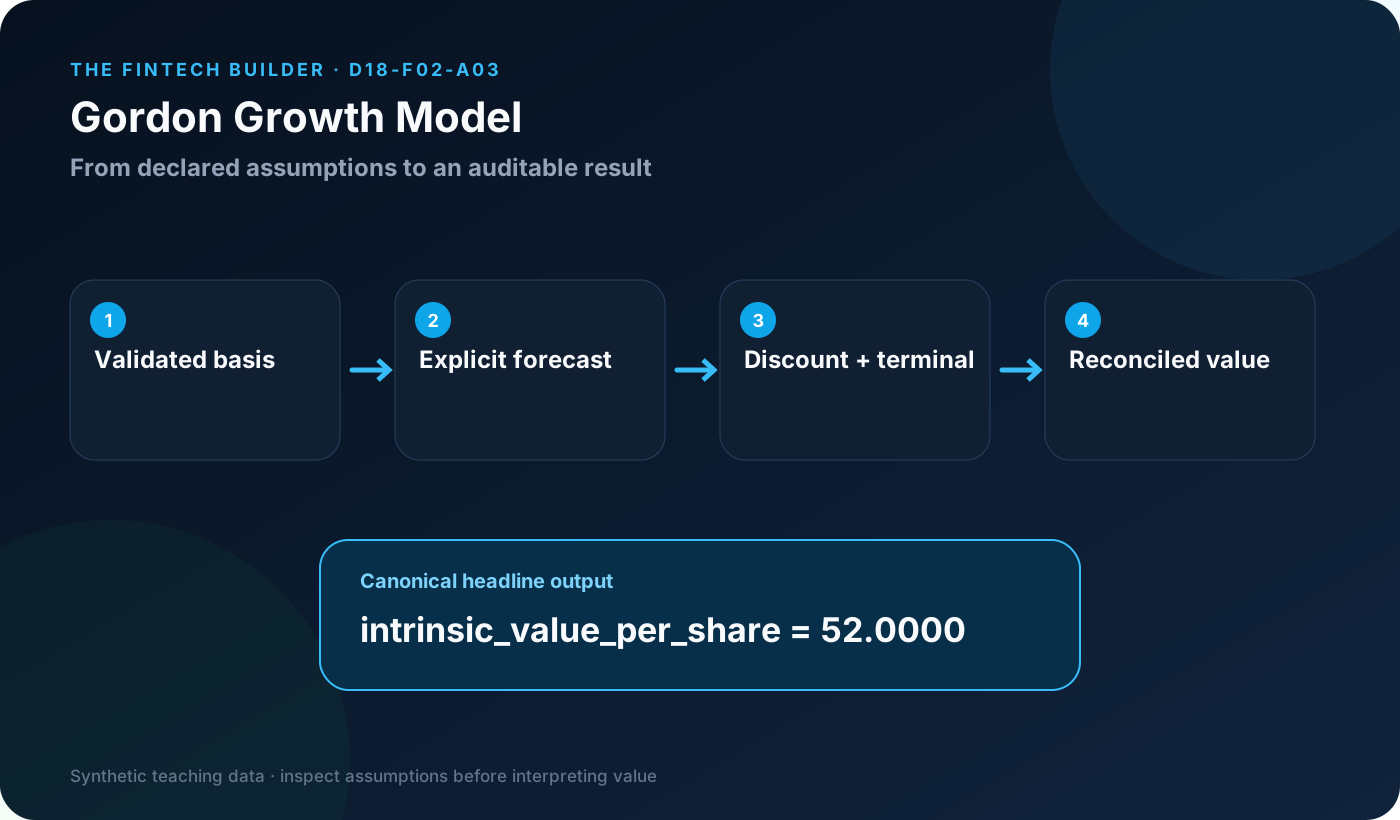
Outcome and pipeline
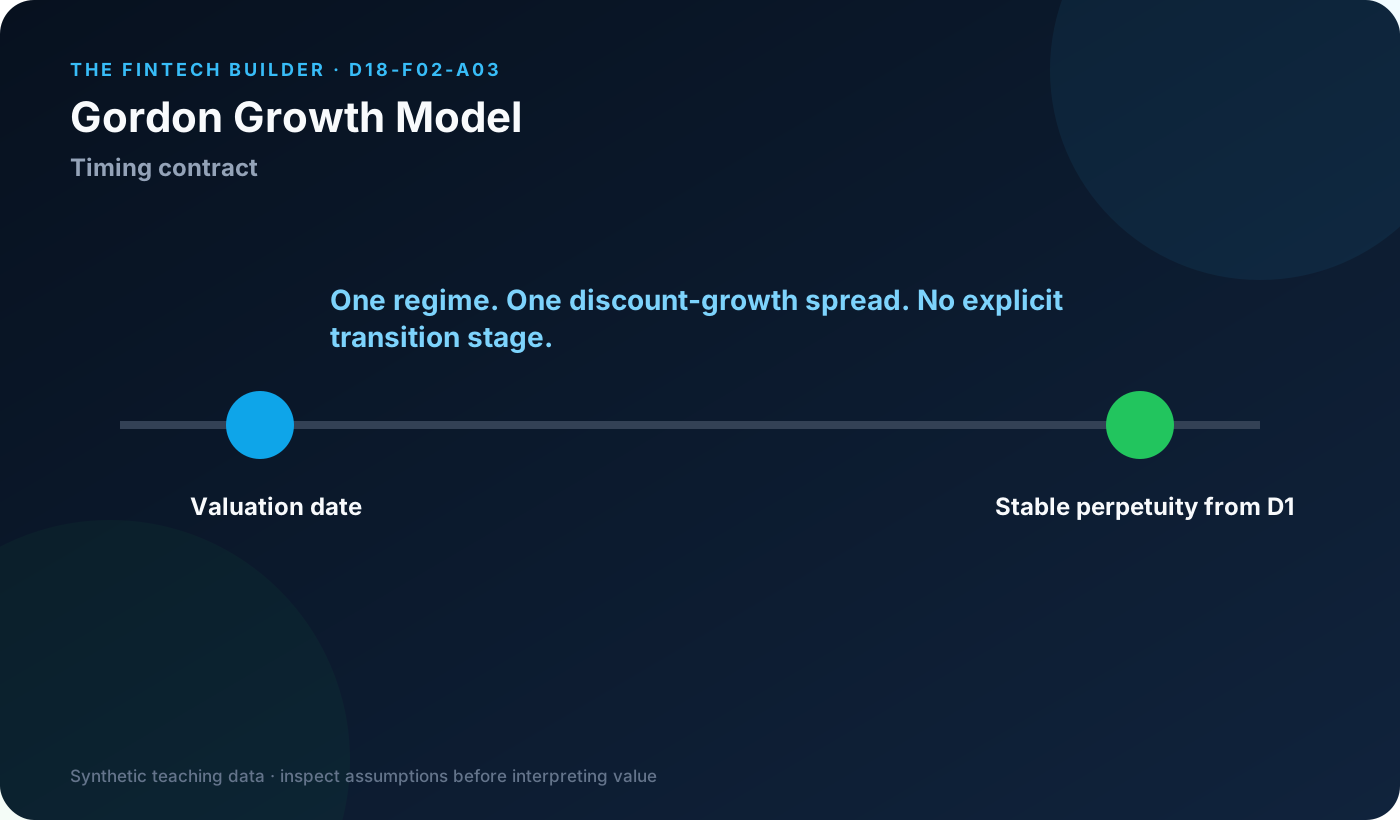
Timing and continuing-value boundary
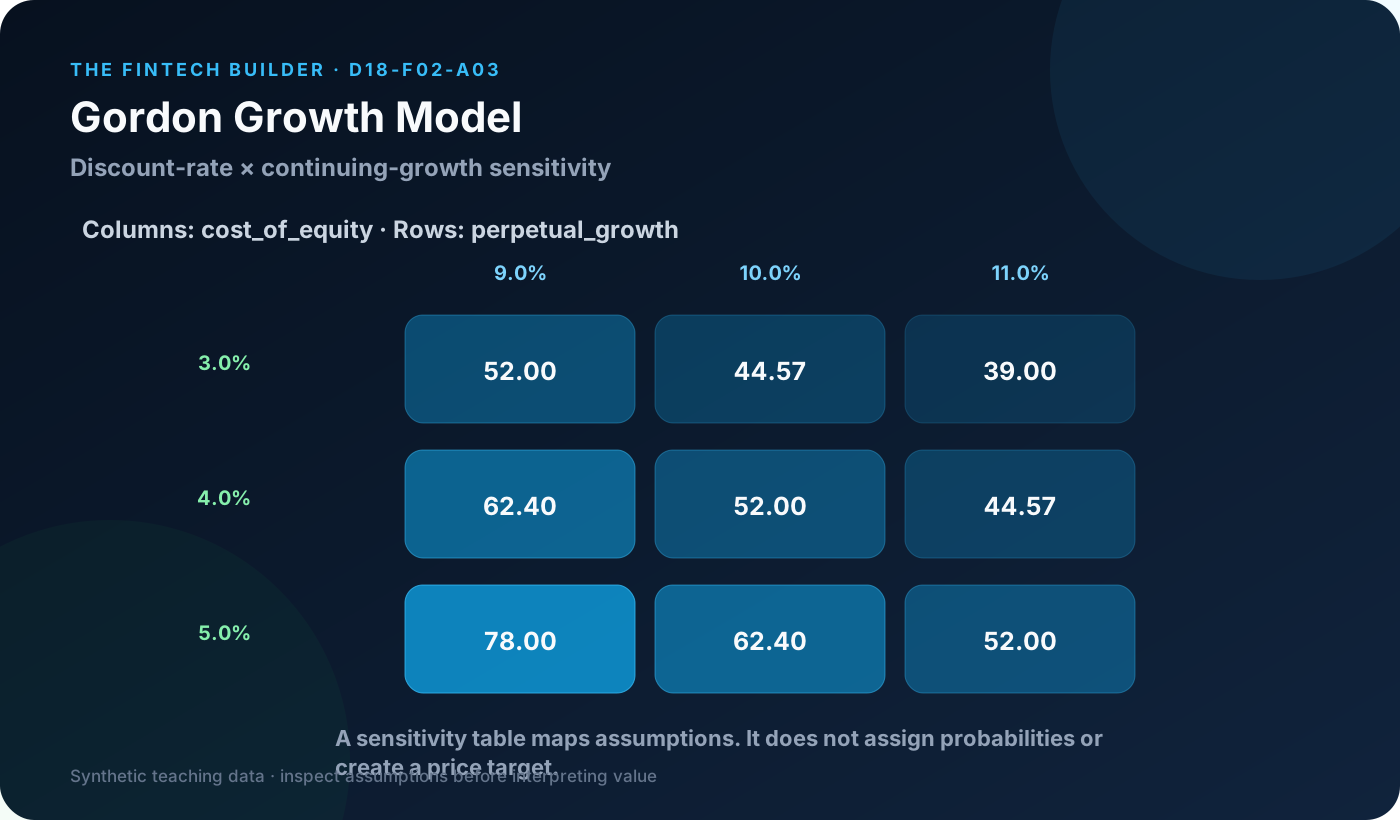
Assumption sensitivity
Reconciliation bridge
Model boundaries
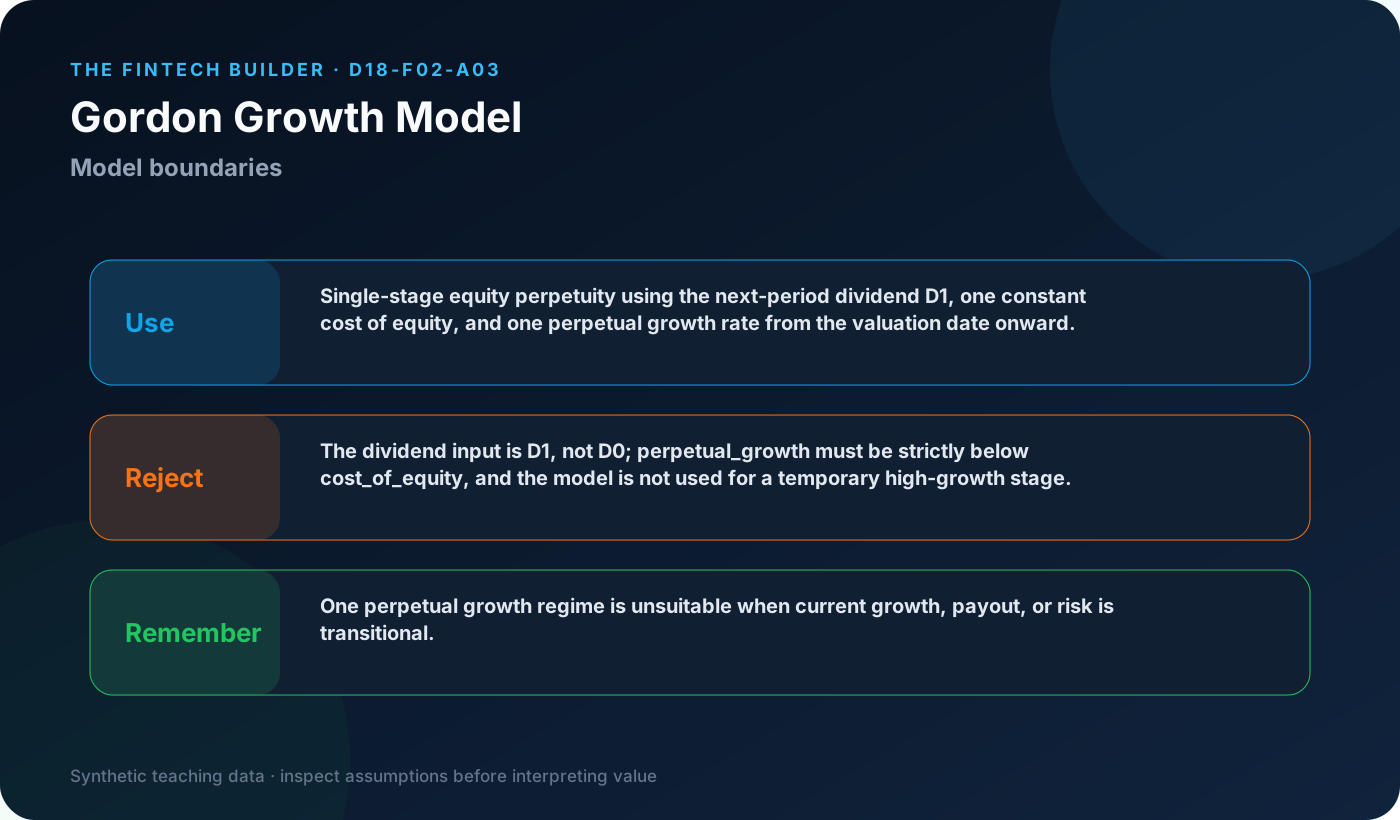
Use these visuals together: the pipeline establishes claim order, the timeline prevents off-by-one errors, the matrix exposes fragility, the bridge checks arithmetic, and the boundary card prevents the result from being mistaken for a recommendation.
Rendered from the canonical Mermaid sources linked by this article.
Gordon Growth Model calculation flow
This flow identifies the selected calculation stages and the structured output.
Takeaway: The formula's risk is concentrated in one denominator, so the spread is a first-class diagnostic.
ReferencesPrimary sources and evidence notesExpand the source trail, evidence role, and limitations behind the engineering choices.
Expand the source trail, evidence role, and limitations behind the engineering choices.
S1 — Capital Equipment Analysis: The Required Rate of Profit
- Organization or authors: Myron J. Gordon and Eli Shapiro
- Source type: Primary or authoritative technical source
- Publication or effective date: 1956
- Version: 1956
- URL or DOI: https://pubsonline.informs.org/doi/10.1287/mnsc.3.1.102
- Accessed: 2026-08-04
- Jurisdiction: International / educational framework
- Supports: The stable-growth capitalization relationship underlying the Gordon growth model.
- Limitations: The original model is a stylized perpetuity; it does not establish that a security has reached a stable state.
S2 — Dividend Discount Models
- Organization or authors: Aswath Damodaran
- Source type: Primary or authoritative technical source
- Publication or effective date: n.d.
- Version: n.d.
- URL or DOI: https://pages.stern.nyu.edu/adamodar/New_Home_Page/lectures/ddm.html
- Accessed: 2026-08-04
- Jurisdiction: International / educational framework
- Supports: Equity value can be expressed as the present value of expected dividends; the Gordon model uses next-period dividend divided by cost of equity less stable growth.
- Limitations: Applicability depends on payout and growth assumptions; the source does not validate this package's synthetic numbers.
Evidence boundary
The sources establish the exact rule, interface, protocol, or research context named above. They do not verify the repository-authored synthetic fixture, thresholds, empirical usefulness, execution probability, or profitability. Package-selected choices remain labeled as implementation choices wherever they are used.
Full dependency-light reference implementations in both supported languages.
/** Canonical TypeScript parity implementation for D18-F02 Intrinsic Valuation. */

type Input = Record<string, unknown>;
type Output = Record<string, unknown>;

function numberValue(value: unknown, name: string): number {
  if (typeof value !== "number" || !Number.isFinite(value)) throw new Error(`${name} must be a finite number`);
  return value;
}

function rate(value: unknown, name: string): number {
  const result = numberValue(value, name);
  if (result <= 0 || result >= 1) throw new Error(`${name} must be strictly between 0 and 1`);
  return result;
}

function growth(value: unknown, name: string, discountRate: number): number {
  const result = numberValue(value, name);
  if (result <= -1) throw new Error(`${name} must be greater than -1`);
  if (result >= discountRate) throw new Error(`${name} must be below the matching discount rate`);
  return result;
}

function series(value: unknown, name: string): number[] {
  if (!Array.isArray(value) || value.length < 1) throw new Error(`${name} must contain at least 1 value`);
  return value.map((item, index) => numberValue(item, `${name}[${index}]`));
}

function sameLength(left: unknown[], right: unknown[], leftName: string, rightName: string): void {
  if (left.length !== right.length) throw new Error(`${leftName} and ${rightName} must have the same length`);
}

function discount(value: number, discountRate: number, period: number): [number, number] {
  const factor = 1 / ((1 + discountRate) ** period);
  return [factor, value * factor];
}

function fcffDcf(data: Input): Output {
  const fcff = series(data.fcff, "fcff");
  const wacc = rate(data.wacc, "wacc");
  const terminalGrowth = growth(data.terminal_growth, "terminal_growth", wacc);
  const cash = numberValue(data.cash_and_non_operating_assets, "cash_and_non_operating_assets");
  const debt = numberValue(data.debt, "debt");
  const preferred = numberValue(data.preferred_equity, "preferred_equity");
  const minority = numberValue(data.noncontrolling_interest, "noncontrolling_interest");
  const shares = numberValue(data.diluted_shares, "diluted_shares");
  if (shares <= 0) throw new Error("diluted_shares must be positive");
  let pvExplicit = 0;
  const schedule = fcff.map((flow, index) => {
    const period = index + 1;
    const [discountFactor, presentValue] = discount(flow, wacc, period);
    pvExplicit += presentValue;
    return { period, fcff: flow, discount_factor: discountFactor, present_value: presentValue };
  });
  const terminalFcff = fcff.at(-1)! * (1 + terminalGrowth);
  const terminalValue = terminalFcff / (wacc - terminalGrowth);
  const [terminalDiscountFactor, pvTerminal] = discount(terminalValue, wacc, fcff.length);
  const enterpriseValue = pvExplicit + pvTerminal;
  const netEquityBridge = cash - debt - preferred - minority;
  const equityValue = enterpriseValue + netEquityBridge;
  return {
    state: "valued", method: "fcff-enterprise-dcf", schedule,
    pv_explicit_fcff: pvExplicit, terminal_fcff: terminalFcff, terminal_value: terminalValue,
    terminal_discount_factor: terminalDiscountFactor, pv_terminal_value: pvTerminal,
    terminal_value_share: enterpriseValue ? pvTerminal / enterpriseValue : 0,
    enterprise_value: enterpriseValue, net_equity_bridge: netEquityBridge,
    equity_value: equityValue, intrinsic_value_per_share: equityValue / shares,
  };
}

function ddm(data: Input): Output {
  const dividends = series(data.dividends, "dividends");
  if (dividends.some((value) => value < 0)) throw new Error("dividends must be nonnegative");
  const cost = rate(data.cost_of_equity, "cost_of_equity");
  const terminalGrowth = growth(data.terminal_growth, "terminal_growth", cost);
  let pvExplicit = 0;
  const schedule = dividends.map((dividend, index) => {
    const period = index + 1;
    const [discountFactor, presentValue] = discount(dividend, cost, period);
    pvExplicit += presentValue;
    return { period, dividend, discount_factor: discountFactor, present_value: presentValue };
  });
  const terminalDividend = dividends.at(-1)! * (1 + terminalGrowth);
  const terminalValue = terminalDividend / (cost - terminalGrowth);
  const [terminalDiscountFactor, pvTerminal] = discount(terminalValue, cost, dividends.length);
  const value = pvExplicit + pvTerminal;
  return {
    state: "valued", method: "multi-stage-dividend-discount", schedule,
    pv_explicit_dividends: pvExplicit, terminal_dividend: terminalDividend,
    terminal_value: terminalValue, terminal_discount_factor: terminalDiscountFactor,
    pv_terminal_value: pvTerminal, terminal_value_share: value ? pvTerminal / value : 0,
    intrinsic_value_per_share: value,
  };
}

function gordon(data: Input): Output {
  const dividendNext = numberValue(data.dividend_next, "dividend_next");
  if (dividendNext < 0) throw new Error("dividend_next must be nonnegative");
  const cost = rate(data.cost_of_equity, "cost_of_equity");
  const perpetualGrowth = growth(data.perpetual_growth, "perpetual_growth", cost);
  const spread = cost - perpetualGrowth;
  return {
    state: "valued", method: "gordon-growth", dividend_timing: "D1-next-period",
    discount_growth_spread: spread, capitalization_multiple: 1 / spread,
    intrinsic_value_per_share: dividendNext / spread,
  };
}

function residualIncome(data: Input): Output {
  const openingBook = numberValue(data.opening_book_value_per_share, "opening_book_value_per_share");
  if (openingBook <= 0) throw new Error("opening_book_value_per_share must be positive");
  const earnings = series(data.earnings_per_share, "earnings_per_share");
  const dividends = series(data.dividends_per_share, "dividends_per_share");
  const adjustments = series(data.nonowner_equity_adjustments_per_share, "nonowner_equity_adjustments_per_share");
  sameLength(earnings, dividends, "earnings_per_share", "dividends_per_share");
  sameLength(earnings, adjustments, "earnings_per_share", "nonowner_equity_adjustments_per_share");
  const cost = rate(data.cost_of_equity, "cost_of_equity");
  const terminalGrowth = growth(data.terminal_residual_income_growth, "terminal_residual_income_growth", cost);
  let book = openingBook;
  let pvExplicit = 0;
  const residualValues: number[] = [];
  const schedule = earnings.map((eps, index) => {
    const period = index + 1;
    const dividend = dividends[index];
    const adjustment = adjustments[index];
    if (dividend < 0) throw new Error("dividends_per_share must be nonnegative");
    const opening = book;
    const equityCharge = cost * opening;
    const residual = eps - equityCharge;
    const [discountFactor, presentValue] = discount(residual, cost, period);
    const closing = opening + eps - dividend + adjustment;
    if (closing <= 0) throw new Error("reconciled common-equity book-value roll-forward must remain positive");
    pvExplicit += presentValue;
    residualValues.push(residual);
    book = closing;
    return {
      period, opening_book_value_per_share: opening, earnings_per_share: eps,
      dividends_per_share: dividend, nonowner_equity_adjustment_per_share: adjustment,
      equity_charge_per_share: equityCharge, residual_income_per_share: residual,
      discount_factor: discountFactor, present_value: presentValue,
      closing_book_value_per_share: closing,
    };
  });
  const terminalResidual = residualValues.at(-1)! * (1 + terminalGrowth);
  const continuingValue = terminalResidual / (cost - terminalGrowth);
  const [terminalDiscountFactor, pvContinuing] = discount(continuingValue, cost, earnings.length);
  const value = openingBook + pvExplicit + pvContinuing;
  return {
    state: "valued", method: "residual-income", schedule,
    pv_explicit_residual_income: pvExplicit, terminal_residual_income_per_share: terminalResidual,
    continuing_value: continuingValue, terminal_discount_factor: terminalDiscountFactor,
    pv_continuing_value: pvContinuing, continuing_value_share: value ? pvContinuing / value : 0,
    closing_book_value_per_share: book, intrinsic_value_per_share: value,
  };
}

function eva(data: Input): Output {
  const openingCapital = numberValue(data.opening_invested_capital, "opening_invested_capital");
  if (openingCapital <= 0) throw new Error("opening_invested_capital must be positive");
  const nopat = series(data.nopat, "nopat");
  const investment = series(data.net_investment, "net_investment");
  sameLength(nopat, investment, "nopat", "net_investment");
  const wacc = rate(data.wacc, "wacc");
  const terminalGrowth = growth(data.terminal_eva_growth, "terminal_eva_growth", wacc);
  let capital = openingCapital;
  let pvExplicit = 0;
  const evaValues: number[] = [];
  const schedule = nopat.map((periodNopat, index) => {
    const period = index + 1;
    const opening = capital;
    const capitalCharge = wacc * opening;
    const periodEva = periodNopat - capitalCharge;
    const roic = periodNopat / opening;
    const [discountFactor, presentValue] = discount(periodEva, wacc, period);
    const closing = opening + investment[index];
    if (closing <= 0) throw new Error("invested-capital roll-forward must remain positive");
    pvExplicit += presentValue;
    evaValues.push(periodEva);
    capital = closing;
    return {
      period, opening_invested_capital: opening, nopat: periodNopat,
      net_investment: investment[index], capital_charge: capitalCharge, roic,
      roic_wacc_spread: roic - wacc, eva: periodEva,
      discount_factor: discountFactor, present_value: presentValue,
      closing_invested_capital: closing,
    };
  });
  const terminalEva = evaValues.at(-1)! * (1 + terminalGrowth);
  const continuingValue = terminalEva / (wacc - terminalGrowth);
  const [terminalDiscountFactor, pvContinuing] = discount(continuingValue, wacc, nopat.length);
  const marketValueAdded = pvExplicit + pvContinuing;
  const enterpriseValue = openingCapital + marketValueAdded;
  return {
    state: "valued", method: "economic-value-added", schedule,
    pv_explicit_eva: pvExplicit, terminal_eva: terminalEva, continuing_value: continuingValue,
    terminal_discount_factor: terminalDiscountFactor, pv_continuing_value: pvContinuing,
    market_value_added: marketValueAdded,
    continuing_value_share: enterpriseValue ? pvContinuing / enterpriseValue : 0,
    closing_invested_capital: capital, enterprise_value: enterpriseValue,
  };
}

const calculators: Record<string, (data: Input) => Output> = {
  "D18-F02-A01": fcffDcf,
  "D18-F02-A02": ddm,
  "D18-F02-A03": gordon,
  "D18-F02-A04": residualIncome,
  "D18-F02-A05": eva,
};

export function calculate(topicId: string, data: Input): Output {
  const calculator = calculators[topicId];
  if (!calculator) throw new Error(`unsupported topic_id: ${topicId}`);
  if (!data || Array.isArray(data) || typeof data !== "object") throw new Error("data must be an object");
  return calculator(data);
}

// --- per-topic entry points
//
// One narrow export per topic. Each binds a single id and delegates to the
// dispatcher above, which still holds the arithmetic — so these change no
// behaviour and exist because a published subpath must be its own function
// rather than a shared `calculate(topicId, …)`.

/** Free-Cash-Flow DCF — D18-F02-A01. */
export function freeCashFlowDcf(data: Input): Output {
  return calculate("D18-F02-A01", data);
}

/** Dividend Discount Model — D18-F02-A02. */
export function dividendDiscountModel(data: Input): Output {
  return calculate("D18-F02-A02", data);
}

/** Gordon Growth Model — D18-F02-A03. */
export function gordonGrowthModel(data: Input): Output {
  return calculate("D18-F02-A03", data);
}

/** Residual-Income Model — D18-F02-A04. */
export function residualIncomeModel(data: Input): Output {
  return calculate("D18-F02-A04", data);
}

/** Economic Value Added — D18-F02-A05. */
export function economicValueAdded(data: Input): Output {
  return calculate("D18-F02-A05", data);
}
The embedded lab now expands to its full document height, keeping the article as the only scroll surface.