
 By Islam Baraka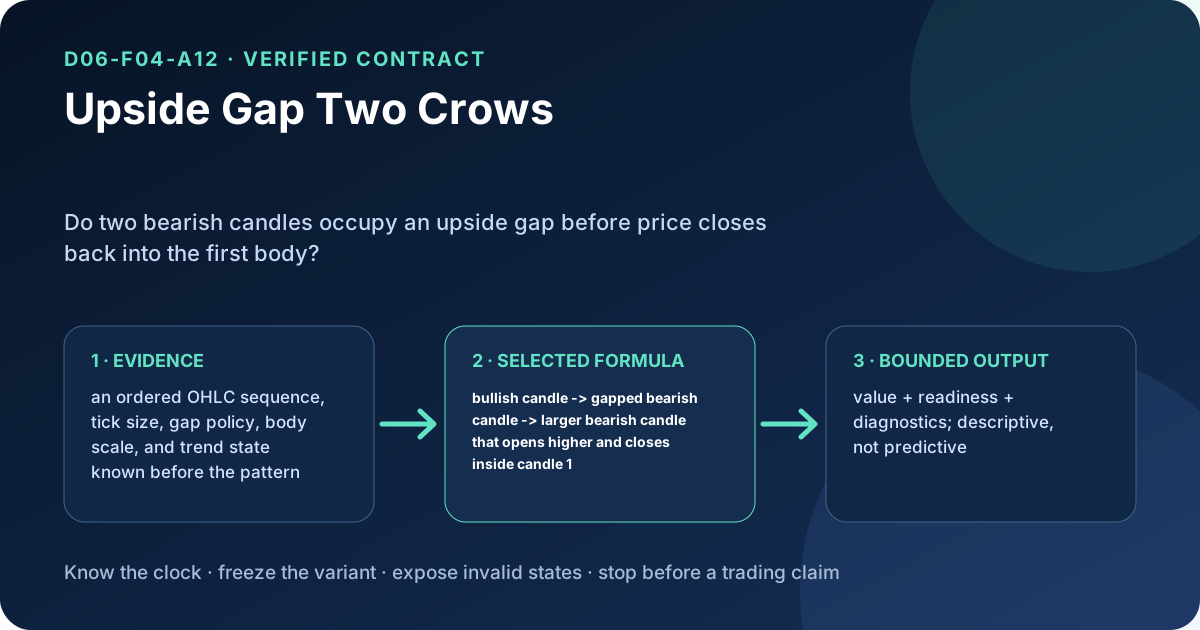
Hero takeaway: Scans three-bar windows for an up candle, a gapped-up down candle, and a second down candle that opens higher still yet closes back inside the first candle's body. Open the hero at full size.
<!-- LEVEL-2-HERO:END -->If you have ever placed Upside Gap Two Crows on a chart and wondered why another platform showed a different answer, the problem probably was not arithmetic. The quiet differences usually live in the input source, lookback, seed, warm-up, equality rule, session reset, or a vendor-specific convention hidden behind the same label.
This guide gives you an audit trail instead of a magic line. You will see exactly what the topic measures, which formula this package selects, how to walk a synthetic example, what to test, and where interpretation must stop. The practical question is: Do two bearish candles occupy an upside gap before price closes back into the first body?
The source lineage and maintained software context are recorded in TA-Lib pattern-recognition catalog, CME Group candlestick chart lesson, Japanese Candlestick Charting Techniques. Those sources establish vocabulary and implementation history; they do not prove that the indicator predicts returns or that every product should share one default.
What you will be able to do
By the end, you can:
- explain Upside Gap Two Crows in plain language before reaching for notation;
- validate an ordered OHLC sequence, tick size, gap policy, body scale, and trend state known before the pattern;
- reproduce the selected calculation or review someone else's implementation;
- distinguish
waiting,invalid,calculated, andinterpretedstates; - diagnose the most common cross-platform mismatches; and
- compare Upside Gap Two Crows with the closest star, continuation, or strike formation and a rejected sequence without calling one universally better.
You need only basic arithmetic and ordered time-series intuition. When OHLC is used,
O, H, L, and C mean open, high, low, and close for one completed observation.
No trading-strategy knowledge is required.
Start with the useful intuition
Upside Gap Two Crows is a lens applied to already observed data. Its job is to make one feature of the path easier to inspect. The output may describe geometry, relative location, smoothed direction, realized range, volume-weighted state, statistical position, or phase. It does not add information that was absent from the inputs.
That distinction matters. A mathematically correct output answers what the selected transformation says now. It does not answer whether the next price will rise, whether an order should be placed, or whether a result will survive costs. Those are separate questions requiring point-in-time data and an outcome study.
Before looking at the formula, inspect the contract map. Notice that validation and timing come first; interpretation comes last.
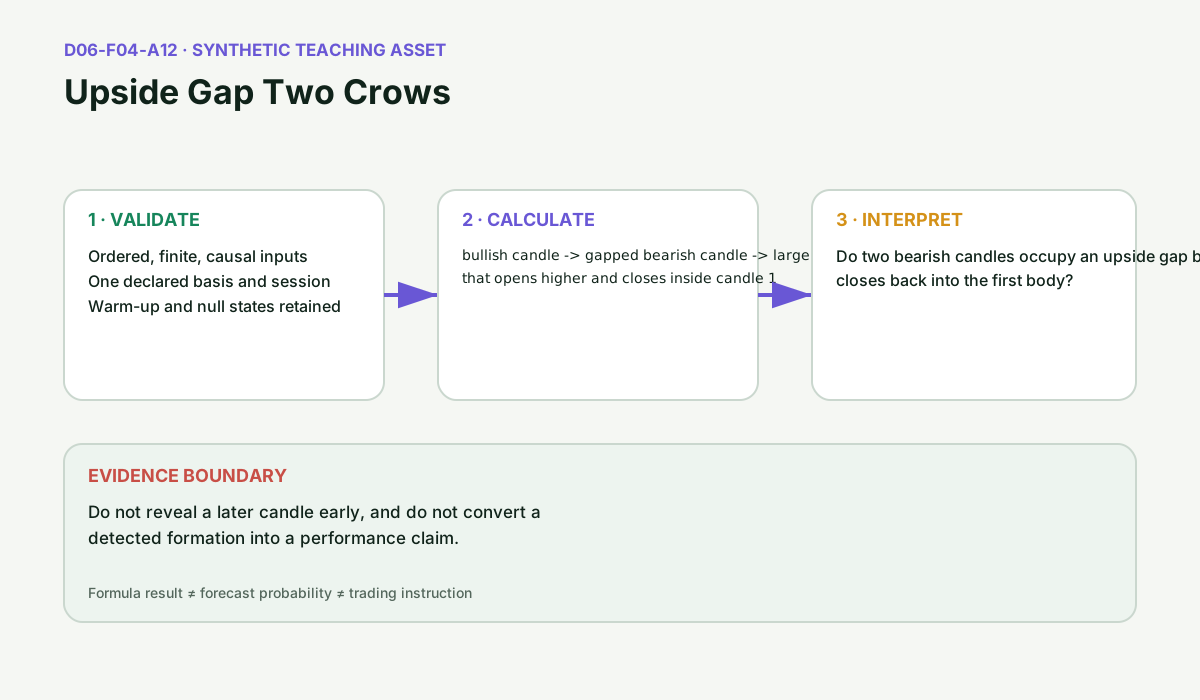
Open the concept map at full size.
Freeze the selected convention
Pattern and level names are not universal machine specifications. This package selects the formula below, prints its equality and timing rules, and treats other legitimate conventions as variants.
bullish candle -> gapped bearish candle -> larger bearish candle that opens higher and closes inside candle 1
Read every subscript as an observation index, not automatically a day. A window of
n=14 can mean 14 daily bars, 14 five-minute bars, or 14 eligible events; those are
different measurements. Calculate with full precision and round only for display.
Where a denominator can be zero, the correct output is an explicit undefined state unless the contract names another policy. Where recursion is present, publish the seed and warm-up. Where a pivot or session range must be confirmed, publish the first timestamp at which it was knowable. A later chart can look obvious while still being impossible to reproduce causally.
The data contract is part of the algorithm
Use an ordered OHLC sequence, tick size, gap policy, body scale, and trend state known before the pattern. The minimum production record should also preserve:
| Field | Why it matters | Safe policy |
|---|---|---|
| timestamp | Orders the evidence clock | timezone-aware, oldest to newest, unique after declared correction precedence |
| price fields | Supply the mathematical input | finite, same currency and adjustment basis |
| volume, when used | Supplies a weight or activity field | name unit, venue coverage, session, and zero/missing policy |
| parameters | Fix the selected variant | store with every output or model version |
| availability time | Prevents future leakage | compute only after required source fields are knowable |
| revision state | Makes replay deterministic | identify provisional, corrected, or final observations |
Reject NaN, infinity, mixed split-adjustment bases, unexplained duplicate timestamps, and out-of-order observations. Do not silently forward-fill prices across a closed market or treat missing volume as zero. Those choices change the meaning of the result.
<!-- LEVEL-1-VERIFICATION:START -->Level 1 verification contract
The short name is not the algorithm. For this package, the reproducible identity of Upside Gap Two Crows is the selected expression, the data basis, the clock, the parameter state, and the invalid-output policy taken together.
| Contract item | Frozen rule for this topic |
|---|---|
| canonical question | Do two bearish candles occupy an upside gap before price closes back into the first body? |
| selected expression | bullish candle -> gapped bearish candle -> larger bearish candle that opens higher and closes inside candle 1 |
| required evidence | an ordered OHLC sequence, tick size, gap policy, body scale, and trend state known before the pattern |
| output clock | The label becomes available only after the final candle in the selected pattern has closed; prior-trend context must use observations available before that close. |
| invalid states | non-finite, misordered, future-dated, basis-mixed, unsupported parameters, insufficient warm-up, or undefined denominator/state |
| interpretation boundary | Do not reveal a later candle early, and do not convert a detected formation into a performance claim. |
The displayed expression is the package's frozen publication convention. Names used by other platforms are not sufficient evidence of formula parity; compare coefficients, windows, equality rules, seeds, and output clocks.
This table separates four things that are often blurred together: cited lineage, the repository's explicit convention, synthetic example inputs, and the interpretation you draw from the result. Read the full definition contract, data contract, and verification fixture before implementing a variant.
<!-- LEVEL-1-VERIFICATION:END -->Calculate it step by step
- Declare the measurement. Name the source price or OHLC fields, interval, session, adjustment basis, parameters, seed, and equality rules.
- Validate before calculating. Check order, finiteness, duplicates, eligibility, and minimum history. A clean error is more informative than a plausible zero.
- Build intermediates causally. Rolling extrema, averages, ranges, pivots, returns, phase states, and volume sums may use only information available now.
- Apply the formula without display rounding. Keep numerator, denominator, weights, state, and boundary comparisons available for audit.
- Emit a structured result. Return the value plus
ready,state, window boundaries, parameters, and reason codes. - Interpret the measurement—not a story. Explain what changed in the input and intermediate state before attaching a market narrative.
A worked numerical example
Use four synthetic candles with closes 110, 106, 106.1, 109 and ranges [105,112], [103,110], [105,107], [105,111]. Compute each body interval first, then evaluate gaps and midpoint rules in sequence. The detector emits searching, candidate, or matched only after the required final candle closes.
Every number in that paragraph is a synthetic teaching input or an author-derived calculation. It was chosen because you can check it with a calculator. It is not a historical security, provider observation, or backtest.
The visual below makes the audit sequence explicit. Read from input contract to intermediate state, then to the selected boundary, and only then to output.
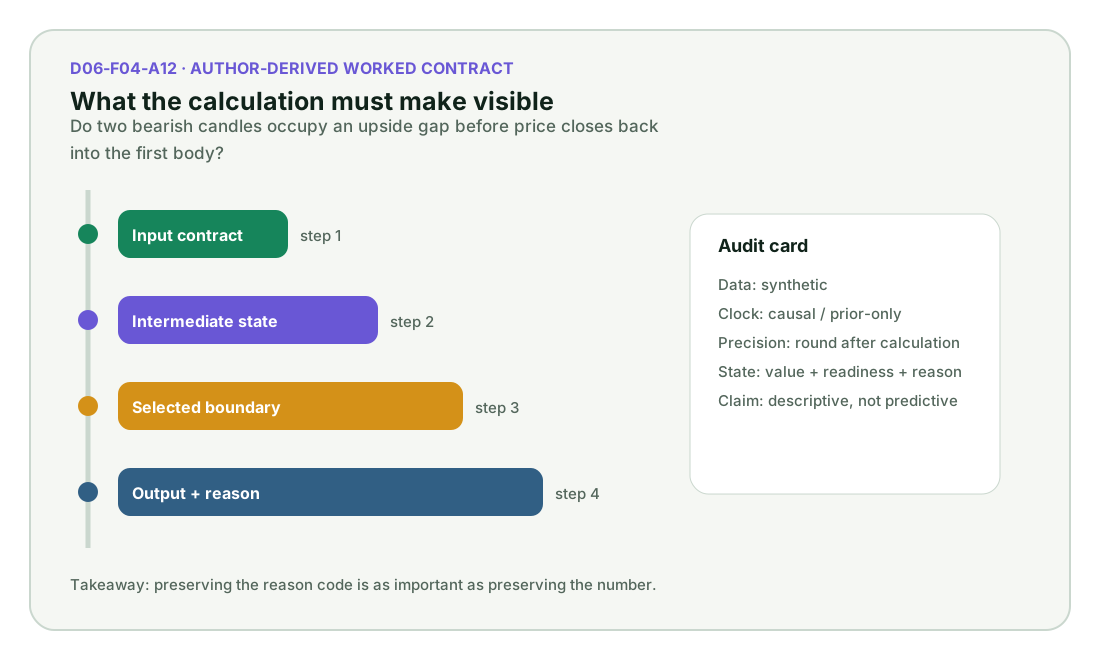
Open the worked-contract trace at full size.
Implementation blueprint
The most useful reference implementation returns diagnostics rather than one naked number. In language-neutral pseudocode:
function calculate(observations, parameters):
    contract = freeze_source_clock_basis_and_variant(parameters)
    rows = validate_sort_and_align(observations, contract)
    if rows are invalid:
        return { ready: false, state: "invalid", reason: exact_reason }
    if rows are shorter than the declared warm-up:
        return { ready: false, state: "waiting", reason: "insufficient_history" }

    intermediate = build_causal_state(rows, contract)
    if required denominator or state is undefined:
        return { ready: false, state: "undefined", diagnostics: intermediate }

    value = apply_selected_formula(intermediate, contract)
    return {
        ready: true,
        state: "calculated",
        value: value,
        parameters: contract.parameters,
        window_start: intermediate.window_start,
        window_end: intermediate.window_end,
        diagnostics: intermediate.audit_fields
    }
This package deliberately does not claim that such pseudocode is a finished Python or TypeScript implementation. A production implementation still needs independent expected values, boundary tests, shared fixtures, numerical tolerances, and parity checks in every delivered language.
Use the guided lab
Open the self-contained Upside Gap Two Crows guided lab. It begins in an informative canonical state and offers three scenarios:
- Canonical — enough valid synthetic evidence to calculate.
- Boundary — one warm-up or equality decision remains unresolved.
- Failure — invalid timing, ordering, basis, or numeric input is rejected.
Use Back and Step to expose one stage at a time. Change the declared window and notice that the lab resets dependent state. Play uses the same transition as Step; with reduced motion, Play advances exactly once. The chart is an evidence-readiness trace, not a simulated market return.
Tests that protect meaning
A strong test suite for Upside Gap Two Crows should cover more than a happy-path value:
| Test | What it protects |
|---|---|
| canonical synthetic fixture | formula, units, sign, and displayed example |
| one observation before warm-up | waiting remains distinct from zero |
| equality at every threshold | inclusive versus strict comparisons |
| zero denominator or zero range | defined null/error policy |
| NaN, infinity, duplicate, reverse order | validation before arithmetic |
| parameter minimum and maximum | rejected versus supported variants |
| split, roll, or session discontinuity | consistent basis and calendar |
| prefix replay | no later observation changes an earlier causal output |
| independent arithmetic | expected values do not call the implementation under test |
For recursive methods, also test the seed, restart behavior, long-history convergence, and a flat series. For rolling statistics, test ties and interpolation. For patterns, test one-tick boundary failures and prior-only context. For phase methods, test phase wrap, sampling regularity, and unstable-period handling.
Where implementations disagree
Two charts carrying the same title can differ for legitimate reasons:
- one uses close while another uses midpoint or typical price;
- one includes the current bar in an extremum while another uses prior-only history;
- one seeds from the first observation while another seeds from an initial average;
- one emits the earliest mathematical value while another removes an unstable period;
- one resets at an exchange session while another runs continuously;
- one treats equality as a match while another requires a strict crossing;
- one adjusts historical OHLC but not volume consistently; or
- the short label refers to materially different published formulas.
The cure is not to hunt for a universally correct screenshot. Compare contracts: source fields, coefficients, window boundaries, seed, warm-up, reset, equality, missing-data policy, and first valid index.
Compare nearby methods by the question they answer
The nearest comparison set is the closest star, continuation, or strike formation and a rejected sequence. Use this decision table:
| Decision | Choose Upside Gap Two Crows when… | Choose a nearby method when… |
|---|---|---|
| target feature | Do two bearish candles occupy an upside gap before price closes back into the first body? is the exact diagnostic | another method measures the feature you actually need |
| units | its raw or normalized scale is useful | cross-asset comparability needs another denominator |
| responsiveness | its selected window and smoothing fit the clock | you need a different lag/noise trade-off |
| auditability | you can publish inputs and intermediate state | a proprietary or opaque approximation cannot be validated |
| evidence | descriptive measurement is enough | a decision requires a separately validated forecast or causal model |
Neither column is automatically superior. The right method is the one whose contract matches the question and whose failure modes your system can monitor.
Practical use—and responsible limits
Use Upside Gap Two Crows as a feature, diagnostic, chart annotation, alert input, screening field, or quality-control measurement only after its availability clock is explicit. Store the parameters and reason codes beside the value so a later reviewer can reconstruct why the state changed.
Do not treat a threshold crossing as an order, a pattern match as confirmation, or a high/low oscillator reading as destiny. Do not reveal a later candle early, and do not convert a detected formation into a performance claim. If you want to claim association with future returns, design a point-in-time study with a frozen universe, survivorship and look-ahead controls, transaction costs, multiple-testing controls, out-of-sample evaluation, and uncertainty intervals.
Historical-example decision
Not useful for definition. A named episode would add story value but no stronger understanding of the deterministic calculation. The synthetic example is smaller, fully redistributable, and independently checkable. A later empirical companion can add real data only after identity, venue, session, adjustment basis, retrieval time, revision status, parameters, costs, biases, uncertainty, and licensing are frozen.
What to remember
- Upside Gap Two Crows asks: Do two bearish candles occupy an upside gap before price closes back into the first body?
- The selected formula is
bullish candle -> gapped bearish candle -> larger bearish candle that opens higher and closes inside candle 1. - Input source, clock, basis, seed, warm-up, window, and equality policy are part of the algorithm.
- Undefined and insufficient-history states must not be converted to zero.
- The worked values are synthetic and author-derived.
- Correct calculation does not establish prediction or profitability.
You can now audit Upside Gap Two Crows from source data to interpretation. Continue with Mat Hold and compare which assumption changes, while keeping Rising/Falling Three Methods nearby as the preceding family reference.
Primary and authoritative references
- TA-Lib pattern-recognition catalog — Maintained names and programmable pattern families; thresholds remain convention-dependent.
- CME Group candlestick chart lesson — Official exchange education for OHLC body and wick anatomy; it does not prove predictive power.
- Japanese Candlestick Charting Techniques — Authoritative practitioner reference for pattern vocabulary and context.
Choose Upside Gap Two Crows deliberately
The useful choice is not “which indicator is best?” It is “which contract answers my question with the fewest hidden choices?” Use this decision table before adding the method to a chart, feature pipeline, or research notebook.
| Choice | Use it when | Verify before accepting output |
|---|---|---|
| Upside Gap Two Crows | You need the exact question and convention printed in this package. | Validate readiness, diagnostics, and the topic-specific failure state. |
| Simpler baseline | You first need an unambiguous reference from the closest star, continuation, or strike formation and a rejected sequence. | Prefer interpretability; record the same source, basis, clock, and window. |
| Nearby alternative | Your actual question differs in smoothing, normalization, geometry, or state semantics. | Freeze its contract separately; never swap formulas under one label. |
| No output | Inputs are missing, non-finite, misordered, basis-mixed, future-dated, or still warming up. | Return waiting, invalid, or undefined with a reason—not zero. |
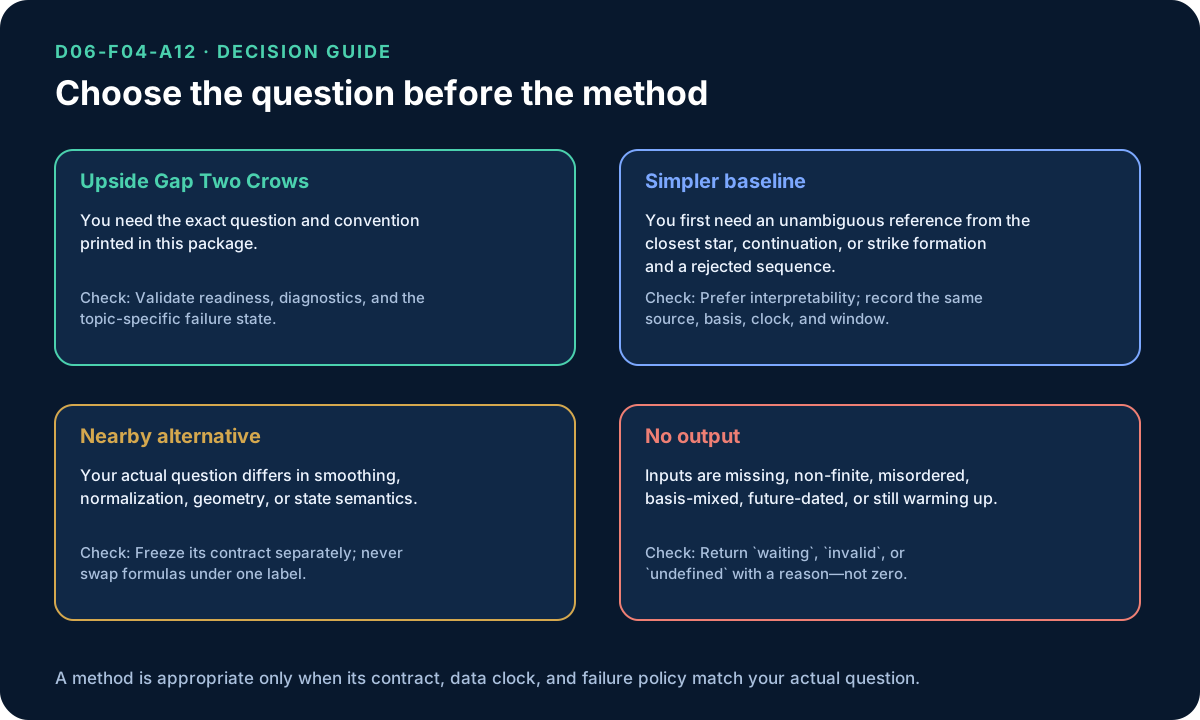
Decision takeaway: choose the selected method only when its exact measurement question matches yours. Otherwise prefer the simpler baseline, freeze a different variant, or withhold output. Open the decision guide at full size.
Learning path and related topics
- Prepare with:
D06-F04-A11. Confirm you understand the family's input basis and availability clock first. - Compare with:
D06-F04-A08,D06-F04-A09. Compare questions, not screenshots; nearby titles may use different windows, normalization, seeds, or state definitions. - Continue to:
D06-F04-A13. Carry forwardready,available_at, parameters, and diagnostics instead of forwarding a naked number. - Implementation boundary: this is a complete implementation package with Python and TypeScript entry points, topic-owned fixtures, and parity checks. The pseudocode remains a teaching blueprint for the shipped contract.
The relationship IDs are stored in metadata.yaml so the visitor layer can resolve stable cards when these article-only topics later clear the complete-package publishing gate.
Executable reference package
This topic now includes a causal reference calculation, a 96-observation synthetic multi-regime fixture, a flat/zero-volume boundary fixture, Python tests, and a Node/TypeScript API parity test. Synthetic observations are teaching data, not issuer history or evidence of predictive value. Run python tests/test_reference.py and node --experimental-strip-types tests/reference.test.ts from this topic directory.
Rendered from the canonical Mermaid sources linked by this article.
Upside Gap Two Crows calculation flow
Purpose: keep validation, timing, calculation, and interpretation separate.
Takeaway: an output is publishable only when its input clock and selected convention are visible.
Upside Gap Two Crows readiness and evidence states
Takeaway: waiting, rejected, and calculated are different states; a system should not coerce them into zero.
ReferencesPrimary sources and evidence notesExpand the source trail, evidence role, and limitations behind the engineering choices.
Expand the source trail, evidence role, and limitations behind the engineering choices.
S1 — TA-Lib pattern-recognition catalog
- Organization or authors: TA-Lib project contributors
- Source type: Maintained library documentation
- Publication/effective date: Undated living documentation
- Version/accessed: accessed 2026-08-11
- URL: TA-Lib pattern-recognition catalog
- Jurisdiction/applicability: technical education and reproducible software convention
- Supports: maintained pattern naming and the programmable pattern family that includes Upside Gap Two Crows
- Limitations: Maintained names and programmable pattern families; thresholds remain convention-dependent.
S2 — CME Group candlestick chart lesson
- Organization or authors: CME Group
- Source type: Official exchange education material
- Publication/effective date: Undated living course page
- Version/accessed: accessed 2026-08-11
- URL: CME Group candlestick chart lesson
- Jurisdiction/applicability: technical education and reproducible software convention
- Supports: exchange-published OHLC body and wick anatomy used to define Upside Gap Two Crows
- Limitations: Official exchange education for OHLC body and wick anatomy; it does not prove predictive power.
S3 — Japanese Candlestick Charting Techniques
- Organization or authors: Steve Nison
- Source type: Original practitioner work
- Publication/effective date: Second edition, Prentice Hall Press, 1 November 2001
- Version/accessed: accessed 2026-08-11
- URL: Japanese Candlestick Charting Techniques
- Jurisdiction/applicability: technical education and reproducible software convention
- Supports: the practitioner vocabulary and contextual reading of Upside Gap Two Crows
- Limitations: Authoritative practitioner reference for pattern vocabulary and context.
Evidence decision
The package uses synthetic teaching inputs and author-derived arithmetic. A named security example is not useful for defining Upside Gap Two Crows because it would add market story without improving the deterministic contract. A later empirical article would need licensed point-in-time data, instrument and venue identity, session and adjustment basis, retrieval time, corrections, parameter version, costs, bias controls, uncertainty, and redistribution permission.
<!-- LEVEL-1-EVIDENCE:START -->Level 1 evidence map
| Claim class | Support | Publication boundary |
|---|---|---|
| lineage and maintained terminology | S1–S3 above | source naming does not establish universal formula parity |
| selected mathematical convention | research/DEFINITION-CONTRACT.md | explicit repository choice unless an exact primary formula source is named |
| numerical teaching values | article worked example | synthetic inputs and author-derived arithmetic, not provider facts |
| causal and invalid-state policy | data-contract/CONTRACT.md | safety and reproducibility policy, not a performance claim |
| historical case | not-useful-for-definition | requires a separately evidenced point-in-time study before publication |
Reviewed 2026-08-11. No current market fact, named security result, forecast, or profitability claim is made.
<!-- LEVEL-1-EVIDENCE:END -->Full dependency-light reference implementations in both supported languages.
/** Dependency-free native TypeScript entry point for D06-F04-A12: Upside Gap Two Crows. */
import { upsideGapTwoCrows as nativeUpsideGapTwoCrows, type TopicInput, type TopicResult } from "../../../../../../shared/missing_152/typescript/referenceRuntime.ts";

export const TOPIC_ID = "D06-F04-A12";
export const TITLE = "Upside Gap Two Crows";

export function upsideGapTwoCrows(input: TopicInput): TopicResult {
  return nativeUpsideGapTwoCrows(input);
}
The embedded lab now expands to its full document height, keeping the article as the only scroll surface.