
 By Islam Baraka
Build a reproducible mid-cycle sensitivity whose window, medians, current cycle position, and nonpositive-EBITDA state are fully exposed.
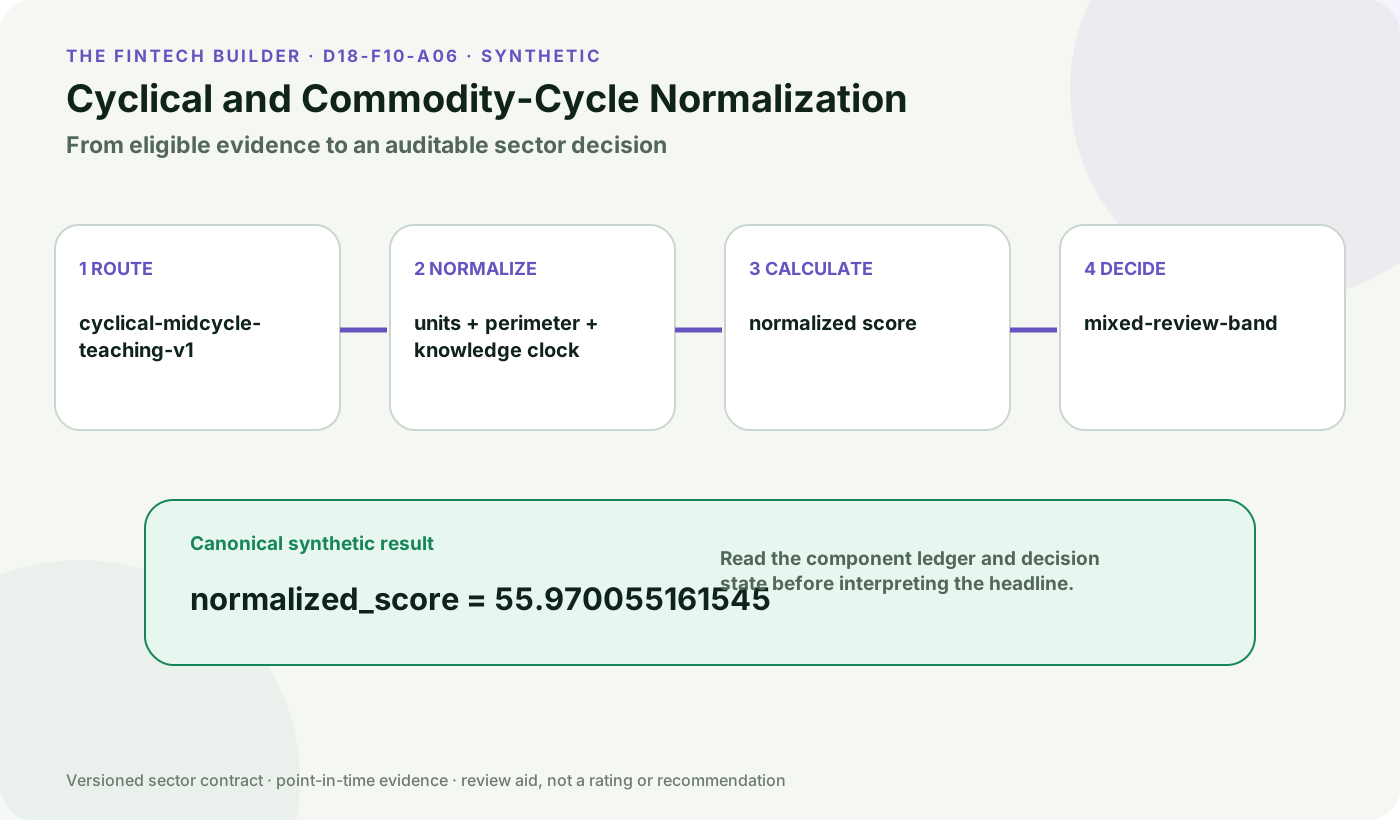
The decision this tutorial makes visible
Spot earnings can make a cyclical producer look strongest near a peak and weakest near a trough; normalization separates current conditions from a declared cycle reference.
The precise question is: How can price, unit cost, volume, cash consistency, and leverage be normalized across a declared cycle window without smuggling in hindsight?
A practitioner needs to know what the diagnostic does and does not justify. A builder needs a contract that can be reproduced from the same point-in-time inputs in Python, TypeScript, a visual, and a browser lab.
Intuition before notation
Replace one volatile snapshot with a disclosed mid-cycle yardstick, then keep today's price percentile visible so normalization cannot disguise where the firm sits in the cycle.
The result depends on the declared algorithm scope, input clocks, units, equality and rounding policies, and unsupported-state treatment. Change one of those and the output represents a different decision even when its field name is unchanged.
Scope and nearby methods
This contract uses equal-length histories of at least seven observations available at the cutoff. It takes point-in-time medians of price, cost, and volume, subtracts declared fixed costs, and never calls the result a universal through-cycle forecast.
| Variant | Definition | Best use | Main limitation |
|---|---|---|---|
| Selected point-in-time medians | Median price, cost and volume | Robust teaching normalization | Can miss structural breaks |
| Regulatory price average | Rule-defined historical average | Specific reserve reporting | Not a universal equity normalization |
| Scenario distribution | Probability-weighted regimes | Risk and valuation work | More assumptions and model risk |
What is sourced, selected, synthetic, and derived
| Role | Material claim | Evidence | Boundary |
|---|---|---|---|
| sourced fact | Some regulatory contexts use historical price averaging to damp short-term volatility. | SEC oil-and-gas guide | That rule is not this universal mid-cycle price. |
| sourced caution | Forecast and non-GAAP definitions require consistent assumptions and reconciliation. | IAS 36 and SEC C&DIs | Neither source endorses this score. |
| package choice | Medians, bands, and the selected window define the teaching normalization. | Repository contract | They require empirical governance in production. |
| synthetic input | The nine-period histories are fabricated. | canonical-input.json | They do not reproduce EIA data. |
The authoritative sources support only the exact facts named in the claim ledger. They do not certify the synthetic numbers in this tutorial. The repository fixture is deliberately invented for auditability, and the displayed output is author-derived under the selected implementation choice.
Formula, symbols, and numerical policy
EBITDA* = (median price − median unit cost) × median volume − fixed costs; leverage* = net debt / EBITDA* when EBITDA*>0.
Those two lines produce the normalized bridge, but they are not the headline. The
published normalized_score is a weighted average of four component scores, each of
which is a declared linear band clamped to [0, 100]. All four thresholds are fixed
in the package; none of them is a caller parameter.
| Component | Raw input | Band | Score 0 at | Score 100 at |
|---|---|---|---|---|
normalized_margin | E* / R*, where R* = P* × V* | higher-is-better | margin ≤ 0.00 | margin ≥ 0.30 |
normalized_leverage | net debt / E* | lower-is-better | leverage ≥ 4.0 | leverage ≤ 0.5 |
cash_consistency | share of history periods with free cash flow > 0 | higher-is-better | ratio ≤ 0.30 | ratio ≥ 0.90 |
cycle_balance | share of history prices at or below today's realized price | centered on 0.50 | |percentile − 0.50| ≥ 0.50 | |percentile − 0.50| ≤ 0.10 |
Written out, with every result clamped to [0, 100]:
margin_score    = 100 * (margin - 0.00) / (0.30 - 0.00)
leverage_score  = 100 * (4.0 - leverage) / (4.0 - 0.5)
cash_score      = 100 * (fcf_ratio - 0.30) / (0.90 - 0.30)
balance_score   = 100 * (0.50 - |percentile - 0.50|) / (0.50 - 0.10)
normalized_score = sum(component * weight)
Two conditional rules complete the contract. When E* is zero or negative the
leverage ratio is undefined, the package reports normalized_net_leverage as null
and scores the leverage component 0, so the headline still resolves to a number;
state becomes nonpositive-midcycle-ebitda-review to mark it. Otherwise state
is a band on the headline itself: strong-review-band at 75 or above,
mixed-review-band at 50 or above, weak-review-band below 50.
The four weights are caller-supplied and required. They must name exactly these four
components, be nonnegative, and sum to 1 within 1e-9; anything else is rejected
rather than renormalized.
| Symbol | Meaning | Unit | Policy |
|---|---|---|---|
| P* | median realized price | currency/unit | Window known at cutoff |
| C* | median unit cost | currency/unit | Same window and basis |
| V* | median volume | units | Same operational scope |
| E* | normalized EBITDA | currency | Package construct, not reported EBITDA |
- Use IEEE-754 binary64 arithmetic without intermediate rounding.
- Treat percentages as decimal fractions and label percentage-point changes explicitly.
- Clamp only declared component transforms to [0,100]; never clamp raw regulatory or accounting inputs silently.
- Round only for presentation after the full component, penalty, and coverage ledger is stored.
Read the formula in the same order as the algorithm. Validate identity, ordering, units, and supported state first. Apply the selected equality and window rules second. Calculate with unrounded numeric values. Round only at the declared presentation boundary, and preserve null as a diagnostic rather than coercing it to zero.
Build the algorithm
- Freeze the cutoff, business perimeter, commodity unit, and cycle window.
- Validate equal histories and exclude every unavailable observation.
- Take medians of price, unit cost, and volume and calculate normalized EBITDA.
- Compute normalized margin, conditional leverage, cash consistency, and current price percentile.
- Publish the score beside the window, current-cycle position, and structural-break caveat.
Production-minded operational checklist
- Resolve sector and framework before calculating.
- Freeze scoring and knowledge-cutoff timestamps.
- Reconcile each input to its filing, regulator, provider, and reporting perimeter.
- Inspect component scores, penalties, and coverage before the headline.
- Retain abstention and unsupported-scope reasons for the integrated router.
The checklist is intentionally strict: an explicit rejection is safer than a plausible output built from stale, malformed, or unsupported state.
Worked synthetic example
The canonical fixture is synthetic teaching data, not an observed control
event, customer order, or broker execution. Its primary author-derived output,
normalized_score, is 55.97005516154452, which the stored fixture records
rounded to twelve decimals as 55.970055161545. The complete input and output
are in datasets/canonical-input.json and datasets/expected-output.json.
The canonical record uses nine synthetic periods. Median price, cost, and volume
form the normalized operating bridge; positive-FCF frequency and current price
percentile add evidence the midpoint alone cannot show. Every step below is
reproducible with a calculator from datasets/canonical-input.json.
Normalized bridge. The nine prices sort to a median P* of 72.0, the nine unit
costs to a C* of 45.0, and the nine volumes to a V* of 9.4. So
R* = 72.0 × 9.4 = 676.8 and E* = (72.0 − 45.0) × 9.4 − 105.0 = 148.8.
Raw component inputs. Margin is 148.8 / 676.8 = 0.21985815602836878. Leverage
is 690.0 / 148.8 = 4.637096774193548. Seven of the nine free-cash-flow periods are
positive, so the ratio is 7 / 9 = 0.7777777777777778. Six of the nine history
prices are at or below the current realized price of 74.0, so the percentile is
6 / 9 = 0.6666666666666666.
Band transforms.
| Component | Raw value | Band arithmetic | Score |
|---|---|---|---|
normalized_margin | 0.21985815602836878 | 100 × 0.21985815602836878 / 0.30 | 73.28605200945627 |
normalized_leverage | 4.637096774193548 | 100 × (4.0 − 4.637096774193548) / 3.5 = −18.20, clamped | 0.0 |
cash_consistency | 0.7777777777777778 | 100 × (0.7777777777777778 − 0.30) / 0.60 | 79.62962962962962 |
cycle_balance | 0.6666666666666666 | 100 × (0.50 − 0.16666666666666663) / 0.40 | 83.33333333333333 |
Headline. Weight and add:
0.32 * 73.28605200945627 = 23.451536643026007
0.28 *  0.0              =  0.0
0.22 * 79.62962962962962 = 17.518518518518515
0.18 * 83.33333333333333 = 14.999999999999998
                    total = 55.97005516154452
The leverage row is the one to notice. At 4.64 the firm is past the 4.0 weak
threshold, so the raw band arithmetic returns a negative number and the clamp pins
the component at 0. Twenty-eight percent of the headline is therefore contributing
nothing, and the remaining three components carry a score of 55.97 into the
mixed-review-band. A reader who saw only the headline would not know that.
Counterfactual checkpoint
Move current price toward the cycle extreme.
Hold the historical window fixed and raise current_realized_price from 74.0 to
the window maximum of 91.0. Every history median is unchanged, so P*, C*,
V*, E*, margin, and leverage all hold their canonical values and their component
scores do not move. Only the percentile changes: all nine history prices are now at
or below the current price, so it reaches 1.0, the distance from the 0.50 centre
reaches 0.50, and cycle_balance clamps to 0.0. The headline falls by the full
weighted contribution of that component, 0.18 × 83.33333333333333, from
55.97005516154452 to 40.97005516154452, and state moves from
mixed-review-band to weak-review-band.
The structured result retains state and diagnostics in addition to the primary number. That makes the calculation independently reviewable and prevents a partial, null, rejected, or venue-bounded outcome from being mistaken for an unqualified value.
Boundary and counterexample workbook
The playground computes every scenario at 61 deterministic parameter states.
The table uses the declared focus step and states whether that focus reproduces
the canonical fixture. The full state ledger and compressed transition
segments are in datasets/scenario-results.json.
| Scenario | Review focus | Purpose | State | Primary output | Diagnostic | Decision segments |
|---|---|---|---|---|---|---|
| Canonical driver sweep | Step 30 · canonical fixture | Move one primary causal driver through the canonical midpoint. | mixed-review-band | normalized score 56.0 | mixed-review-band · point-in-time-median-cycle-window | 3 |
| Adverse operating stress | Step 30 · comparison focus | Apply a controlled operating or earnings stress while retaining the framework. | mixed-review-band | normalized score 51.0 | mixed-review-band · point-in-time-median-cycle-window | 2 |
| Balance-sheet resilience | Step 30 · comparison focus | Vary a funding, leverage, capital, or liquidity channel. | mixed-review-band | normalized score 56.0 | mixed-review-band · point-in-time-median-cycle-window | 1 |
| Boundary crossing | Step 30 · comparison focus | Cross a declared review boundary and inspect equality behavior. | weak-review-band | normalized score 47.3 | weak-review-band · point-in-time-median-cycle-window | 3 |
| Evidence-quality stress | Step 30 · canonical fixture | Change evidence usability or freshness without hiding the diagnostic. | mixed-review-band | normalized score 56.0 | mixed-review-band · point-in-time-median-cycle-window | 2 |
| Concentration or mix | Step 30 · canonical fixture | Vary concentration, mix, or component balance. | mixed-review-band | normalized score 56.0 | mixed-review-band · point-in-time-median-cycle-window | 1 |
| Recovery path | Step 30 · comparison focus | Trace a recovery from an adverse state toward a resilient state. | weak-review-band | normalized score 47.5 | weak-review-band · point-in-time-median-cycle-window | 3 |
These rows are not backtest observations. They are controlled counterexamples that expose how one driver changes the state, output, or reason code while the rest of the contract stays fixed.
Visualize the boundary

Open this SVG at full size, or use the guided playground to compare the seven topic-specific canonical, boundary, policy, and failure scenarios.
The Mermaid flow answers where the selected calculation sits in the processing sequence. The SVG keeps the formula, output, decision boundary, and invariant visible together. The lab lets the reader step through the same structured states without changing the underlying definition.
Implementation walkthrough
The Python and TypeScript references begin with the same validation contract, reject malformed and unsupported state before calculation, preserve declared ordering and rounding policies, and return structured diagnostics rather than one context-free number.
The main implementation branches are:
- Normalized EBITDA is nonpositive — Emit nonpositive-midcycle-ebitda-review and null leverage, because Debt/negative EBITDA is not an interpretable multiple.
- History contains future observations at the cutoff — Reject and rebuild the window, because Hindsight would overstate reproducibility.
- Structural break changes cost or asset base — Version or reroute the model, because An old median may no longer represent the business.
Neither reference silently fetches data, mutates caller-owned inputs outside the declared engine behavior, guesses hidden state, or substitutes a provider default. Shared JSON fixtures make value, null, state, and reason-code drift visible across languages.
Testing and validation
Definition tests compare every canonical field, reject malformed state, and exercise the material boundary. Family validation recomputes every playground state from the reference function. Independent arithmetic is recorded beside the fixture rather than inferred only from implementation output.
The audit must preserve these invariants:
- framework and policy version
- point-in-time normalized input ledger
- component transform thresholds and scores
- weight vector and penalties
- coverage, state, reason, and final output
Passing the suite proves the selected package contract and Python/TypeScript parity; it does not prove empirical usefulness for a live issuer universe.
Failure modes and misuse
- The 0-100 teaching bands and default weights are package choices, not regulations, ratings, or market standards.
- Definition fidelity and code parity do not establish predictive validity, calibration, causality, fair value, or investment performance.
- Accounting frameworks, prudential regimes, business mixes, and reporting perimeters can make apparently identical ratios incomparable.
- A complete component ledger can still omit material qualitative, governance, legal, catastrophe, operational, or market risks.
Debugging order
When a result looks surprising, inspect the state in this order:
- Confirm framework and reporting perimeter
- Check units and knowledge dates
- Recalculate raw intermediates
- Inspect bounded component transforms
- Reconcile weights, penalties, coverage, and state
Evidence and historical boundary
Historical decision: not useful. A named Cyclical and Commodity-Cycle Normalization case would introduce issuer identity, filing and regulator scope, restatement, data-license, and scoring-policy questions without teaching the deterministic mechanism better than a controlled synthetic record.
The primary sources are SEC oil and gas guide, IAS 36, EIA spot prices, SEC non-GAAP C&DIs. They support the source roles listed in the research ledger, not a redistributable historical observation, a private participant decision, production conformance certification, execution-quality result, profitability claim, or prediction claim.
Summary and next topic
You can now compute and audit Cyclical and Commodity-Cycle Normalization before passing its versioned output to the integrated scoring router. The learning flow is: Early-Stage Liquidity and Runway Score → Cyclical and Commodity-Cycle Normalization → Holding-Company Look-Through Score. Carry the result forward only with its scope, clock, state, and evidence label.
Verified model contract — Level 1
- Selected calculation:
EBITDA* = (median price − median unit cost) × median volume − fixed costs; leverage* = net debt / EBITDA* when EBITDA*>0. - Reproducibility boundary: the canonical fixture is synthetic; the stored input, intermediate ledger, output, and cross-language implementations define the executable example.
- Interpretation ceiling: Definition fidelity and code parity do not establish predictive validity, calibration, causality, fair value, or investment performance.
Level 2 learning layer
How to choose this model or a nearby method
| Method | Best use | Assumption that must hold | Main limitation |
|---|---|---|---|
| Selected point-in-time medians | Robust teaching normalization | Window represents relevant cycle | Can miss structural breaks |
| Regulatory price average | Specific reserve reporting | Applicable rule and product | Not a universal equity normalization |
| Scenario distribution | Risk and valuation work | Probabilities are defensible | More assumptions and model risk |
The selected package is appropriate only when its framework tag, reporting perimeter, unit policy, and point-in-time evidence contract are all satisfied. If a stop condition in the topic decision matrix fires, use the named review, reroute, or abstention state instead of forcing a score.
Compact glossary
| Symbol | Meaning | Unit | Policy |
|---|---|---|---|
P* | median realized price | currency/unit | Window known at cutoff |
C* | median unit cost | currency/unit | Same window and basis |
V* | median volume | units | Same operational scope |
E* | normalized EBITDA | currency | Package construct, not reported EBITDA |
Visual asset map
| Asset | Learning job | Status |
|---|---|---|
| Article hero | See route → normalize → calculate → decide at a glance | Ready |
| System map | Connect formula, boundary, invariant, counterfactual, and output | Ready |
| Model anatomy | Follow the four-stage calculation pipeline | Ready |
| Component ledger | Reconstruct the headline from named dimensions | Ready |
| Decision boundary | Separate a computable result from a permissible interpretation | Ready |
| Evidence clock | Prevent point-in-time leakage | Ready |
| Mermaid flow | Inspect the text-native algorithm flow | Ready |
| Guided playground | Predict, reveal, sweep 427 calculations, and explain state changes | Ready |
Related concepts and continuation
- Previous family topic: D18-F10-A05
- Next family topic: D18-F10-A07
- Weight governance: D18-F10-A08
- Coverage and abstention: D18-F10-A09
Deep visual atlas
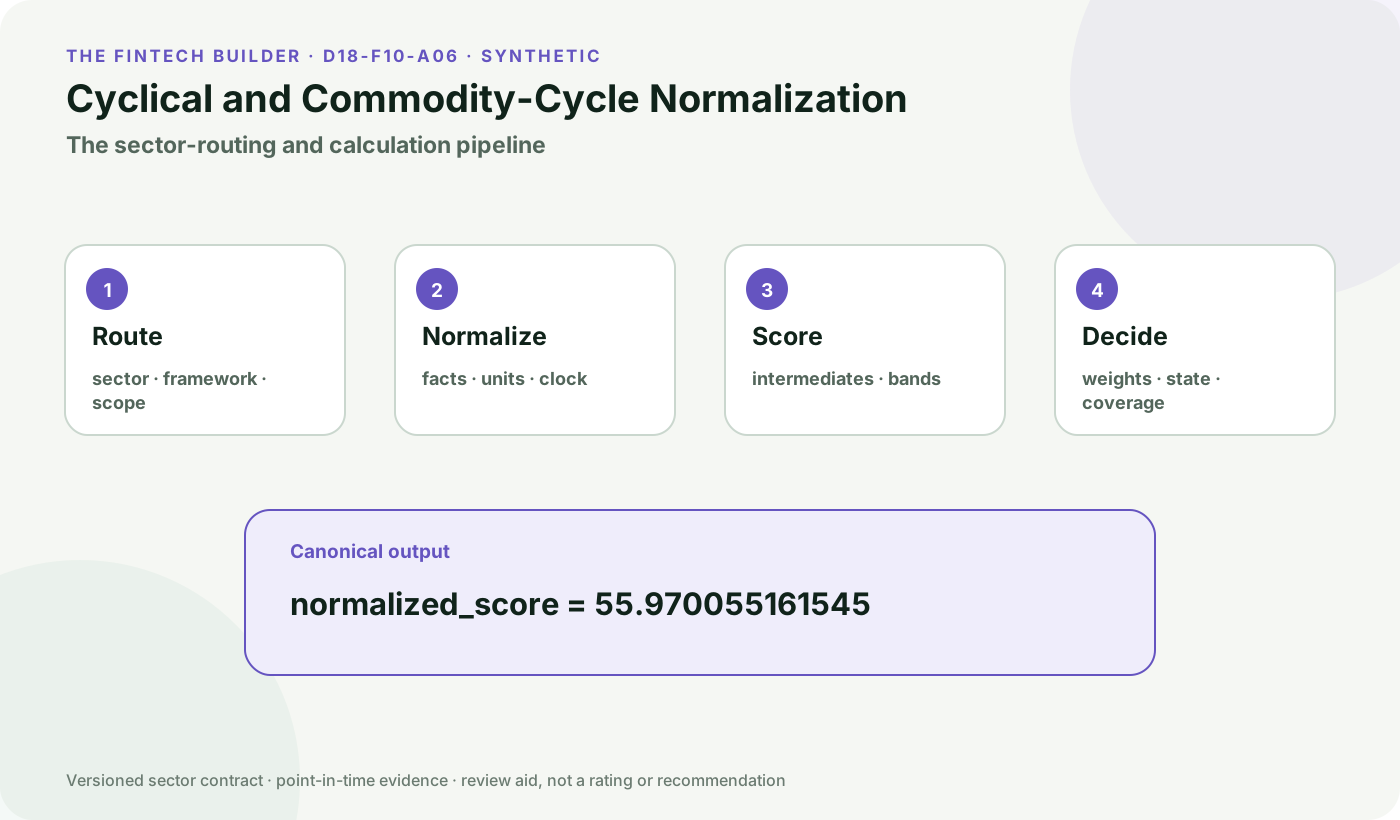
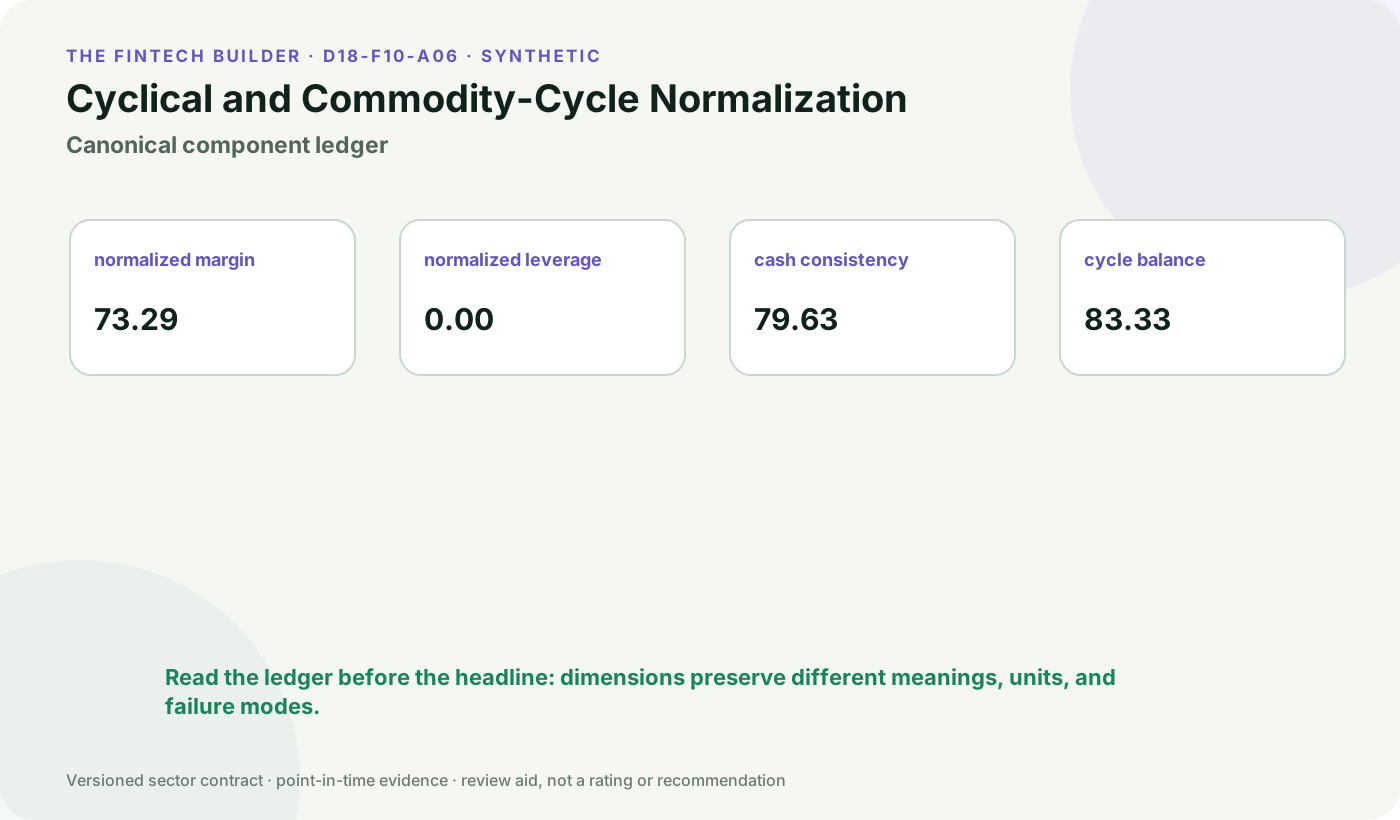
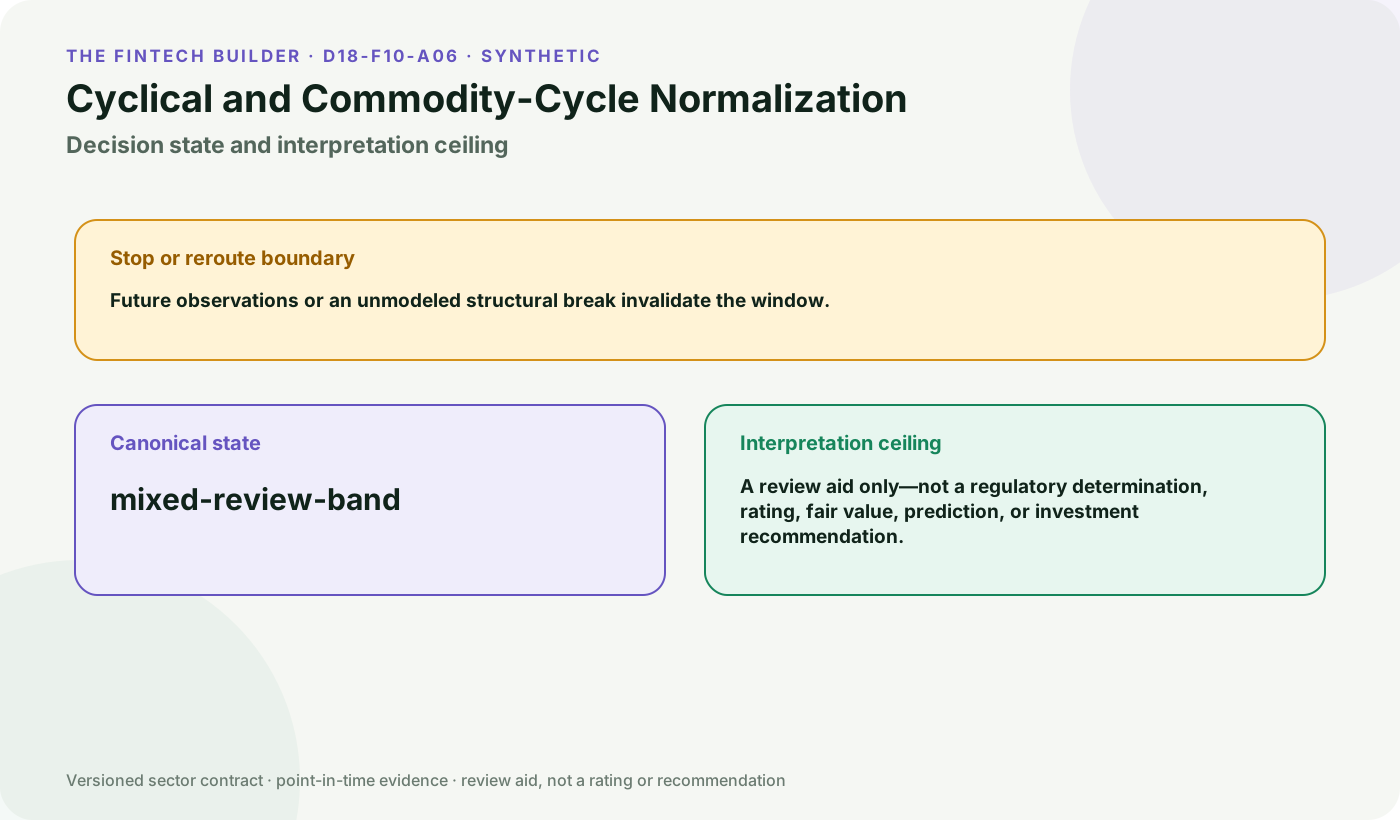
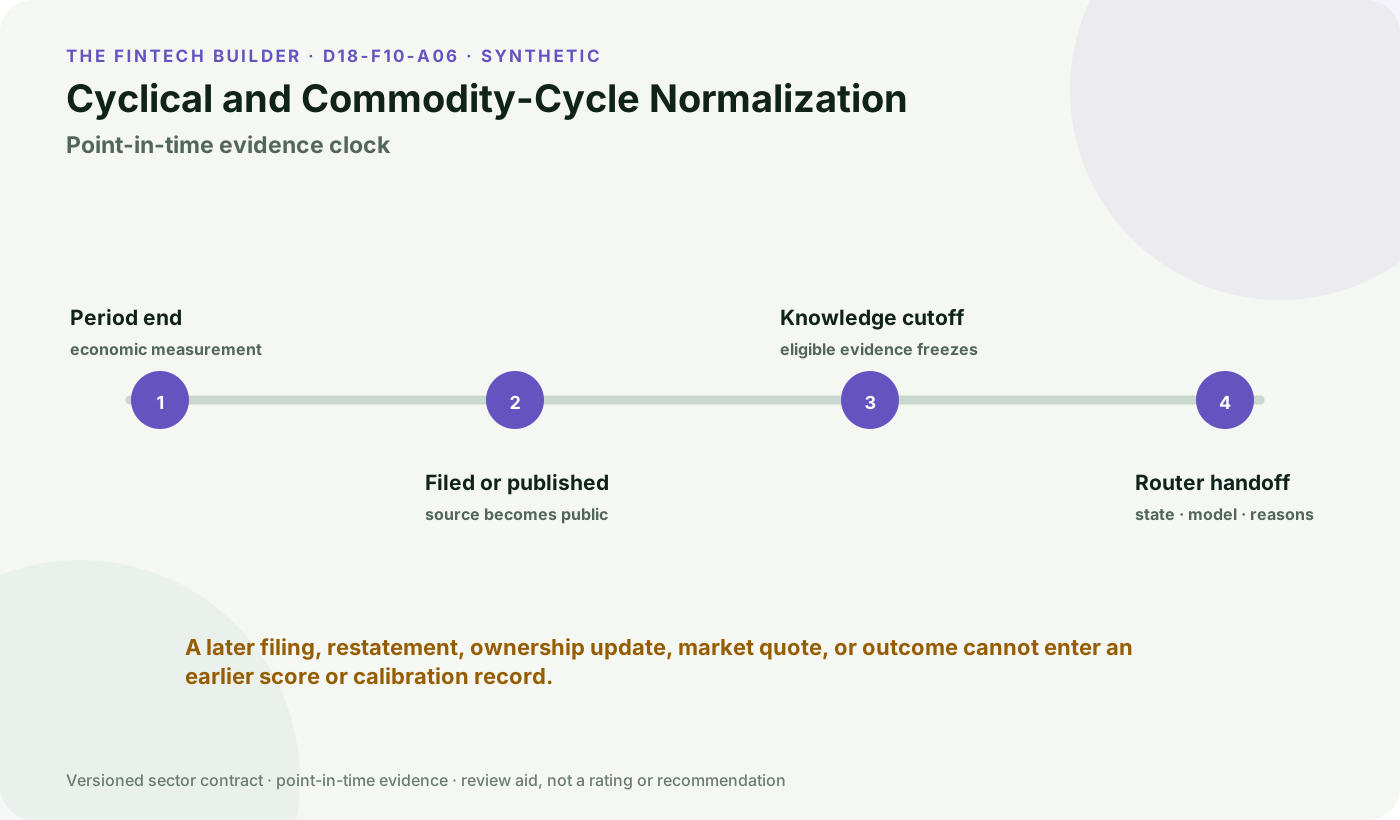
The teaching sequence is route → normalize → calculate → decide. Use the component ledger to reconstruct the headline, the boundary map to stop unsupported interpretation, and the evidence clock to block hindsight.
Guided playground protocol
- Orient: identify the framework, active driver, and invariant.
- Predict: commit to decrease, stay flat, or increase before revealing the adjacent numeric result.
- Experiment: sweep all 61 computed states in each of seven scenarios and inspect discontinuities.
- Explain: reconcile
median price-cost-volume bridge and current price percentileto the headline and apply this boundary: Future observations or an unmodeled structural break invalidate the window.
Rendered from the canonical Mermaid sources linked by this article.
Cyclical and Commodity-Cycle Normalization calculation flow
This flow identifies the selected calculation stages and the structured output.
Takeaway: Normalization is credible only when the frozen window and today's cycle position are both visible.
ReferencesPrimary sources and evidence notesExpand the source trail, evidence role, and limitations behind the engineering choices.
Expand the source trail, evidence role, and limitations behind the engineering choices.
S1 — Oil and Gas Reporting Modernization — Small Entity Compliance Guide
- Organization or authors: U.S. Securities and Exchange Commission
- Source type: Official regulatory guide
- Publication or effective date: Updated 2024; accessed 2026-08-08
- Version: Current web version
- URL or DOI: https://www.sec.gov/rules-regulations/oil-gas-reporting-modernization-small-entity-compliance-guide
- Accessed: 2026-08-09
- Jurisdiction: U.S. oil and gas reporting
- Supports: A 12-month average price is used in specified reserve calculations to reduce seasonality and short-term volatility.
- Limitations: That regulatory average is not a universal mid-cycle valuation price.
S2 — IAS 36 Impairment of Assets
- Organization or authors: International Accounting Standards Board
- Source type: Official accounting standard overview
- Publication or effective date: Accessed 2026-08-08
- Version: Current standard page
- URL or DOI: https://www.ifrs.org/issued-standards/list-of-standards/ias-36-impairment-of-assets/
- Accessed: 2026-08-09
- Jurisdiction: IFRS
- Supports: Value-in-use uses expected cash flows from assets in their current condition and a consistent discount rate.
- Limitations: The standard does not define this package's median cycle window or equity score.
S3 — Spot Prices for Crude Oil and Petroleum Products
- Organization or authors: U.S. Energy Information Administration
- Source type: Official public dataset
- Publication or effective date: Accessed 2026-08-08
- Version: Current historical series
- URL or DOI: https://www.eia.gov/dnav/pet/pet_pri_spt_s1_m.htm
- Accessed: 2026-08-09
- Jurisdiction: U.S. public energy statistics
- Supports: EIA publishes documented historical spot-price series and aggregation notes.
- Limitations: The package fixture is synthetic and does not redistribute or derive from the current EIA series.
S4 — Non-GAAP Financial Measures Compliance and Disclosure Interpretations
- Organization or authors: U.S. Securities and Exchange Commission
- Source type: Official staff guidance
- Publication or effective date: Updated 2022; accessed 2026-08-08
- Version: Current web version
- URL or DOI: https://www.sec.gov/rules-regulations/staff-guidance/corporation-finance-interpretations/non-gaap-financial-measures
- Accessed: 2026-08-09
- Jurisdiction: United States SEC reporting
- Supports: Adjusted measures can be misleading when definitions, recurring adjustments, prominence, or reconciliation are inadequate.
- Limitations: Does not standardize analyst AFFO, utility FFO, or normalized commodity earnings.
Evidence boundary
Sources define sector measures, disclosure regimes, and methodological cautions. They do not endorse the repository's synthetic fixtures, weights, score bands, or investment use.
Full dependency-light reference implementations in both supported languages.
/** Deterministic TypeScript reference for D18-F10 sector-specific scoring. */

export type RecordValue = Record<string, any>;

const numberValue = (data: RecordValue, name: string): number => {
  const value = data[name];
  if (typeof value !== "number" || !Number.isFinite(value)) throw new TypeError(`${name} must be a finite number`);
  return value;
};
const nonnegative = (data: RecordValue, name: string): number => {
  const value = numberValue(data, name); if (value < 0) throw new RangeError(`${name} must be nonnegative`); return value;
};
const positive = (data: RecordValue, name: string): number => {
  const value = numberValue(data, name); if (value <= 0) throw new RangeError(`${name} must be positive`); return value;
};
const textValue = (data: RecordValue, name: string): string => {
  const value = data[name]; if (typeof value !== "string" || !value.trim()) throw new TypeError(`${name} must be a nonempty string`); return value.trim();
};
const dateValue = (value: unknown, name: string): Date => {
  if (typeof value !== "string" || !/^\d{4}-\d{2}-\d{2}$/.test(value)) throw new TypeError(`${name} must be YYYY-MM-DD`);
  const result = new Date(`${value}T00:00:00Z`); if (!Number.isFinite(result.getTime()) || result.toISOString().slice(0, 10) !== value) throw new RangeError(`${name} must be YYYY-MM-DD`); return result;
};
const requireFramework = (data: RecordValue, expected: string): void => { if (textValue(data, "framework") !== expected) throw new RangeError(`framework must be ${expected}`); };
const clamp = (value: number, low = 0, high = 100): number => Math.min(high, Math.max(low, value));
const higher = (value: number, weak: number, strong: number): number => { if (strong <= weak) throw new RangeError("strong threshold must exceed weak threshold"); return clamp(100 * (value - weak) / (strong - weak)); };
const lower = (value: number, strong: number, weak: number): number => { if (weak <= strong) throw new RangeError("weak threshold must exceed strong threshold"); return clamp(100 * (weak - value) / (weak - strong)); };
const centered = (value: number, center: number, fullDistance: number, zeroDistance: number): number => {
  if (zeroDistance <= fullDistance) throw new RangeError("zero-score distance must exceed full-score distance");
  return clamp(100 * (zeroDistance - Math.abs(value - center)) / (zeroDistance - fullDistance));
};
const weightsFor = (data: RecordValue, names: string[]): Record<string, number> => {
  const raw = data.weights;
  if (!raw || typeof raw !== "object" || Array.isArray(raw) || Object.keys(raw).sort().join("|") !== [...names].sort().join("|")) throw new RangeError("weights must contain exactly the declared component names");
  const result = Object.fromEntries(names.map(name => [name, nonnegative(raw, name)]));
  const total = Object.values(result).reduce((sum, value) => sum + value, 0);
  if (Math.abs(total - 1) > 1e-9) throw new RangeError("weights must sum to 1");
  return result;
};
const weightedScore = (components: Record<string, number>, weights: Record<string, number>): number => Object.entries(components).reduce((sum, [name, value]) => sum + value * weights[name], 0);
const scoreState = (score: number): string => score >= 75 ? "strong-review-band" : score >= 50 ? "mixed-review-band" : "weak-review-band";

function bankScore(data: RecordValue): RecordValue {
  requireFramework(data, "basel-iii-teaching-v1");
  const names = ["capital", "leverage", "short_liquidity", "stable_funding", "asset_quality", "coverage", "margin", "efficiency"];
  const weights = weightsFor(data, names);
  const values = {cet1_ratio: nonnegative(data,"cet1_ratio"), leverage_ratio: nonnegative(data,"leverage_ratio"), lcr: nonnegative(data,"lcr"), nsfr: nonnegative(data,"nsfr"), npl_ratio: nonnegative(data,"npl_ratio"), provision_coverage_ratio: nonnegative(data,"provision_coverage_ratio"), net_interest_margin: numberValue(data,"net_interest_margin"), cost_income_ratio: nonnegative(data,"cost_income_ratio")};
  const components = {capital:higher(values.cet1_ratio,.07,.14), leverage:higher(values.leverage_ratio,.03,.06), short_liquidity:higher(values.lcr,1,1.4), stable_funding:higher(values.nsfr,1,1.3), asset_quality:lower(values.npl_ratio,.02,.08), coverage:higher(values.provision_coverage_ratio,.6,1.2), margin:higher(values.net_interest_margin,.01,.04), efficiency:lower(values.cost_income_ratio,.4,.7)};
  const minimums = data.minimums; if (!minimums || typeof minimums !== "object" || Array.isArray(minimums)) throw new TypeError("minimums must be an object");
  const checks: Record<string,number> = {cet1_ratio:nonnegative(minimums,"cet1_ratio"), leverage_ratio:nonnegative(minimums,"leverage_ratio"), lcr:nonnegative(minimums,"lcr"), nsfr:nonnegative(minimums,"nsfr")};
  const breaches = Object.entries(checks).filter(([name, minimum]) => values[name as keyof typeof values] < minimum).map(([name])=>name);
  const base = weightedScore(components, weights), penalty = 12.5 * breaches.length, score = clamp(base - penalty);
  return {state:breaches.length?"prudential-floor-review":scoreState(score),method:"bank-sector-score-v1",component_scores:components,weights,base_score:base,floor_breaches:breaches,penalty,fundamental_score:score,coverage_ratio:1,reason:"package-bands-with-declared-prudential-minimums"};
}

function insuranceScore(data: RecordValue): RecordValue {
  requireFramework(data,"solvency-ii-nonlife-teaching-v1");
  const names=["solvency","minimum_capital","underwriting","reserve_quality","own_fund_quality","concentration","profitability"], weights=weightsFor(data,names);
  const values={scr_coverage_ratio:nonnegative(data,"scr_coverage_ratio"),mcr_coverage_ratio:nonnegative(data,"mcr_coverage_ratio"),combined_ratio:nonnegative(data,"combined_ratio"),adverse_reserve_development_ratio:numberValue(data,"adverse_reserve_development_ratio"),tier1_own_funds_share:nonnegative(data,"tier1_own_funds_share"),investment_concentration_ratio:nonnegative(data,"investment_concentration_ratio"),return_on_equity:numberValue(data,"return_on_equity")};
  const components={solvency:higher(values.scr_coverage_ratio,1,2),minimum_capital:higher(values.mcr_coverage_ratio,1,3),underwriting:lower(values.combined_ratio,.88,1.08),reserve_quality:lower(values.adverse_reserve_development_ratio,-.02,.08),own_fund_quality:higher(values.tier1_own_funds_share,.5,.9),concentration:lower(values.investment_concentration_ratio,.1,.4),profitability:higher(values.return_on_equity,.02,.15)};
  const breaches=["scr_coverage_ratio","mcr_coverage_ratio"].filter(name=>values[name as keyof typeof values]<1),base=weightedScore(components,weights),penalty=20*breaches.length,score=clamp(base-penalty);
  return {state:breaches.length?"capital-requirement-review":scoreState(score),method:"insurance-sector-score-v1",component_scores:components,weights,base_score:base,floor_breaches:breaches,penalty,fundamental_score:score,coverage_ratio:1,reason:"solvency-ii-tagged-nonlife-package-bands"};
}

function reitScore(data: RecordValue): RecordValue {
  requireFramework(data,"nareit-equity-reit-teaching-v1");
  const names=["distribution","leverage","coverage","occupancy","same_store_growth","liquidity"],weights=weightsFor(data,names);
  const ffo=numberValue(data,"nareit_ffo"),capex=nonnegative(data,"recurring_capex"),rent=numberValue(data,"straight_line_rent_adjustment"),dividends=positive(data,"common_dividends"),ebitda=positive(data,"ebitda_re"),interest=positive(data,"interest_expense"),nearDebt=positive(data,"near_term_debt_maturities");
  const affo=ffo-capex-rent,distribution=affo/dividends,leverage=nonnegative(data,"net_debt")/ebitda,interestCoverage=ebitda/interest,liquidity=nonnegative(data,"available_liquidity")/nearDebt;
  const components={distribution:higher(distribution,.8,1.4),leverage:lower(leverage,3.5,8),coverage:higher(interestCoverage,1.5,5),occupancy:higher(nonnegative(data,"occupancy_ratio"),.8,.97),same_store_growth:higher(numberValue(data,"same_store_noi_growth"),-.05,.08),liquidity:higher(liquidity,.75,2)};
  const score=weightedScore(components,weights);
  return {state:affo<=0?"affo-proxy-deficit-review":scoreState(score),method:"reit-sector-score-v1",nareit_ffo:ffo,affo_proxy:affo,distribution_coverage:distribution,net_debt_to_ebitda_re:leverage,interest_coverage:interestCoverage,liquidity_coverage:liquidity,component_scores:components,weights,fundamental_score:score,coverage_ratio:1,reason:"nareit-ffo-plus-explicit-package-affo-proxy"};
}

function utilityScore(data: RecordValue): RecordValue {
  requireFramework(data,"ferc-regulated-electric-teaching-v1");
  const names=["earned_return","cash_debt","capital_structure","interest_coverage","capex_funding","regulatory_lag","rate_base_growth"],weights=weightsFor(data,names);
  const allowed=positive(data,"allowed_roe"),earned=numberValue(data,"earned_roe"),debt=positive(data,"total_debt"),ffoDebt=numberValue(data,"funds_from_operations")/debt,interestCoverage=numberValue(data,"ebit")/positive(data,"interest_expense"),capexFunding=numberValue(data,"cash_from_operations")/positive(data,"capital_expenditure");
  const components={earned_return:centered(earned-allowed,0,.005,.04),cash_debt:higher(ffoDebt,.08,.22),capital_structure:lower(nonnegative(data,"debt_to_capital"),.4,.65),interest_coverage:higher(interestCoverage,1.5,5),capex_funding:higher(capexFunding,.4,1),regulatory_lag:lower(nonnegative(data,"regulatory_lag_months"),3,18),rate_base_growth:centered(numberValue(data,"rate_base_growth"),.05,.01,.08)};
  const score=weightedScore(components,weights);
  return {state:scoreState(score),method:"utility-sector-score-v1",earned_allowed_roe_gap:earned-allowed,ffo_to_debt:ffoDebt,interest_coverage:interestCoverage,capex_funding_ratio:capexFunding,component_scores:components,weights,fundamental_score:score,coverage_ratio:1,reason:"ferc-tagged-package-bands"};
}

function earlyStageScore(data: RecordValue): RecordValue {
  requireFramework(data,"early-stage-liquidity-teaching-v1");
  const names=["runway","burn_trend","obligation_cover","revenue_cover"],weights=weightsFor(data,names),cashFlows=data.monthly_net_cash_flows,revenues=data.monthly_revenue;
  if(!Array.isArray(cashFlows)||cashFlows.length<6)throw new RangeError("monthly_net_cash_flows must contain at least 6 observations");
  if(!Array.isArray(revenues)||revenues.length!==cashFlows.length)throw new RangeError("monthly_revenue must match cash-flow history");
  const flows=cashFlows.map((v:any)=>numberValue({v},"v")),revs=revenues.map((v:any)=>nonnegative({v},"v"));
  const unrestricted=nonnegative(data,"unrestricted_cash"),investments=nonnegative(data,"liquid_investments"),facility=nonnegative(data,"unconditionally_committed_facility"),obligations=nonnegative(data,"near_term_obligations"),minimumCash=nonnegative(data,"minimum_operating_cash");
  const available=unrestricted+investments+facility-obligations-minimumCash,latest=flows.slice(-6),burn=Math.max(0,-latest.reduce((a:number,b:number)=>a+b,0)/latest.length),prior=Math.max(0,-latest.slice(0,3).reduce((a:number,b:number)=>a+b,0)/3),current=Math.max(0,-latest.slice(3).reduce((a:number,b:number)=>a+b,0)/3),burnRatio=prior>0?current/prior:(current===0?0:2),gross=unrestricted+investments+facility,obligationCover=obligations>0?gross/obligations:10,latestRevenue=revs.slice(-3).reduce((a:number,b:number)=>a+b,0)/3,revenueCover=current>0?latestRevenue/current:10,runway=burn>0?available/burn:null;
  const components={runway:runway===null?100:higher(runway,6,24),burn_trend:lower(burnRatio,.75,1.25),obligation_cover:higher(obligationCover,.75,2),revenue_cover:higher(revenueCover,0,1)},score=weightedScore(components,weights);
  const state=available<0?"negative-available-liquidity":runway===null?"nonburning-observation":runway<12?"funding-window-under-12-months":scoreState(score);
  return {state,method:"early-stage-runway-score-v1",available_liquidity:available,monthly_burn:burn,prior_three_month_burn:prior,latest_three_month_burn:current,burn_ratio:burnRatio,runway_months:runway,obligation_coverage:obligationCover,revenue_to_burn:revenueCover,component_scores:components,weights,runway_score:score,coverage_ratio:1,reason:"historical-burn-sensitivity-not-management-forecast"};
}

const medianValue=(values:number[]):number=>{const sorted=[...values].sort((a,b)=>a-b),middle=Math.floor(sorted.length/2);return sorted.length%2?sorted[middle]:(sorted[middle-1]+sorted[middle])/2;};
function cyclicalScore(data:RecordValue):RecordValue{
  requireFramework(data,"cyclical-midcycle-teaching-v1");
  const names=["normalized_margin","normalized_leverage","cash_consistency","cycle_balance"],weights=weightsFor(data,names),arrays:Record<string,number[]>={};
  for(const name of ["realized_price_history","unit_cost_history","volume_history","free_cash_flow_history"]){const raw=data[name];if(!Array.isArray(raw)||raw.length<7)throw new RangeError(`${name} must contain at least 7 observations`);arrays[name]=raw.map((v:any)=>numberValue({v},"v"));}
  if(new Set(Object.values(arrays).map(v=>v.length)).size!==1)throw new RangeError("cycle histories must have equal length");
  const prices=arrays.realized_price_history,costs=arrays.unit_cost_history,volumes=arrays.volume_history;if([...prices,...costs,...volumes].some(v=>v<=0))throw new RangeError("price, cost, and volume histories must be positive");
  const normalizedPrice=medianValue(prices),normalizedCost=medianValue(costs),normalizedVolume=medianValue(volumes),revenue=normalizedPrice*normalizedVolume,ebitda=(normalizedPrice-normalizedCost)*normalizedVolume-nonnegative(data,"fixed_costs"),margin=ebitda/revenue,netDebt=nonnegative(data,"net_debt"),leverage=ebitda>0?netDebt/ebitda:null,positiveFcf=arrays.free_cash_flow_history.filter(v=>v>0).length/arrays.free_cash_flow_history.length,currentPrice=positive(data,"current_realized_price"),percentile=prices.filter(v=>v<=currentPrice).length/prices.length;
  const components={normalized_margin:higher(margin,0,.3),normalized_leverage:leverage===null?0:lower(leverage,.5,4),cash_consistency:higher(positiveFcf,.3,.9),cycle_balance:centered(percentile,.5,.1,.5)},score=weightedScore(components,weights);
  return {state:ebitda<=0?"nonpositive-midcycle-ebitda-review":scoreState(score),method:"cyclical-midcycle-normalization-v1",normalized_price:normalizedPrice,normalized_unit_cost:normalizedCost,normalized_volume:normalizedVolume,normalized_revenue:revenue,normalized_ebitda:ebitda,normalized_margin:margin,normalized_net_leverage:leverage,positive_fcf_ratio:positiveFcf,cycle_percentile:percentile,component_scores:components,weights,normalized_score:score,coverage_ratio:1,reason:"point-in-time-median-cycle-window"};
}

function holdingCompanyScore(data:RecordValue):RecordValue{
  requireFramework(data,"holding-company-lookthrough-teaching-v1");
  const names=["nav_buffer","lookthrough_leverage","parent_coverage","diversification","freshness","listed_coverage"],weights=weightsFor(data,names),holdings=data.holdings;
  if(!Array.isArray(holdings)||holdings.length<2)throw new RangeError("holdings must contain at least two records");
  const ids=new Set<string>(),rows=holdings.map((raw:any)=>{if(!raw||typeof raw!=="object"||Array.isArray(raw))throw new TypeError("each holding must be an object");const id=textValue(raw,"id");if(ids.has(id))throw new RangeError("holding IDs must be unique");ids.add(id);const ownership=numberValue(raw,"ownership_ratio");if(!(ownership>0&&ownership<=1))throw new RangeError("ownership_ratio must be in (0, 1]");if(typeof raw.listed!=="boolean"||typeof raw.stale!=="boolean")throw new TypeError("listed and stale must be booleans");return{id,ownership_ratio:ownership,attributable_equity_value:ownership*nonnegative(raw,"equity_value"),attributable_debt:ownership*nonnegative(raw,"debt"),attributable_dividends:ownership*nonnegative(raw,"dividends_to_parent"),listed:raw.listed,stale:raw.stale};});
  const parentCash=nonnegative(data,"parent_cash"),parentDebt=nonnegative(data,"parent_debt"),other=nonnegative(data,"other_parent_liabilities"),parentInterest=positive(data,"parent_interest_expense"),stake=rows.reduce((s,r)=>s+r.attributable_equity_value,0),gav=stake+parentCash;if(gav<=0)throw new RangeError("gross asset value must be positive");
  const nav=gav-parentDebt-other,attributableDebt=rows.reduce((s,r)=>s+r.attributable_debt,0),enterprise=stake+attributableDebt+parentCash,leverage=enterprise>0?(parentDebt+attributableDebt)/enterprise:1,parentCoverage=rows.reduce((s,r)=>s+r.attributable_dividends,0)/parentInterest,shares=stake>0?rows.map(r=>r.attributable_equity_value/stake):[1],concentration=shares.reduce((s,v)=>s+v*v,0),freshness=stake>0?rows.filter(r=>!r.stale).reduce((s,r)=>s+r.attributable_equity_value,0)/stake:0,listed=stake>0?rows.filter(r=>r.listed).reduce((s,r)=>s+r.attributable_equity_value,0)/stake:0,navRatio=nav/gav;
  const components={nav_buffer:higher(navRatio,.2,.8),lookthrough_leverage:lower(leverage,.2,.65),parent_coverage:higher(parentCoverage,1,4),diversification:lower(concentration,.25,.7),freshness:higher(freshness,.6,1),listed_coverage:higher(listed,.3,1)},score=weightedScore(components,weights),marketCap=data.parent_market_cap===undefined?null:nonnegative(data,"parent_market_cap"),discount=marketCap===null||nav<=0?null:1-marketCap/nav;
  return {state:nav<=0?"nonpositive-nav-review":scoreState(score),method:"holding-company-lookthrough-score-v1",holding_ledger:rows,gross_asset_value:gav,net_asset_value:nav,attributable_subsidiary_debt:attributableDebt,lookthrough_leverage:leverage,parent_interest_coverage:parentCoverage,concentration_hhi:concentration,fresh_value_coverage:freshness,listed_value_coverage:listed,discount_to_nav:discount,component_scores:components,weights,look_through_score:score,coverage_ratio:1,reason:"attributable-stakes-with-parent-bridge"};
}

const sigmoid=(value:number):number=>value>=0?1/(1+Math.exp(-value)):Math.exp(value)/(1+Math.exp(value));
const projectSimplex=(values:number[]):number[]=>{const ordered=[...values].sort((a,b)=>b-a);let cumulative=0,rho=0;ordered.forEach((value,index)=>{cumulative+=value;if(value-(cumulative-1)/(index+1)>0)rho=index+1;});const theta=(ordered.slice(0,rho).reduce((a,b)=>a+b,0)-1)/rho,projected=values.map(v=>Math.max(v-theta,0)),total=projected.reduce((a,b)=>a+b,0);return projected.map(v=>v/total);};
const brier=(rows:number[][],labels:number[],weights:number[],intercept:number,slope:number):number=>rows.reduce((sum,row,index)=>{const score=row.reduce((s,v,j)=>s+weights[j]*v,0)/100,p=sigmoid(intercept+slope*(score-.5));return sum+(p-labels[index])**2;},0)/rows.length;
function calibrateWeights(data:RecordValue):RecordValue{
  requireFramework(data,"sector-weight-calibration-teaching-v1");
  const names=data.component_names,rowsRaw=data.feature_rows,labelsRaw=data.labels,datesRaw=data.observation_dates;
  if(!Array.isArray(names)||names.length<2||new Set(names).size!==names.length||!names.every((n:any)=>typeof n==="string"&&n))throw new RangeError("component_names must be unique nonempty strings");
  if(!Array.isArray(rowsRaw)||rowsRaw.length<12)throw new RangeError("feature_rows must contain at least 12 observations");if(!Array.isArray(labelsRaw)||labelsRaw.length!==rowsRaw.length)throw new RangeError("labels must match feature_rows");if(!Array.isArray(datesRaw)||datesRaw.length!==rowsRaw.length)throw new RangeError("observation_dates must match feature_rows");
  const rows=rowsRaw.map((row:any)=>{if(!Array.isArray(row)||row.length!==names.length)throw new RangeError("each feature row must match component_names");const values=row.map((v:any)=>numberValue({v},"v"));if(values.some((v:number)=>v<0||v>100))throw new RangeError("feature scores must be within [0, 100]");return values;});
  const labels=labelsRaw.map((v:any)=>{if(v!==0&&v!==1)throw new RangeError("labels must be binary 0/1 integers");return v;});const dates=datesRaw.map((v:any)=>dateValue(v,"observation_dates"));if(dates.some((v:Date,i:number)=>i<dates.length-1&&v.getTime()>=dates[i+1].getTime()))throw new RangeError("observation_dates must be strictly increasing");
  const split=Math.trunc(numberValue(data,"train_end_index"));if(split<8||split>rows.length-4)throw new RangeError("train_end_index must leave at least 8 training and 4 validation rows");const baseMap=data.base_weights;if(!baseMap||typeof baseMap!=="object"||Array.isArray(baseMap)||Object.keys(baseMap).sort().join("|")!==[...names].sort().join("|"))throw new RangeError("base_weights must match component_names");const base=names.map((n:string)=>nonnegative(baseMap,n));if(Math.abs(base.reduce((a:number,b:number)=>a+b,0)-1)>1e-9)throw new RangeError("base_weights must sum to 1");
  const learningRate=positive(data,"learning_rate"),ridge=nonnegative(data,"ridge_penalty"),slope=positive(data,"logit_slope"),iterations=Math.trunc(positive(data,"iterations"));if(iterations>5000)throw new RangeError("iterations must not exceed 5000");let weights=[...base],intercept=0;const trainRows=rows.slice(0,split),validationRows=rows.slice(split),trainLabels=labels.slice(0,split),validationLabels=labels.slice(split);
  for(let iteration=0;iteration<iterations;iteration++){const probabilities=trainRows.map((row:number[])=>sigmoid(intercept+slope*(row.reduce((s:number,v:number,j:number)=>s+weights[j]*v,0)/100-.5))),residuals=probabilities.map((p:number,i:number)=>p-trainLabels[i]),gradIntercept=residuals.reduce((a:number,b:number)=>a+b,0)/residuals.length,gradWeights=names.map((_:string,column:number)=>residuals.reduce((sum:number,residual:number,i:number)=>sum+residual*slope*trainRows[i][column]/100,0)/trainRows.length+ridge*(weights[column]-base[column]));intercept-=learningRate*gradIntercept;weights=projectSimplex(weights.map((v:number,i:number)=>v-learningRate*gradWeights[i]));}
  const baseTrain=brier(trainRows,trainLabels,base,0,slope),baseValidation=brier(validationRows,validationLabels,base,0,slope),candidateTrain=brier(trainRows,trainLabels,weights,intercept,slope),candidateValidation=brier(validationRows,validationLabels,weights,intercept,slope),improved=candidateValidation<=baseValidation,selected=improved?weights:base,selectedIntercept=improved?intercept:0,selectedValidation=improved?candidateValidation:baseValidation;
  return {state:improved?"calibrated-improved":"retain-base-weights",method:"nonnegative-simplex-logloss-v1",component_names:names,base_weights:Object.fromEntries(names.map((n:string,i:number)=>[n,base[i]])),candidate_weights:Object.fromEntries(names.map((n:string,i:number)=>[n,weights[i]])),selected_weights:Object.fromEntries(names.map((n:string,i:number)=>[n,selected[i]])),candidate_intercept:intercept,selected_intercept:selectedIntercept,base_train_brier:baseTrain,base_validation_brier:baseValidation,candidate_train_brier:candidateTrain,candidate_validation_brier:candidateValidation,selected_validation_brier:selectedValidation,weight_shift_l1:weights.reduce((s:number,v:number,i:number)=>s+Math.abs(v-base[i]),0),train_rows:trainRows.length,validation_rows:validationRows.length,coverage_ratio:1,reason:"temporal-holdout-governs-selection"};
}

const ROUTES:Record<string,[string,string,string[]]>={bank:["D18-F10-A01","basel-iii-teaching-v1",["cet1_ratio","leverage_ratio","lcr","nsfr","npl_ratio","provision_coverage_ratio","net_interest_margin","cost_income_ratio"]],insurance:["D18-F10-A02","solvency-ii-nonlife-teaching-v1",["scr_coverage_ratio","mcr_coverage_ratio","combined_ratio","adverse_reserve_development_ratio","tier1_own_funds_share","investment_concentration_ratio","return_on_equity"]],reit:["D18-F10-A03","nareit-equity-reit-teaching-v1",["nareit_ffo","recurring_capex","common_dividends","net_debt","ebitda_re","interest_expense","occupancy_ratio","same_store_noi_growth"]],utility:["D18-F10-A04","ferc-regulated-electric-teaching-v1",["allowed_roe","earned_roe","funds_from_operations","total_debt","debt_to_capital","ebit","interest_expense","capital_expenditure"]],"early-stage":["D18-F10-A05","early-stage-liquidity-teaching-v1",["unrestricted_cash","liquid_investments","monthly_net_cash_flows","near_term_obligations"]],cyclical:["D18-F10-A06","cyclical-midcycle-teaching-v1",["realized_price_history","unit_cost_history","volume_history","free_cash_flow_history","net_debt"]],"holding-company":["D18-F10-A07","holding-company-lookthrough-teaching-v1",["holdings","parent_cash","parent_debt","parent_interest_expense"]]};
function coverageDecision(data:RecordValue):RecordValue{
  requireFramework(data,"coverage-router-teaching-v1");const sector=textValue(data,"sector"),candidate=textValue(data,"candidate_framework"),asOf=dateValue(data.as_of,"as_of"),minimum=numberValue(data,"minimum_coverage"),maxAge=Math.trunc(positive(data,"max_age_days"));if(!(minimum>0&&minimum<=1))throw new RangeError("minimum_coverage must be in (0, 1]");if(!ROUTES[sector])return{state:"abstain",method:"sector-coverage-router-v1",selected_model:null,coverage_ratio:0,available_fields:[],missing_fields:[],stale_fields:[],future_fields:[],reasons:["unsupported-sector"],reason:"unsupported-sector"};
  const [model,expected,required]=ROUTES[sector];if(candidate!==expected)return{state:"abstain",method:"sector-coverage-router-v1",selected_model:null,coverage_ratio:0,available_fields:[],missing_fields:[...required],stale_fields:[],future_fields:[],reasons:["framework-mismatch"],reason:"framework-mismatch"};const facts=data.facts;if(!Array.isArray(facts))throw new TypeError("facts must be an array");const ledger:Record<string,any>={};for(const raw of facts){if(!raw||typeof raw!=="object"||Array.isArray(raw))throw new TypeError("each fact must be an object");const name=textValue(raw,"name");if(ledger[name])throw new RangeError("fact names must be unique");if(typeof raw.value_present!=="boolean")throw new TypeError("value_present must be boolean");ledger[name]=raw;}
  const available:string[]=[],missing:string[]=[],stale:string[]=[],future:string[]=[];for(const name of required){const fact=ledger[name];if(!fact||!fact.value_present){missing.push(name);continue;}const knowledge=dateValue(fact.knowledge_date,`${name}.knowledge_date`),periodEnd=dateValue(fact.period_end,`${name}.period_end`);if(knowledge.getTime()>asOf.getTime())future.push(name);else if((asOf.getTime()-periodEnd.getTime())/86400000>maxAge)stale.push(name);else available.push(name);}const coverage=available.length/required.length,reasons:string[]=[];if(future.length)reasons.push("future-evidence");if(stale.length)reasons.push("stale-evidence");if(missing.length)reasons.push("missing-required-fields");let state:string,selected:string|null;if(future.length){state="abstain";selected=null;}else if(coverage===1){state="supported";selected=model;}else if(coverage>=minimum){state="partial-review";selected=model;}else{state="abstain";selected=null;reasons.push("coverage-below-minimum");}if(!reasons.length)reasons.push("complete-current-coverage");return{state,method:"sector-coverage-router-v1",selected_model:selected,coverage_ratio:coverage,available_fields:available,missing_fields:missing,stale_fields:stale,future_fields:future,required_field_count:required.length,reasons,reason:reasons[0]};
}

export function calculate(topicId:string,data:RecordValue):RecordValue{
  if(!data||typeof data!=="object"||Array.isArray(data))throw new TypeError("input must be an object");
  const functions:Record<string,(value:RecordValue)=>RecordValue>={"D18-F10-A01":bankScore,"D18-F10-A02":insuranceScore,"D18-F10-A03":reitScore,"D18-F10-A04":utilityScore,"D18-F10-A05":earlyStageScore,"D18-F10-A06":cyclicalScore,"D18-F10-A07":holdingCompanyScore,"D18-F10-A08":calibrateWeights,"D18-F10-A09":coverageDecision};
  if(!functions[topicId])throw new RangeError(`unsupported topic ID: ${topicId}`);return functions[topicId](data);
}

// --- per-topic entry points
//
// One narrow export per topic. Each binds a single id and delegates to the
// dispatcher above, which still holds the arithmetic — so these change no
// behaviour and exist because a published subpath must be its own function
// rather than a shared `calculate(topicId, …)`.

/** Bank Fundamental Score — D18-F10-A01. */
export function bankFundamentalScore(data: RecordValue): RecordValue {
  return calculate("D18-F10-A01", data);
}

/** Insurance Fundamental Score — D18-F10-A02. */
export function insuranceFundamentalScore(data: RecordValue): RecordValue {
  return calculate("D18-F10-A02", data);
}

/** REIT Fundamental Score — D18-F10-A03. */
export function reitFundamentalScore(data: RecordValue): RecordValue {
  return calculate("D18-F10-A03", data);
}

/** Utility Fundamental Score — D18-F10-A04. */
export function utilityFundamentalScore(data: RecordValue): RecordValue {
  return calculate("D18-F10-A04", data);
}

/** Early-Stage Liquidity and Runway Score — D18-F10-A05. */
export function earlyStageLiquidityAndRunwayScore(data: RecordValue): RecordValue {
  return calculate("D18-F10-A05", data);
}

/** Cyclical and Commodity-Cycle Normalization — D18-F10-A06. */
export function cyclicalAndCommodityCycleNormalization(data: RecordValue): RecordValue {
  return calculate("D18-F10-A06", data);
}

/** Holding-Company Look-Through Score — D18-F10-A07. */
export function holdingCompanyLookThroughScore(data: RecordValue): RecordValue {
  return calculate("D18-F10-A07", data);
}

/** Sector-Specific Weight Calibration — D18-F10-A08. */
export function sectorSpecificWeightCalibration(data: RecordValue): RecordValue {
  return calculate("D18-F10-A08", data);
}

/** Unsupported-Scope and Coverage Decision — D18-F10-A09. */
export function unsupportedScopeAndCoverageDecision(data: RecordValue): RecordValue {
  return calculate("D18-F10-A09", data);
}
The embedded lab now expands to its full document height, keeping the article as the only scroll surface.