
 By Islam Baraka
Domain: D00 — Financial Mathematics, Statistics, and Data Foundations
Family: D00-F01 — Mathematical Language and Quantitative Reasoning
Audience: a curious beginner who may not have studied finance or programming
Delivery: plain-language lesson, hand-worked arithmetic, and a small interactive lab
The one-sentence idea
Keep the meaning attached to every number, even when the scale changes.
Why this matters in money
SAR 2 million, SAR 2,000 thousand, and 2,000,000 SAR are the same amount, but only when the scale is stated. Unit checks prevent adding apples to oranges and help fair comparisons across different sizes.
What you will be able to do
- name the unit and scale of a number
- use a dimension check before combining quantities
- turn a total into a meaningful per-unit number
What you need first
- A01 variables
- A03 rates and per-unit comparisons
You do not need to program for this lesson. We use ordinary words and small numbers first. Later domains may show implementation details after the idea is comfortable.
Words to know
| Term | In simple words |
|---|---|
| Unit | The kind of quantity being measured, such as SAR, shares, or customers. |
| Dimension | The type of relationship a quantity has, such as money per customer. |
| Scale | The multiplier used to write a large or small number. |
| Normalization | Putting values on a comparable basis, often per unit or as a ratio. |
Scope and simple boundary
We use money, counts, and per-unit examples. Currency conversion and accounting presentation rules belong to their owning domains.
Definition contract
| Decision | Our simple choice | What we do not claim | Check |
|---|---|---|---|
| Unit | Write the unit beside the number. | Do not add SAR to customers or compare millions with raw units silently. | Every table row names its unit. |
| Scale | Convert scale before arithmetic. | 2.0 million is not 2.0 unless the scale is retained. | 2.0 million = 2,000,000. |
| Normalization | Divide by the named base and retain the new unit. | A per-customer amount is not dimensionless. | SAR 2,400 / 120 customers = SAR 20/customer. |
Input contract
| Name | Kind | Unit | Empty? | Meaning |
|---|---|---|---|---|
| total | money | SAR | No | A total amount with an explicit scale. |
| count | count | customers | No | A positive number of units. |
| scale | multiplier | 1, 1,000, 1,000,000 | No | How the displayed number is scaled. |
All values in one example must use the same time period, currency, and scale unless the lesson explicitly shows a conversion. A missing or impossible input is a question to resolve, not a number to guess.
Output contract
| Output | Kind | Unit | Meaning | Safety rule |
|---|---|---|---|---|
| base_amount | money | SAR | Total after applying the scale. | Same economic amount, clearer base unit. |
| per_unit | rate | SAR/customer | Base amount divided by count. | Count must be positive. |
| dimension_check | label | text | Whether the operation's units make sense. | A failed check needs review. |
The rule in everyday language
base amount = displayed amount × scale; per-unit amount = base amount / count
Think of the rule as a sentence. Say what each number means before you put it into the sentence.
Symbol table
| Name | Meaning | Unit |
|---|---|---|
| displayed amount | number as written | scaled SAR |
| scale | multiplier | unitless |
| count | number of units | customers |
| per unit | amount for one unit | SAR/customer |
Four small steps
- Read the number and its scale together.
- Convert to one common base before adding or comparing.
- Check the dimensions of each operation.
- Normalize only after choosing a meaningful denominator.
Worked example (synthetic teaching numbers)
A service reports SAR 2.4 thousand from 120 customers. Base amount = 2.4 × 1,000 = SAR 2,400. Per customer = 2,400 / 120 = SAR 20 per customer. The ratio keeps a unit; it is not a bare score.
Independent check
SAR 2.4 thousand plus SAR 500 is SAR 2,900, not SAR 502.4. The scale must be resolved before the addition.
The numbers above are synthetic and author-derived for learning. They are not an observation about a named company, market, customer, or investment.
Simple playground
Open the small guided lab. Choose a number, press Step, and read the explanation under the result. The lab is designed to show one idea at a time, not to replace the lesson.
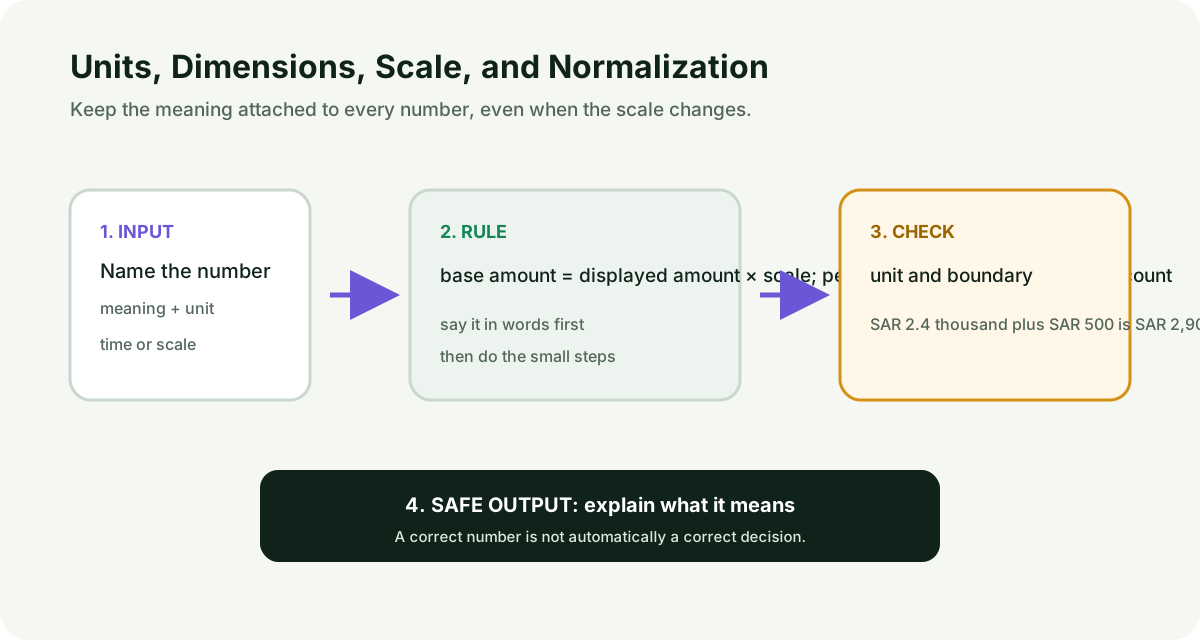
What to notice: the input, the rule, the check, and the safe interpretation are shown in that order. Open the full-size visual.
Where this is useful
- per-customer and per-share metrics
- million/thousand scale checks
- comparable dashboards
What this does not tell you
Normalization improves comparability but does not remove differences in quality, currency, timing, or business model.
This is educational content, not investment, tax, legal, accounting, or regulatory advice. A simple calculation can be correct and still be the wrong calculation for a real decision.
Historical-example decision
Not useful for this lesson. A named company would add a story but would not teach the primitive more clearly than the small synthetic numbers above. A real case would also need a verified entity, period, unit, and publication right. The lesson therefore keeps its arithmetic transparent and synthetic.
Related lessons
Evidence boundary
The plain-language definitions and measurement cautions are supported by BIPM, NIST. The formula wording, examples, and lab behavior are author-derived teaching choices. See the claim ledger and references for the boundary.
Optional verification implementation
You do not need code to learn this lesson. The package now includes matching Python and TypeScript verification façades, a shared worked-example fixture, and parity tests. They reproduce the lesson’s frozen rule and remain optional for nontechnical learners.
Enhancement studio: draw, compare, explain
This additive studio does not replace the beginner lesson above. It gives you two more drawings, a decision comparison, and short practice prompts so you can explain the idea without copying a formula or writing code.
Drawing 1 — name, apply, check
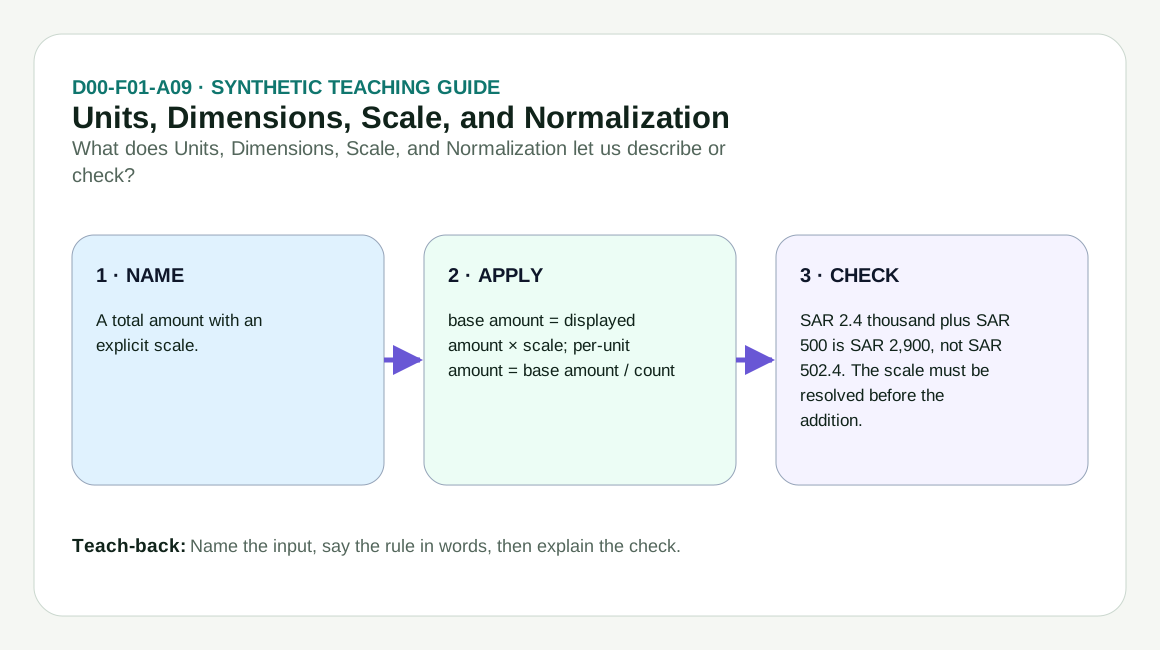
Read left to right: name what the data means, apply the narrow lesson rule, then use an independent check. Open the full-size concept anatomy.
Choose the right idea
| Decision | This lesson | Closest next or comparison | Why the difference matters |
|---|---|---|---|
| Main question | Keep the meaning attached to every number, even when the scale changes. | Rounding, Precision, Tolerance, and Significant Digits | Choose the question before choosing the arithmetic. |
| Safe rule | base amount = displayed amount × scale; per-unit amount = base amount / count | Uses its own input and boundary contract. | Neighboring lessons can use the same numbers but answer different questions. |
| Required check | SAR 2.4 thousand plus SAR 500 is SAR 2,900, not SAR 502.4. The scale must be resolved before the addition. | Re-check its own unit, time, denominator, or schema. | A correct answer to the wrong question is still wrong. |
| Stop condition | Do not add SAR to customers or compare millions with raw units silently. | Move only when its prerequisites are satisfied. | Unknown meaning is a reason to pause, not to guess. |
Drawing 2 — common-mistake clinic
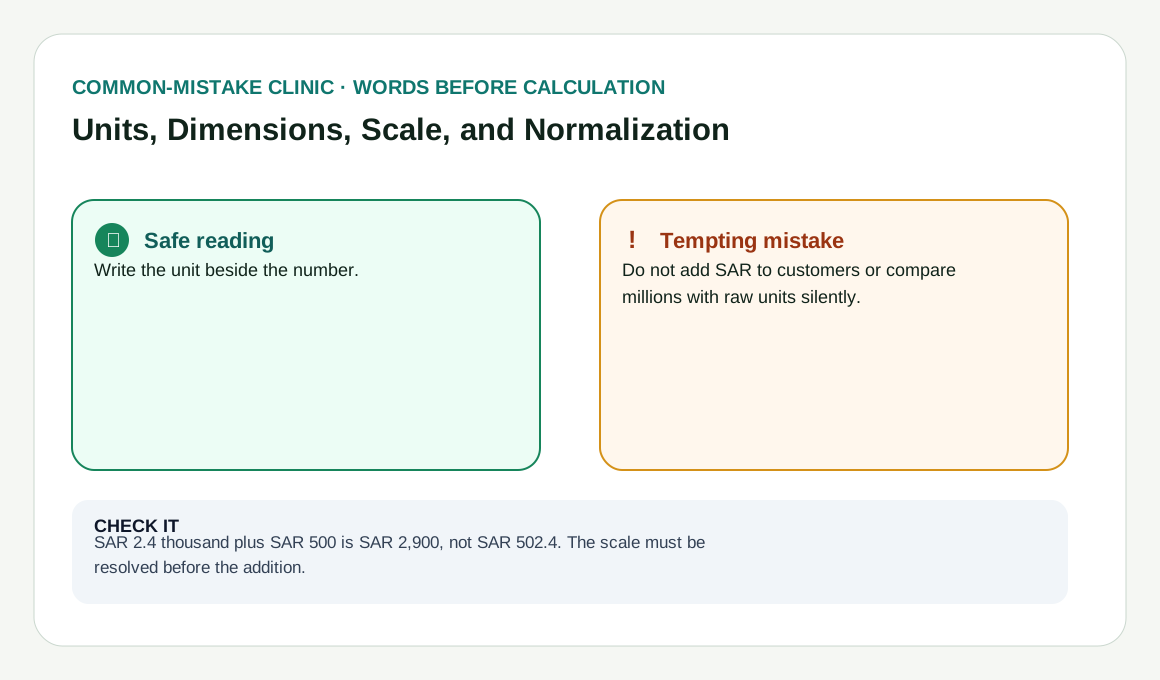
The left side states the safe interpretation; the right side shows the mistake that often produces a believable but misleading result. Open the full-size mistake comparison.
Explain it back without code
- Name it: What does the first input or observation mean?
Answer: A total amount with an explicit scale. - Choose it: Which rule belongs to this question?
Answer: base amount = displayed amount × scale; per-unit amount = base amount / count - Challenge it: What check could make you stop?
Answer: SAR 2.4 thousand plus SAR 500 is SAR 2,900, not SAR 502.4. The scale must be resolved before the addition.
If your explanation leaves out the unit, period, denominator, grain, or availability time that the lesson needs, it is not complete yet.
Related concepts and learning handoff
- Governed glossary: Unit, Dimension, Scale, Normalization. Browse the full financial glossary when a term is unfamiliar.
- Continue with: Rounding, Precision, Tolerance, and Significant Digits.
- Evidence boundary: all displayed numbers remain synthetic teaching data; the drawings do not claim a market observation, forecast, or investment result.
Rendered from the canonical Mermaid sources linked by this article.
Units, Dimensions, Scale, and Normalization — four-part map
This diagram shows the learner's path from a named input to a safe explanation.
Takeaway: the check is not an afterthought. It tells the learner whether the answer belongs to the question that was asked.
ReferencesPrimary sources and evidence notesExpand the source trail, evidence role, and limitations behind the engineering choices.
Expand the source trail, evidence role, and limitations behind the engineering choices.
The family uses a small shared evidence set. Each source has a limited role; the examples and lab are clearly author-derived synthetic teaching material.
BIPM — The International System of Units (SI Brochure), 9th edition
- Organization or authors: Bureau International des Poids et Mesures
- Source type: International standards publication
- Publication or effective date: 2019, updated web edition 2026
- Version: current web edition accessed for this build
- URL: https://www.bipm.org/en/publications/si-brochure
- Accessed: 2026-08-10
- Jurisdiction: general educational or measurement context
- Supports: The meaning of units, derived dimensions, and dimensionless ratios.
- Limitations: It does not define financial reporting or market-data conventions.
NIST — NIST/SEMATECH e-Handbook of Statistical Methods
- Organization or authors: NIST/SEMATECH
- Source type: Official statistical handbook
- Publication or effective date: 2022 current web edition
- Version: current web edition accessed for this build
- URL: https://www.itl.nist.gov/div898/handbook/
- Accessed: 2026-08-10
- Jurisdiction: general educational or measurement context
- Supports: Definitions, careful measurement language, and the difference between a calculation and a claim.
- Limitations: It does not choose this family's teaching examples or financial conventions.
Author-derived and synthetic boundary
The formulas are standard classroom definitions expressed in plain language. The worked values, visual labels, and playground scenarios are synthetic teaching inputs created for this package. They do not establish a company fact, market outcome, or investment result.
Full dependency-light reference implementations in both supported languages.
import { runTopic as runD00Topic, type D00Input, type D00Output } from "../../../../shared/typescript/d00Engine.ts";

/** Run the canonical D00-F01-A09 calculation. */
export function unitsDimensionsScaleAndNormalization(input: D00Input): D00Output {
  return runD00Topic("D00-F01-A09", input);
}
The embedded lab now expands to its full document height, keeping the article as the only scroll surface.