
 By Islam Baraka
The number is only as good as its convention
Decentralized-finance dashboards often compress a complicated state into one percentage, ratio, price, or loss amount. That compression is useful only when the reader can recover the assumptions underneath it. Liquidation-Price Calculation addresses one narrow question: how to solve the selected collateral price that makes a frozen multi-asset health factor equal one.
The package freezes this definition:
P* = max(0, (total debt value − other threshold-adjusted collateral)/(selected quantity × selected liquidation threshold)).
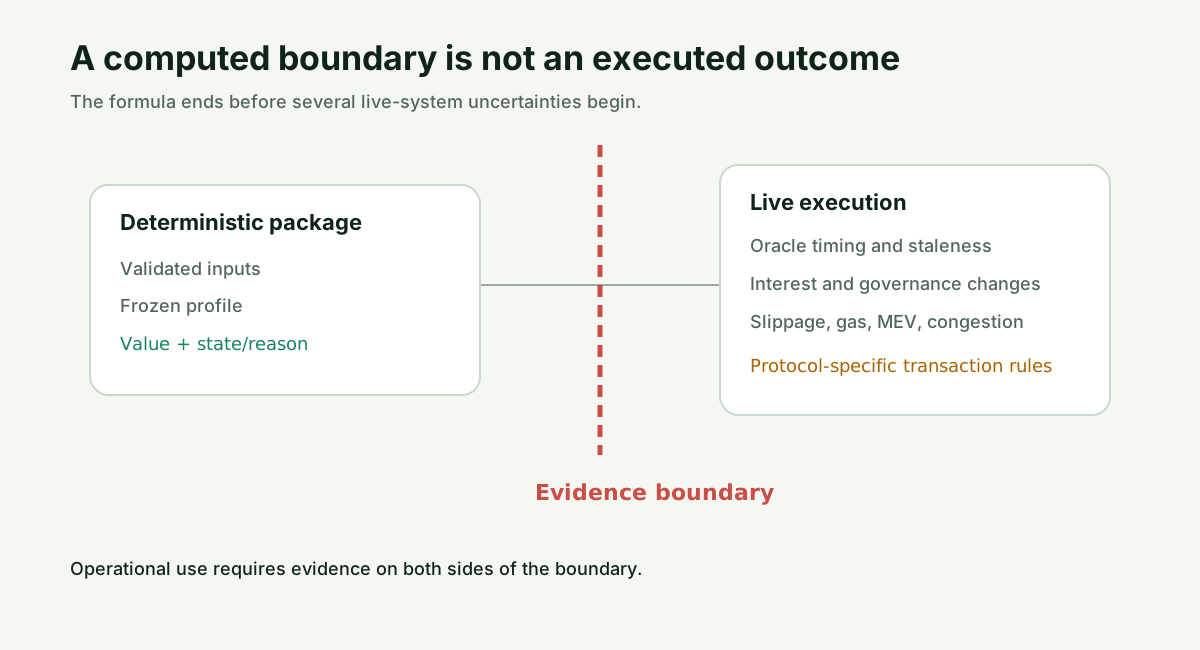
The scope is a selected collateral's break-even oracle price under the Aave-style health-factor convention, holding quantities, other prices, debt prices, and thresholds fixed. That scope is deliberately smaller than a live protocol. The method excludes oracle latency, intra-block execution, interest after the snapshot, simultaneous price moves, nonlinear collateral rules, e-mode, isolation mode, fees, bonuses, and guaranteed execution prices.
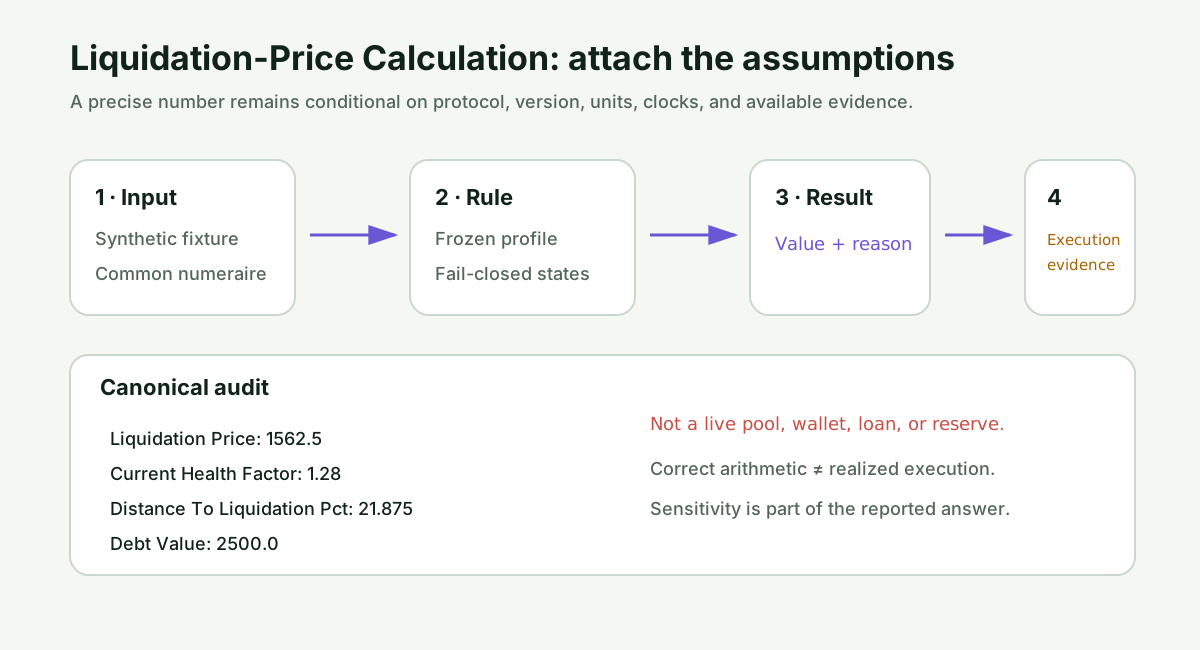
Start with the economic intuition
Remove the safety contribution of every other collateral asset from debt, then ask what unit price the selected asset must have to fill the remaining threshold-adjusted gap.
Solve one price, freeze everything else
Start from the same health-factor equation and set it equal to one. Hold debt values, collateral quantities, other collateral prices, and thresholds fixed. The selected asset must supply whatever threshold-adjusted value remains after other eligible collateral is counted. Dividing that gap by selected quantity and threshold gives the break-even oracle price.
When other collateral already covers all debt, the mathematical lower bound is zero. When the selected quantity or effective threshold is zero, no finite selected price can solve the stated equation, so the result is null with a reason. These states are more useful than forcing a misleading number.
The result is not an execution price. Interest can accrue, several prices can move together, and an oracle update can lag a market. Liquidator bonuses, close factors, slippage, and transaction ordering determine what happens after eligibility—not the threshold price itself.
Diagnostic deep dive: solve one variable and name everything frozen
Set the frozen health factor equal to one:
Separate the selected collateral from every other eligible contribution:
Then isolate its price:
Every term outside is held constant. That sentence is the method’s most important limitation.
| Output state | Meaning | Correct response |
|---|---|---|
| Positive finite price | Selected collateral must supply a positive adjusted gap | Report price plus frozen debt/other collateral |
| Zero | Other eligible collateral already covers debt | Report the lower bound, not a negative price |
| Null: zero capacity | Quantity or effective threshold is zero | Do not force a finite trigger |
| Current HF below one | Eligibility already exists under the snapshot | Do not describe the result as a future trigger |
selected_capacity_per_price is the threshold-adjusted collateral value contributed by one unit of selected price. remaining_adjusted_gap is the part of debt not covered by other collateral. Their quotient is the trigger. other_collateral_cover_pct explains why two accounts with identical WETH and debt can have different WETH break-even prices.
One-price sensitivity is not a shock surface
If debt accrues while collateral falls, if several collateral prices move with different correlations, or if debt is not stable in the chosen numeraire, a single liquidation price is no longer the complete answer. Use a scenario surface or recompute the health factor from each joint state. Likewise, the oracle threshold is not the price a liquidator receives: bonus, close factor, slippage, gas, MEV, and transaction ordering occur after eligibility.
Practitioner workflow
Freeze deployment, block, oracle source, debt index, quantities, other prices, and thresholds; solve the selected price; verify the result by substituting it back into the health-factor equation; report the percentage buffer; then stress debt and threshold separately. The right label is “break-even oracle price under frozen inputs,” never “guaranteed liquidation price.”
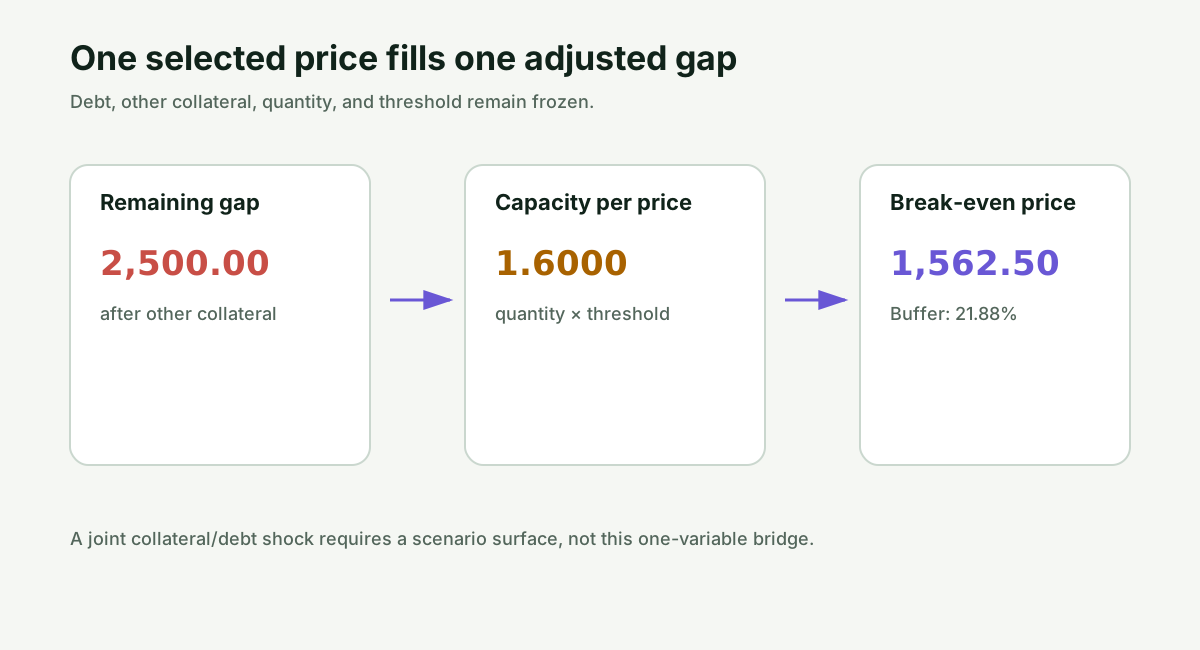
The durable habit is to attach the convention to the number. Say “simple fee APR over 365 observed days using time-weighted LP capital,” not “the pool yields 5.5%.” Say “break-even WETH oracle price with debt and all other collateral frozen,” not “the account will liquidate at this market price.” Precision in language preserves reproducibility.
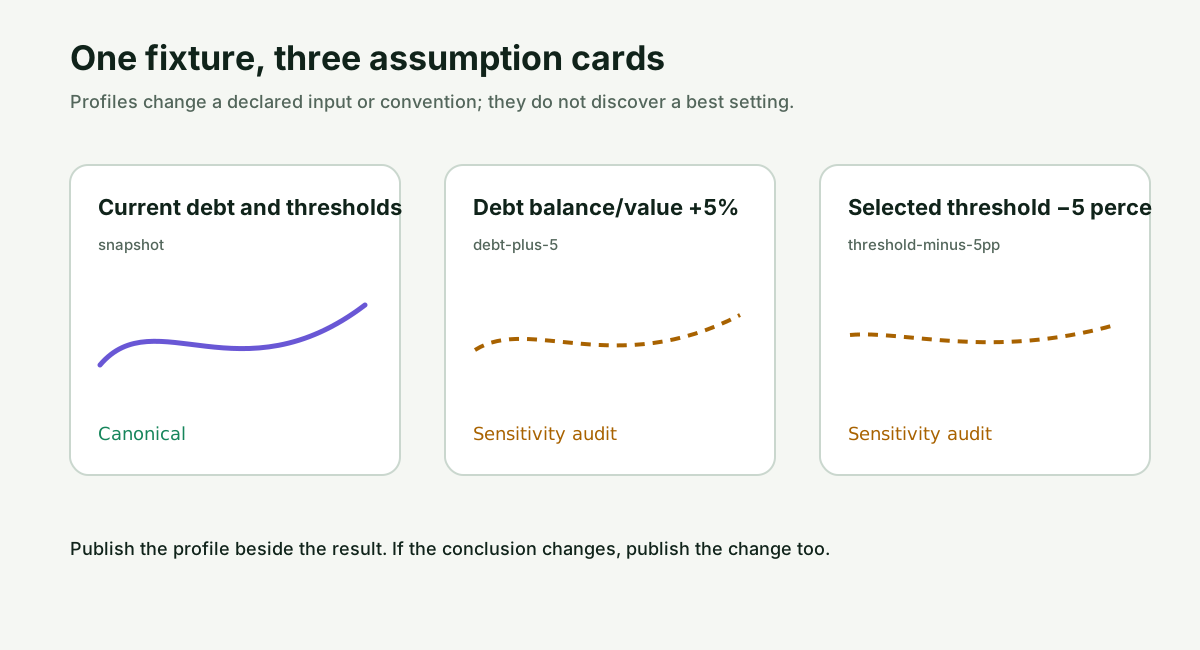
Why the canonical data are synthetic
A live historical example was evaluated and classified not useful. Real DeFi positions require a chain, deployment, contract version, block, token-decimal rules, oracle source, governance parameter history, interest index, transaction order, and data license. The identity burden would overshadow the calculation.
Instead, eight deterministic scenarios expose the exact learning boundaries. Equality cases verify comparison operators. Zero-debt and zero-threshold cases verify null semantics. Stress cases reveal nonlinear tails, denominator bias, price sensitivity, and buffer exhaustion. The fee-APR topic retains 365 daily observations, while the other topics publish 241-point curves. Synthetic truth is clearly labeled and is never described as observed protocol behavior.
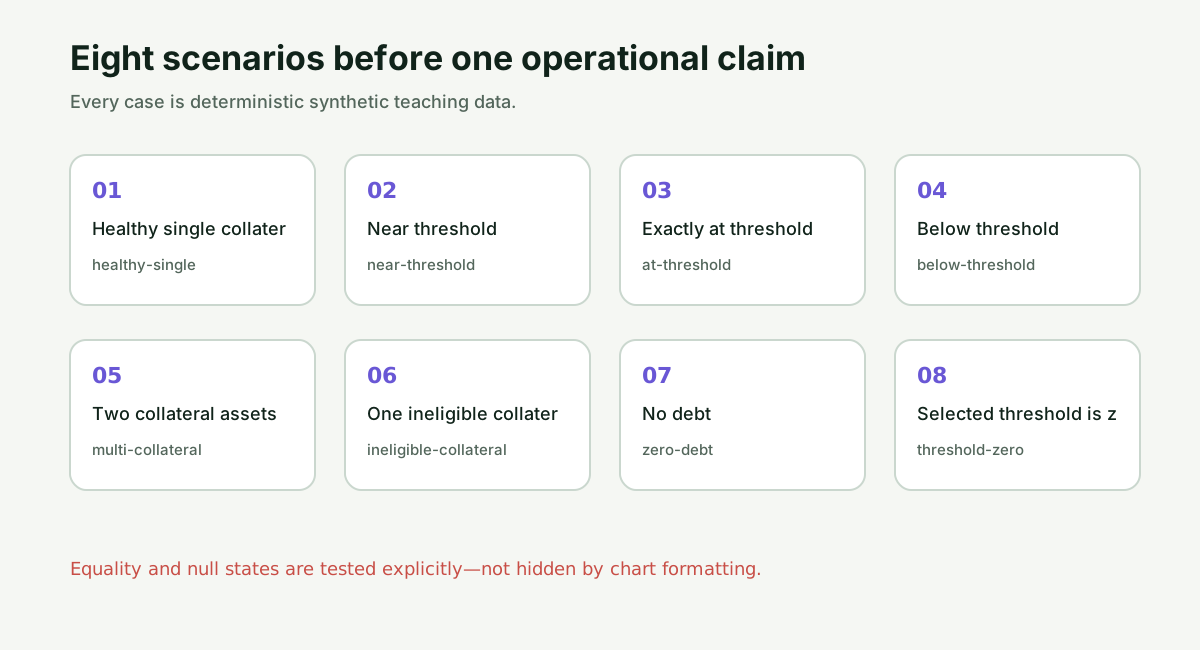
A five-part audit
First, identify the protocol convention. Aave’s health factor is not Compound III’s account liquidity, and Compound’s absorb process is not Maker’s Dutch auction. A generic educational model must name the concepts it borrows and the mechanics it does not reproduce.
Second, align valuation time. A collateral price observed after a governance threshold change cannot be combined with a debt balance from before interest accrued unless the calculation explicitly intends that mixed snapshot. Production records should preserve block or event time, availability time, parameter effective time, finality, and source.
Third, check units and denominators. Token quantities become common-numeraire values through prices. Rates remain fractions until presentation. APR divides fee income by capital exposed during the measurement window. A health factor divides threshold-adjusted collateral by debt; swapping numerator and denominator reverses the risk meaning.
Fourth, inspect equality and null states. Exactly one is a meaningful health-factor boundary under the frozen convention. Zero debt should not create an infinite JSON value. A selected collateral with no eligible threshold-weighted capacity cannot produce a finite liquidation price. Explicit states make downstream decisions safer.
Fifth, compare a challenge profile. A result that changes materially under a reasonable fee cut, collateral shock, debt accrual, threshold change, recovery haircut, or unavailable backstop must be reported as sensitive.
Five liquidation-price statements to reject
- The result is a guaranteed market fill price.
- Other collateral does not affect the selected trigger.
- A null result should be replaced with an extremely large number.
- Several prices can move together without changing a one-variable solution.
- Interest, thresholds, and oracle timing remain frozen in a live account.
Each rejected statement removes a different ambiguity: comparison basis, denominator, protocol convention, timing, or execution. A precise answer keeps those boundaries attached to the displayed number.
Failure modes and misuse boundaries
- Protocol mismatch: do not paste a threshold, fee share, or reserve rule from one protocol into another.
- Time mismatch: prices, balances, accrued debt, and governance parameters must share an observation and knowledge time.
- Oracle versus execution: an oracle threshold does not guarantee a fill, auction result, or liquidation transaction.
- Annualization illusion: scaling a short exceptional period to one year is arithmetic, not a forecast.
- Missing total return: fee income alone omits inventory and token-price effects; impermanent loss alone omits fees and costs.
- Nominal versus available buffers: a reserve or backstop must be legally and technically available at the event time.
- Smart-contract and chain risk: reorgs, congestion, MEV, oracle faults, and contract failures can dominate the model.
- Synthetic evidence: clean fixture behavior proves implementation correctness only.
Out of scope: oracle latency, intra-block execution, interest after the snapshot, simultaneous price moves, nonlinear collateral rules, e-mode, isolation mode, fees, bonuses, and guaranteed execution prices.
What a correct result can support
A correct calculation can support monitoring, scenario design, reconciliations, UI explanations, risk limits, and test fixtures. It can help a user see which input drives a ratio or which buffer absorbs the next dollar of loss. It can also identify when a calculation is unsupported and should return a reason rather than a number.
It cannot by itself certify a pool’s future yield, an account’s safety, a liquidation’s fill price, a protocol’s solvency, or the legal availability of a backstop. Those claims need live point-in-time data, protocol-specific execution logic, empirical validation, and often governance or legal evidence.
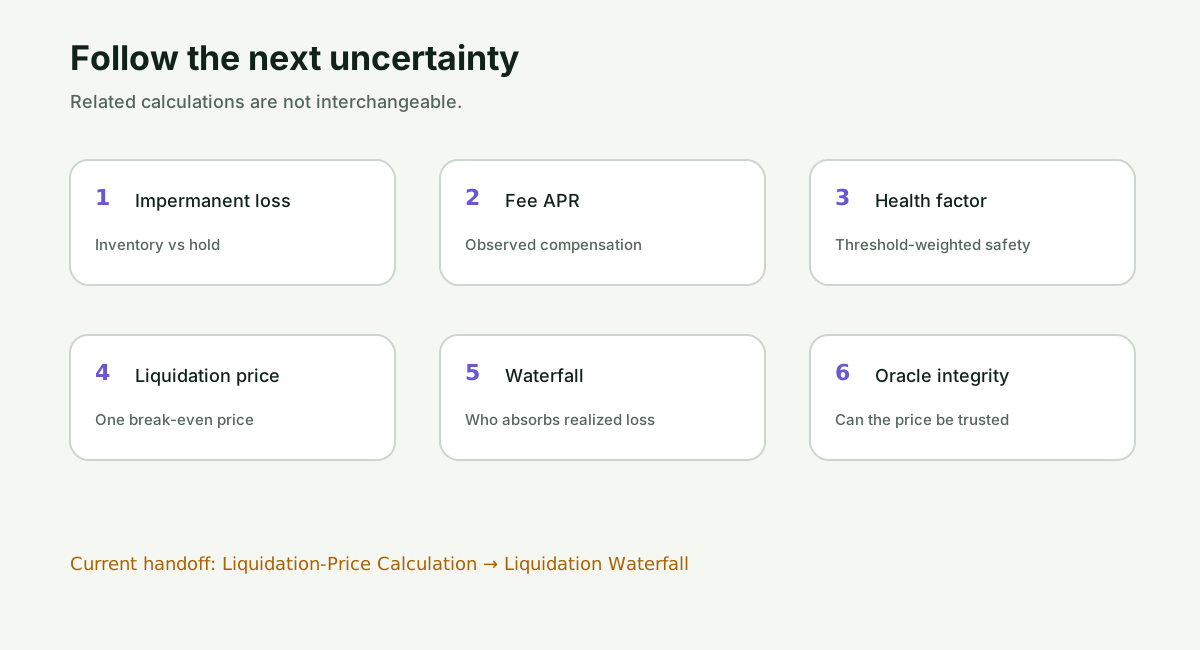
The family is sequenced around the decisions a liquidity provider or lending-risk analyst actually faces. Impermanent loss measures inventory rebalancing against holding. Fee APR isolates observed compensation. Health factor aggregates threshold-weighted protection. Liquidation price solves one break-even input. The waterfall explains what absorbs a realized shortfall. The next domain question—oracle integrity—tests whether the prices feeding those calculations deserve trust.
Reproduce before operationalizing
The package supplies Python and TypeScript implementations, canonical and adversarial fixtures, shared-result parity checks, a worked example, five static explanations, and a guided lab. Reproduction is the minimum evidence needed to debate the assumptions productively.
Before connecting any result to a wallet or risk system, replace every synthetic field with a sourced point-in-time record. Add chain and contract identifiers, token decimals, oracle rounds, governance parameter effective times, interest indices, transaction simulation, and fail-closed staleness rules. Then validate the complete decision rule out of sample and under congestion, reorg, and failed-execution scenarios.
Sources
- Health Factor & Liquidations — Health-factor formula, weighted liquidation thresholds, eligibility below one, and liquidation-process concepts.
- Aave V3 Risk Parameters — Per-asset liquidation thresholds, the weighted-threshold health-factor formula, and the distinction between LTV and liquidation threshold.
- Aave V3 LiquidationLogic.sol — Eligibility below health factor one, close-factor branching, liquidation bonus, and protocol-fee implementation boundaries.
Protocol sources establish only their named mechanics. Every scenario, sensitivity profile, visual, and cross-protocol risk workflow in this article is author-derived educational material reviewed on 2026-07-29.
Rendered from the canonical Mermaid sources linked by this article.
Liquidation-Price Calculation — Calculation and Decision Flow
ReferencesPrimary sources and evidence notesExpand the source trail, evidence role, and limitations behind the engineering choices.
Expand the source trail, evidence role, and limitations behind the engineering choices.
Reviewed: 2026-07-29
| Source | Title | Role | Used for |
|---|---|---|---|
| AAVE_LIQUIDATIONS | Health Factor & Liquidations | Official protocol help documentation | Health-factor formula, weighted liquidation thresholds, eligibility below one, and liquidation-process concepts. |
| AAVE_RISK_PARAMETERS | Aave V3 Risk Parameters | Official protocol risk documentation | Per-asset liquidation thresholds, the weighted-threshold health-factor formula, and the distinction between LTV and liquidation threshold. |
| AAVE_V3_LOGIC | Aave V3 LiquidationLogic.sol | Official maintained reference implementation | Eligibility below health factor one, close-factor branching, liquidation bonus, and protocol-fee implementation boundaries. |
AAVE_LIQUIDATIONS — Health Factor & Liquidations
- Organization or authors: Aave; Aave Labs documentation team
- Source type: Official protocol help documentation
- Publication or effective date: 2026-07-29
- Version: Page accessed 2026-07-29
- URL or DOI: https://aave.com/help/borrowing/liquidations
- Accessed: 2026-07-29
- Jurisdiction: Aave Protocol; market and deployment parameters vary
- Supports: Health-factor formula, weighted liquidation thresholds, eligibility below one, and liquidation-process concepts.
- Limitations: Governance parameters and version-specific close-factor or dust rules can change; this package freezes only the health-factor convention.
AAVE_RISK_PARAMETERS — Aave V3 Risk Parameters
- Organization or authors: Aave; Aave risk contributors
- Source type: Official protocol risk documentation
- Publication or effective date: 2026-07-29
- Version: risk-v3 main branch accessed 2026-07-29
- URL or DOI: https://github.com/aave/risk-v3/blob/main/asset-risk/risk-parameters.md
- Accessed: 2026-07-29
- Jurisdiction: Aave V3 deployments; parameters vary by market
- Supports: Per-asset liquidation thresholds, the weighted-threshold health-factor formula, and the distinction between LTV and liquidation threshold.
- Limitations: Example parameter values are not portable across deployments or governance dates.
AAVE_V3_LOGIC — Aave V3 LiquidationLogic.sol
- Organization or authors: Aave; Aave protocol contributors
- Source type: Official maintained reference implementation
- Publication or effective date: 2026-07-29
- Version: aave-v3-core master accessed 2026-07-29
- URL or DOI: https://github.com/aave/aave-v3-core/blob/master/contracts/protocol/libraries/logic/LiquidationLogic.sol
- Accessed: 2026-07-29
- Jurisdiction: Aave V3 implementation; deployment and release rules can differ
- Supports: Eligibility below health factor one, close-factor branching, liquidation bonus, and protocol-fee implementation boundaries.
- Limitations: The repository is an implementation reference, not proof that every deployment uses identical parameters or release logic.
Evidence boundary
Protocol documentation establishes only the named protocol’s mechanics and versioned terminology. The formulas, fixtures, stress curves, comparison profiles, diagnostics, diagrams, and generic financial workflow in this package are author-derived unless attributed above. Synthetic scenarios are not protocol telemetry, investment performance, or evidence that any liquidation would execute at the modeled price.
Full dependency-light reference implementations in both supported languages.
/** Dependency-free reference calculations for D25-F02. */
export type JsonObject = Record<string, any>;

function finite(value: unknown, name: string, minimum?: number, maximum?: number): number {
  if (typeof value !== "number" || !Number.isFinite(value)) throw new Error(`${name} must be a finite number`);
  if (minimum !== undefined && value < minimum) throw new Error(`${name} must be at least ${minimum}`);
  if (maximum !== undefined && value > maximum) throw new Error(`${name} must be at most ${maximum}`);
  return value;
}

function rounded(value: any, digits = 10): any {
  if (typeof value === "number") return Number(value.toFixed(digits));
  if (Array.isArray(value)) return value.map(item => rounded(item, digits));
  if (value && typeof value === "object") return Object.fromEntries(Object.entries(value).map(([key, item]) => [key, rounded(item, digits)]));
  return value;
}

export function impermanentLoss(data: JsonObject, config: JsonObject): JsonObject {
  const initialValue = finite(data.initial_pool_value, "initial_pool_value", 1e-9);
  const ratio = finite(data.price_ratio, "price_ratio", 1e-9);
  const feeFraction = finite(config.fee_return_fraction ?? 0, "fee_return_fraction", 0);
  const holdValue = initialValue * (1 + ratio) / 2;
  const poolValue = initialValue * Math.sqrt(ratio);
  const relativeValue = poolValue / holdValue;
  const fees = initialValue * feeFraction;
  const trace = Array.from({ length: 241 }, (_, index) => {
    const logRatio = Math.log(0.2) + index * (Math.log(5) - Math.log(0.2)) / 240;
    const r = Math.exp(logRatio);
    const hv = initialValue * (1 + r) / 2;
    const pv = initialValue * Math.sqrt(r);
    return { price_ratio: r, impermanent_loss: pv / hv - 1, hold_value: hv, pool_value: pv, net_pool_value: pv + fees };
  });
  return rounded({
    initial_pool_value: initialValue,
    price_ratio: ratio,
    hold_value: holdValue,
    pool_value_excluding_fees: poolValue,
    impermanent_loss_fraction: relativeValue - 1,
    impermanent_loss_amount: poolValue - holdValue,
    fee_income: fees,
    net_pool_value: poolValue + fees,
    net_vs_hold_fraction: (poolValue + fees) / holdValue - 1,
    trace,
  });
}

export function feeApr(data: JsonObject, config: JsonObject): JsonObject {
  if (!Array.isArray(data.rows) || data.rows.length === 0) throw new Error("rows must be a non-empty list");
  const annualization = finite(config.annualization_days ?? 365, "annualization_days", 1e-9);
  const protocolShare = finite(config.protocol_fee_share ?? 0, "protocol_fee_share", 0, 1);
  const basis = config.capital_basis ?? "time_weighted";
  if (!["time_weighted", "ending"].includes(basis)) throw new Error("capital_basis must be time_weighted or ending");
  let elapsed = 0, capitalTime = 0, cumulative = 0, cumulativeVolume = 0;
  const trace: JsonObject[] = [];
  data.rows.forEach((row: JsonObject, index: number) => {
    const duration = finite(row.duration_days ?? 1, `rows[${index}].duration_days`, 1e-9);
    const volume = finite(row.volume, `rows[${index}].volume`, 0);
    const feeRate = finite(row.fee_rate, `rows[${index}].fee_rate`, 0, 1);
    const share = finite(row.lp_share, `rows[${index}].lp_share`, 0, 1);
    const capital = finite(row.lp_capital, `rows[${index}].lp_capital`, 1e-9);
    const fees = volume * feeRate * share * (1 - protocolShare);
    elapsed += duration; capitalTime += capital * duration; cumulative += fees; cumulativeVolume += volume;
    const denominator = basis === "time_weighted" ? capitalTime / elapsed : capital;
    trace.push({
      index, timestamp: row.timestamp, volume, lp_capital: capital, daily_fee_income: fees,
      cumulative_fee_income: cumulative, running_apr: cumulative / denominator * annualization / elapsed,
    });
  });
  const averageCapital = capitalTime / elapsed;
  const denominator = basis === "time_weighted" ? averageCapital : finite(data.rows.at(-1).lp_capital, "ending lp_capital", 1e-9);
  return rounded({
    elapsed_days: elapsed,
    gross_volume: cumulativeVolume,
    lp_fee_income: cumulative,
    time_weighted_average_capital: averageCapital,
    capital_denominator: denominator,
    capital_basis: basis,
    protocol_fee_share: protocolShare,
    simple_fee_apr: cumulative / denominator * annualization / elapsed,
    period_fee_return: cumulative / denominator,
    annualization_days: annualization,
    trace,
  });
}

export function healthFactor(data: JsonObject, config: JsonObject): JsonObject {
  if (!Array.isArray(data.collateral) || data.collateral.length === 0 || !Array.isArray(data.debts))
    throw new Error("collateral must be non-empty and debts must be a list");
  const cm = finite(config.collateral_price_multiplier ?? 1, "collateral_price_multiplier", 0);
  const dm = finite(config.debt_price_multiplier ?? 1, "debt_price_multiplier", 0);
  let collateralValue = 0, adjusted = 0, debtValue = 0;
  const collateralLedger = data.collateral.map((asset: JsonObject, index: number) => {
    const quantity = finite(asset.quantity, `collateral[${index}].quantity`, 0);
    const price = finite(asset.price, `collateral[${index}].price`, 0) * cm;
    const threshold = finite(asset.liquidation_threshold, `collateral[${index}].liquidation_threshold`, 0, 1);
    const eligible = asset.eligible ?? true;
    const value = quantity * price;
    const contribution = eligible ? value * threshold : 0;
    collateralValue += value; adjusted += contribution;
    return { asset: asset.asset ?? `C${index}`, value, threshold, eligible, adjusted_contribution: contribution };
  });
  const debtLedger = data.debts.map((asset: JsonObject, index: number) => {
    const quantity = finite(asset.quantity, `debts[${index}].quantity`, 0);
    const price = finite(asset.price, `debts[${index}].price`, 0) * dm;
    const value = quantity * price; debtValue += value;
    return { asset: asset.asset ?? `D${index}`, value };
  });
  const hf = debtValue === 0 ? null : adjusted / debtValue;
  const state = hf === null ? "no-debt" : hf < 1 ? "liquidatable" : hf === 1 ? "at-threshold" : "above-threshold";
  const trace = Array.from({ length: 241 }, (_, index) => {
    const multiplier = 0.4 + index / 240;
    const stressed = adjusted * multiplier;
    return { collateral_price_multiplier: multiplier, health_factor: debtValue === 0 ? null : stressed / debtValue, adjusted_collateral_value: stressed };
  });
  return rounded({
    total_collateral_value: collateralValue,
    threshold_adjusted_collateral_value: adjusted,
    total_debt_value: debtValue,
    weighted_average_liquidation_threshold: collateralValue === 0 ? 0 : adjusted / collateralValue,
    health_factor: hf,
    buffer_value: hf === null ? null : adjusted - debtValue,
    state, collateral_ledger: collateralLedger, debt_ledger: debtLedger, trace,
  });
}

export function liquidationPrice(data: JsonObject, config: JsonObject): JsonObject {
  if (!Array.isArray(data.collateral) || data.collateral.length === 0 || !Array.isArray(data.debts) || !data.selected_asset)
    throw new Error("collateral, debts, and selected_asset are required");
  const debtMultiplier = finite(config.debt_multiplier ?? 1, "debt_multiplier", 0);
  const shift = finite(config.threshold_shift ?? 0, "threshold_shift", -1, 1);
  let debtValue = 0;
  data.debts.forEach((asset: JsonObject, index: number) => {
    debtValue += finite(asset.quantity, `debts[${index}].quantity`, 0) * finite(asset.price, `debts[${index}].price`, 0);
  });
  debtValue *= debtMultiplier;
  let otherAdjusted = 0;
  let chosen: JsonObject | null = null;
  data.collateral.forEach((asset: JsonObject, index: number) => {
    const quantity = finite(asset.quantity, `collateral[${index}].quantity`, 0);
    const price = finite(asset.price, `collateral[${index}].price`, 0);
    const threshold = finite(asset.liquidation_threshold, `collateral[${index}].liquidation_threshold`, 0, 1);
    if (asset.asset === data.selected_asset) chosen = { quantity, current_price: price, threshold: Math.max(0, Math.min(1, threshold + shift)) };
    else if (asset.eligible ?? true) otherAdjusted += quantity * price * threshold;
  });
  if (chosen === null) throw new Error("selected_asset is not present in collateral");
  const c = chosen as JsonObject;
  const denominator = c.quantity * c.threshold;
  const required = denominator <= 0 ? null : Math.max(0, (debtValue - otherAdjusted) / denominator);
  const reason = denominator <= 0 ? "selected collateral has zero quantity or zero effective liquidation threshold" : required === 0 ? "other collateral alone covers debt" : "finite break-even price";
  const currentAdjusted = c.quantity * c.current_price * c.threshold;
  const currentHf = debtValue === 0 ? null : (otherAdjusted + currentAdjusted) / debtValue;
  const trace = Array.from({ length: 241 }, (_, index) => {
    const price_multiplier = 0.4 + index / 240;
    const selected_price = c.current_price * price_multiplier;
    const health_factor = debtValue === 0 ? null : (otherAdjusted + c.quantity * selected_price * c.threshold) / debtValue;
    return { price_multiplier, selected_price, health_factor };
  });
  return rounded({
    selected_asset: data.selected_asset,
    selected_quantity: c.quantity,
    current_selected_price: c.current_price,
    effective_selected_liquidation_threshold: c.threshold,
    total_debt_value: debtValue,
    other_adjusted_collateral_value: otherAdjusted,
    liquidation_price: required,
    distance_to_liquidation_fraction: required === null || c.current_price === 0 ? null : (c.current_price - required) / c.current_price,
    current_health_factor: currentHf,
    reason, trace,
  });
}

export function liquidationWaterfall(data: JsonObject, config: JsonObject): JsonObject {
  const debt = finite(data.debt_value, "debt_value", 0);
  const collateral = finite(data.collateral_sale_proceeds, "collateral_sale_proceeds", 0);
  const reserve = finite(data.protocol_reserve, "protocol_reserve", 0);
  const insurance = finite(data.insurance_fund, "insurance_fund", 0);
  const backstop = finite(data.backstop_capacity, "backstop_capacity", 0);
  const recoveryRate = finite(config.collateral_recovery_rate ?? 1, "collateral_recovery_rate", 0, 1);
  const enabled = config.backstop_enabled ?? true;
  const capacities: Array<[string, number]> = [
    ["collateral-recovery", collateral * recoveryRate],
    ["protocol-reserve", reserve],
    ["insurance-fund", insurance],
    ["backstop", enabled ? backstop : 0],
  ];
  let remaining = debt, cumulative = 0;
  const ledger = capacities.map(([layer, capacity]) => {
    const absorbed = Math.min(remaining, capacity); remaining -= absorbed; cumulative += absorbed;
    return { layer, available_capacity: capacity, absorbed, remaining_debt: remaining, cumulative_absorbed: cumulative };
  });
  ledger.push({ layer: "uncovered-bad-debt", available_capacity: null as any, absorbed: remaining, remaining_debt: 0, cumulative_absorbed: cumulative + remaining });
  const stressTrace = Array.from({ length: 241 }, (_, index) => {
    const collateral_proceeds_multiplier = index * 1.2 / 240;
    const stressed = collateral * recoveryRate * collateral_proceeds_multiplier;
    const capacity = stressed + reserve + insurance + (enabled ? backstop : 0);
    return { collateral_proceeds_multiplier, covered_debt: Math.min(debt, capacity), uncovered_bad_debt: Math.max(0, debt - capacity) };
  });
  return rounded({
    debt_value: debt,
    effective_collateral_proceeds: collateral * recoveryRate,
    total_buffer_capacity: reserve + insurance + (enabled ? backstop : 0),
    covered_debt: debt - remaining,
    uncovered_bad_debt: remaining,
    coverage_fraction: debt === 0 ? 1 : (debt - remaining) / debt,
    backstop_enabled: enabled,
    ledger,
    trace: stressTrace,
  });
}

export function runTopic(kind: string, data: JsonObject, config: JsonObject): JsonObject {
  if (!data || typeof data !== "object" || !config || typeof config !== "object") throw new Error("data and config must be objects");
  const functions: Record<string, (d: JsonObject, c: JsonObject) => JsonObject> = {
    impermanent_loss: impermanentLoss,
    fee_apr: feeApr,
    health_factor: healthFactor,
    liquidation_price: liquidationPrice,
    waterfall: liquidationWaterfall,
  };
  if (!functions[kind]) throw new Error(`unknown topic kind: ${kind}`);
  return functions[kind](data, config);
}
The embedded lab now expands to its full document height, keeping the article as the only scroll surface.