
 By Islam Baraka
A payment has already reduced cash by 700 minor units. Its accounting destination is still unknown. An investigation identifies 400 of the amount, then the remaining 300. How do you clear suspense without recording the payment a second time—and how do you correct a classification later without losing its history?
We will build a strict sequential model for that decision. You will calculate the remaining balance, verify the evidence and approval gates, replay an accepted command safely within the model, and inspect an exact reversal plus replacement. Every Cedar amount, account extension, source record and approval below is synthetic. “Committed” means a modeled accepted transition; the reference implementation performs no durable database write.
Start with what is already booked
Suspense temporarily holds an entry whose correct account is still being determined. Investigation and an appropriate-account journal are separate from the initial payment. That bookkeeping context is described by ACCA's technical article; our exact JSON and authority rules are selected teaching conventions.
Our trusted origin journal is:
| Account | Debit | Credit |
|---|---|---|
Temporary debit suspense: unidentified_payments_usd | 700 | — |
cash_usd | — | 700 |
All numbers are USD minor units, so 700 represents USD 7.00. The account owner is entity CB-A in ledger CB-GENERAL. The suspense account is a temporary debit classification pending investigation. Its label does not prove a recoverable asset should be recognized in financial reporting. The OCC handbook's suspense discussion, printed page 27, is a useful bounded warning about that distinction.
The origin's cash delta is -700. This is one branch's movement, not the complete cash-account balance. None of our later classification journals includes cash.
Bind the classification to actual evidence
The shared reconciliation fixture contains immutable internal row I-MISSING, an outflow of 700, and an external E-MISSING report that was later withdrawn. The complete input keeps that withdrawal and its prior version. We do not treat the old external report as current confirmation.
The original source fixture establishes the internal cash movement. It does not identify the counter-account. Our tutorial explicitly adds the trusted synthetic origin journal above and its row→journal binding. These named suspense and destination accounts are chart extensions for this branch; the earlier posting chart is not silently changed.
There are four different facts to check:
- The supplied source histories are complete through independent trusted heads, including future/unselected revisions.
- The selected immutable internal row exactly matches the bound origin identity, amount, currency and outflow direction.
- A verified investigation supports this amount and destination.
- A distinct checker has approved this exact command, after the investigation.
An exact or fuzzy match is a proposal. It supplies none of the missing authority. JSON receipt IDs also do not authenticate their owners; the host must provide trusted provenance and access control.
The clocks matter. Our origin was recorded at 12:00 UTC on 20 October 2026; the exported source row was observed at 08:00 UTC on 21 October. Require:
origin recorded_at ≤ row observer available_at ≤ knowledge cutoff K ≤ trusted now
origin recorded_at ≤ classification effective_at ≤ trusted now
The observer receipt follows the journal's recording. It is not a physical commit timestamp. For corrections we also require effective time no earlier than the target classification's effective time. These are explicit restrictions of this bounded profile. Closed prior-period adjustments use a separate approved process.
Calculate partial classification exactly
Let O be the original positive amount, C the sum of active classifications, and R the remainder. All are exact integer minor units:
O = C + R, with C ≥ 0 and R ≥ 0.
| Symbol | Meaning | Unit |
|---|---|---|
| O | Trusted origin amount | USD minor units |
| C | Sum of unsuperseded accepted classifications | USD minor units |
| R | Unclassified remainder, O − C | USD minor units |
| A | Set of active resolution IDs | Exact identity set |
An approved amount x requires 0 < x ≤ R. The new journal is Dr approved destination x / Cr suspense x. C increases by x and R decreases by x. Cash remains unchanged.
Notice the fixed cash diagnostic as the remainder shrinks.
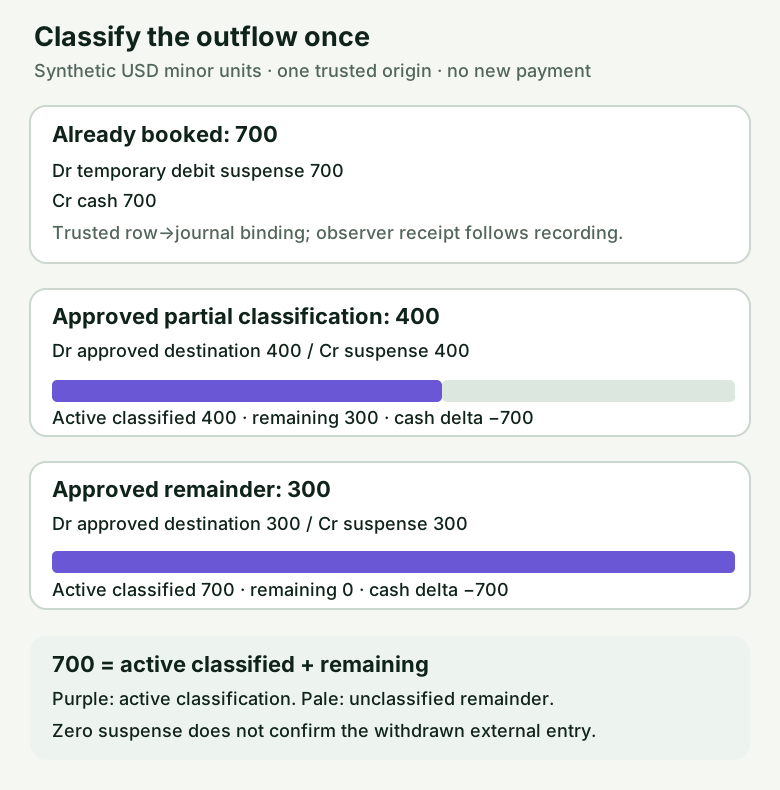
Open the full-size partial-resolution diagram.
| Accepted state | Active classification | Remaining | Origin cash delta |
|---|---|---|---|
| Before investigation | 0 | 700 | -700 |
| R-1: expense 400 | 400 | 300 | -700 |
| R-2: expense 300 | 700 | 0 | -700 |
Trying to classify another 400 after R-1 rejects OVER_RESOLUTION: only 300 remains. The rejected attempt changes neither version nor accepted business identity. A corrected retry may still use that previously unaccepted identity.
Give identity and authority different jobs
The input command includes a scoped business operation, expected version, fresh resolution and journal IDs, amount, destination, effective time/month, investigation and approval IDs, maker and reason. Correction adds the target resolution and reversal journal IDs. No correction-only fields are silently ignored on a normal resolve command.
The trusted context provides authorized item scopes, current processing time, complete sources, investigation, command-bound approval, chart policy and open periods. Amounts are positive canonical strings through 10^30−1. Booleans, numeric JSON money, leading zeros, zero, exponents and rounding are rejected. Python uses arbitrary-precision integers; TypeScript uses bigint; output money remains strings.
For a new operation, require a verified investigation for the exact row, destination and amount. Approval must bind the entire semantic command, including its journal identity. Its maker must match the command's maker and differ from its checker. Reusing an approval ID for a different accepted command in this state is forbidden. Current suspense and destination accounts must be active, the new destination allowed, and the booking month open.
For an existing business operation, authorize first and validate accepted state. An exact command returns its original complete stored result before today's accounts, period or evidence are rechecked. Changed payload gives IDEMPOTENCY_CONFLICT. This protects the meaning of an earlier accepted operation; it does not grant permission to disclose it to an unauthorized caller.
The ordering is deliberate. A replay changes no journal or version. A new command passes every gate before a record is appended.
Correct a classification without rewriting it
Suppose R-1's 400 should be an approved receivable rather than expense. This profile supports a same-amount destination correction. It retains R-1, appends its exact reversal, then appends replacement R-3:
| New journal | Debit | Credit |
|---|---|---|
| Exact reversal | Suspense 400 | Original expense 400 |
| Replacement | Approved receivable 400 | Suspense 400 |
The stored reversal preserves the original leg order and flips each side: Cr expense 400, then Dr suspense 400. Both journals share the modeled operation's recorded time and one original→reversal→replacement link. Validate both destinations and the whole correction before returning any append.
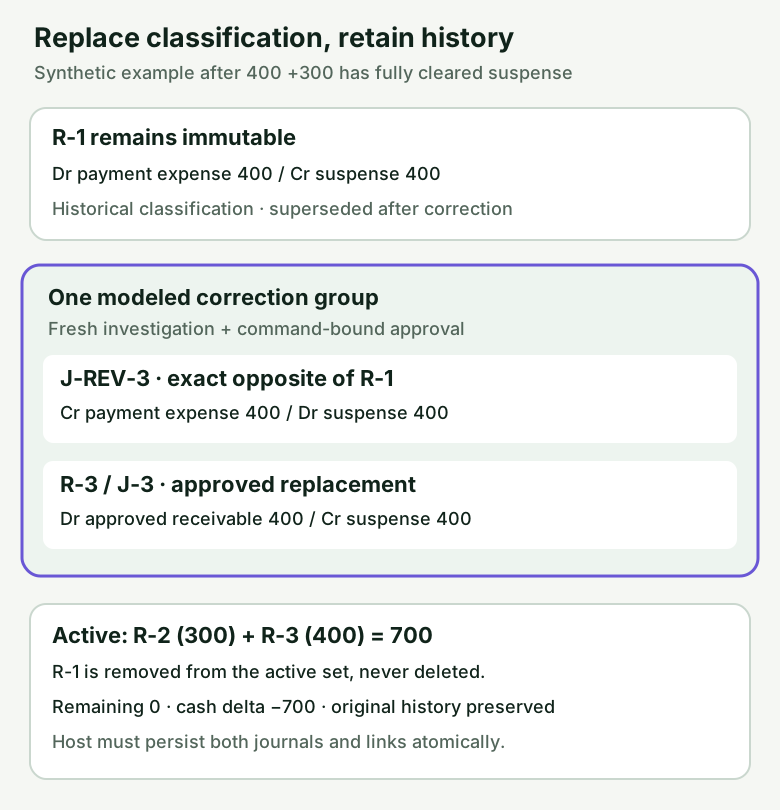
Open the full-size correction diagram.
The active set changes from {R-1, R-2} to {R-2, R-3}. R-2 is 300 and R-3 is 400, so C remains 700 and R remains zero. Do not add R-1 and R-3 together, and do not deduct the original amount twice. A second correction of superseded R-1 rejects; a new approved correction may target active R-3.
Changing the replacement amount to 399 is explicitly unsupported. The model emits no reversal, replacement, version or accepted identity. Broader amount redistribution needs its own approved contract.
Implement the transition from validated state
The canonical reducer validates all accepted records by reconstructing their original journal groups, active IDs, amounts and receipts. It does not apply today's policy to historical decisions. Corrupt totals, duplicate identities, reused approvals and changed historical output reject INVALID_STATE.
The central active-set update is small once those conditions are established:
if command['operation'] == 'correct':
    target = active.pop(command['original_resolution_id'])
    # Derive exact reversal from target; replacement amount already equals it.
active[command['resolution_id']] = command
classified = sum(int(c['amount_minor']) for c in active.values())
remaining = int(item['original_minor']) - classified
This is the validated accumulation step, not a substitute for the evidence and authority gates. The same operation constructs the journal group, links and detached accepted record. Its returned snapshot is atomic as a model value.
The package is self-contained: Python implementation, TypeScript implementation, a pinned source selector and standalone usage example. It accepts at most 128 records; exact replay still works at that limit. The readable historical validation is O(H + N²) for bounded source history H and records N, excluding output-copy cost. This is not a throughput claim.
Step through rejected and accepted attempts
Open the guided suspense lab. It embeds the canonical TypeScript implementation and records its source hash. Its 12-attempt branch includes pending approval, self-approval, partial 400, replay, changed-payload conflict, over-resolution, a closed month, final 300, unsupported amount change, accepted correction, a competing correction and a correction chain.
Back reconstructs a prior educational snapshot; it does not issue a real financial reversal. Other scenarios show incomplete-source repair, approval failures, observer chronology and the exact 30-digit money boundary. Exact values remain visible beside the proportional bar. The two SVGs and the tables above preserve the explanation without scripts.
Verify what the model actually proves
The independent pre-code oracle contains 78 complete transition/state cases, including 11 accepted results. Both languages also run the pinned 105-case complete source oracle. Parity compares full objects: journal order, receipts, links, active IDs, exact strings, rejection state and source routes. Additional checks cover balanced journals, conservation, no resolution cash leg, unchanged inputs and detached outputs.
Run python tests/run_parity.py from the package. Download the full validation report, parity receipt, browser receipt and independent arithmetic.
These checks prove the declared deterministic model against its synthetic inputs. A real host must authenticate approvals and source ownership, allocate each origin once across items, protect globally unique journal identities, and lock/version the item while persisting its identity, journals and links in one transaction. Sequential snapshots cannot establish live concurrent duplicate protection or crash durability. Use the separate Append-Only Journal Enforcement execution profile when studying actual database controls.
Keep classification and reconciliation separate
A cleared suspense balance tells us the internal outflow has an accepted accounting destination. It does not restore a withdrawn bank statement row, confirm settlement or prove opening-to-closing balances agree. In this fixture cash is still down 700 and the external evidence gap remains.
The Federal Reserve manual, section 4.50, gives specialized context for debit items pending disposition or verification; it does not prescribe our destination or approval policy. Historical case: not useful without a complete reusable journal, evidence and approval chronology. This article's values are synthetic and its arithmetic author derived.
Continue with Balance-Proof Algorithm to compare independently controlled opening balances, all selected movements and closing balances. Review Exact Reference Match for the source-selection rules and Many-to-Many Reconciliation for why even a unique grouping remains a proposal.
Rendered from the canonical Mermaid sources linked by this article.
Evidence, approval and the accepted identity
The flow separates replay of an existing acceptance from validation of a new classification.
Only the final model append changes version. A real host must supply the corresponding durable transaction and global source-allocation constraints.
ReferencesPrimary sources and evidence notesExpand the source trail, evidence role, and limitations behind the engineering choices.
Expand the source trail, evidence role, and limitations behind the engineering choices.
All Cedar amounts, chart extensions, approvals and chronology are synthetic. Exact schemas, resource bounds, distinct maker/checker and same-amount correction are author-selected controls. No source below establishes a universal automated posting authorization rule.
- ACCA — Suspense accounts and error correction. Official technical article. Accessed: 25 October 2026. Supports: temporary accounting classification and investigation before appropriate-account journals. Limitations: bookkeeping education; no Cedar data, recoverability assessment or API. Its own illustrative numerical example is not reproduced.
- Federal Reserve — Financial Accounting Manual for Federal Reserve Banks, May 2025, section 4.50, printed pages 27–28. Official PDF. Accessed: 25 October 2026. Supports: specialized debit suspense pending information/verification; section 4.40 documents audit-trail considerations. Limitations: Reserve Bank rules, not a commercial-bank chart or universal clearance deadline.
- OCC — Comptroller's Handbook, Problem Bank Supervision, version 1.0 September 2021, cover annotation March 20 2025, printed page 27. Official PDF. Accessed: 25 October 2026. Supports: review of suspense/clearing and accounting-classification risk. Limitations: problem-bank supervision; a temporary debit alone does not establish recognized recoverable asset treatment.
- BIL — camt.053.001.02 Implementation Guidelines v2.1, 8 August 2023, pages 58–59. Official guide. Accessed: 25 October 2026, through the frozen shared source contract. Supports: declared normalization of entry direction, booking status and reversal classification in the pinned input layer. Limitations: provider/version-specific; no full XML parser or claim of bank certification.
The local selector and its 105 independent complete goldens are pinned from Exact Reference Match; they are implementation evidence, not independent authority for the synthetic origin's counterpart. The private stage report retains the research register and pre-code API/78-case oracle. Source links provide context; no confidential bank file is included.
Full dependency-light reference implementations in both supported languages.
/** Sequential debit-suspense acceptance model; no durable transaction claim. */
import { selectReconciliationRows } from "./exact-match.js";
type Obj = Record<string, any>;
const SCOPE = [
  "ledger_id",
  "entity_id",
  "reconciliation_account_id",
  "suspense_item_id",
];
const COMMAND = [
  ...SCOPE,
  "schema_version",
  "operation",
  "business_operation_id",
  "expected_version",
  "resolution_id",
  "amount_minor",
  "destination_account_id",
  "journal_id",
  "effective_at",
  "booking_period",
  "investigation_id",
  "approval_id",
  "maker_id",
  "reason",
];
const CONTEXT = [
  "authorized_scopes",
  "now",
  "source",
  "investigation",
  "approval",
  "accounts",
  "open_periods",
];
const REF = [
  "source_id",
  "row_id",
  "revision",
  "sequence",
  "source_version_ref",
];
const ITEM = [
  ...SCOPE,
  "currency",
  "original_minor",
  "suspense_account_id",
  "origin_row_ref",
  "origin_journal",
];
const IDENT = /^[A-Za-z0-9][A-Za-z0-9._:-]{0,63}$/;
const POSITIVE = /^[1-9][0-9]{0,29}$/;
const NONNEGATIVE = /^(0|[1-9][0-9]{0,29})$/;
const STAMP =
  /^[0-9]{4}-[0-9]{2}-[0-9]{2}T[0-9]{2}:[0-9]{2}:[0-9]{2}\.[0-9]{3}Z$/;
const PERIOD = /^[0-9]{4}-[0-9]{2}$/;
// Python str.strip whitespace, deliberately excluding BOM U+FEFF.
const EDGE_SPACE =
  /^[\u0009-\u000D\u001C-\u0020\u0085\u00A0\u1680\u2000-\u200A\u2028\u2029\u202F\u205F\u3000]+|[\u0009-\u000D\u001C-\u0020\u0085\u00A0\u1680\u2000-\u200A\u2028\u2029\u202F\u205F\u3000]+$/g;
class Invalid extends Error {
  constructor(
    code: string,
    public status = "rejected",
  ) {
    super(code);
  }
}
function need(condition: any, code: string): asserts condition {
  if (!condition) throw new Invalid(code);
}
function plain(v: any): boolean {
  return (
    v !== null &&
    typeof v === "object" &&
    !Array.isArray(v) &&
    Object.getPrototypeOf(v) === Object.prototype
  );
}
function exact(v: any, keys: string[], code = "INVALID_SCHEMA"): void {
  need(
    plain(v) &&
      Object.keys(v).length === keys.length &&
      keys.every((k) => Object.hasOwn(v, k)),
    code,
  );
}
function identifier(v: any): void {
  need(typeof v === "string" && IDENT.test(v), "INVALID_IDENTIFIER");
}
function amount(v: any, nonnegative = false): bigint {
  need(
    typeof v === "string" && (nonnegative ? NONNEGATIVE : POSITIVE).test(v),
    "INVALID_AMOUNT",
  );
  return BigInt(v);
}
function timestamp(v: any): void {
  need(
    typeof v === "string" && STAMP.test(v) && v.slice(0, 4) !== "0000",
    "INVALID_TIMESTAMP",
  );
  const d = new Date(v);
  need(
    !Number.isNaN(d.getTime()) && d.toISOString() === v,
    "INVALID_TIMESTAMP",
  );
}
function period(v: any): void {
  need(
    typeof v === "string" && PERIOD.test(v) && v.slice(0, 4) !== "0000",
    "INVALID_PERIOD",
  );
  const d = new Date(v + "-01T00:00:00.000Z");
  need(
    !Number.isNaN(d.getTime()) && d.toISOString().slice(0, 7) === v,
    "INVALID_PERIOD",
  );
}
function semantic(v: any): string {
  return JSON.stringify(v, (_k, x) =>
    plain(x)
      ? Object.fromEntries(
          Object.keys(x)
            .sort()
            .map((k) => [k, x[k]]),
        )
      : x,
  );
}
function clone<T>(v: T): T {
  return JSON.parse(JSON.stringify(v));
}
function scope(v: any): string {
  need(plain(v) && SCOPE.every((k) => Object.hasOwn(v, k)), "INVALID_SCHEMA");
  SCOPE.forEach((k) => identifier(v[k]));
  return JSON.stringify([...SCOPE].sort().map((k) => v[k]));
}
function validateRef(v: any): void {
  exact(v, REF);
  ["source_id", "row_id", "source_version_ref"].forEach((k) =>
    identifier(v[k]),
  );
  amount(v.revision);
  amount(v.sequence);
}
function validateCommand(c: Obj): void {
  need(plain(c), "INVALID_SCHEMA");
  exact(c, [
    ...COMMAND,
    ...(c.operation === "correct"
      ? ["original_resolution_id", "reversal_journal_id"]
      : []),
  ]);
  need(c.schema_version === "d30-suspense-command-v1", "UNSUPPORTED_SCHEMA");
  need(["resolve", "correct"].includes(c.operation), "UNSUPPORTED_OPERATION");
  scope(c);
  [
    "business_operation_id",
    "resolution_id",
    "destination_account_id",
    "journal_id",
    "investigation_id",
    "approval_id",
    "maker_id",
  ].forEach((k) => identifier(c[k]));
  if (c.operation === "correct") {
    identifier(c.original_resolution_id);
    identifier(c.reversal_journal_id);
  }
  amount(c.amount_minor);
  amount(c.expected_version, true);
  timestamp(c.effective_at);
  period(c.booking_period);
  need(typeof c.reason === "string", "INVALID_REASON");
  const chars = [...c.reason];
  need(
    chars.every((ch) => {
      const n = ch.codePointAt(0)!;
      return !(n >= 0xd800 && n <= 0xdfff);
    }) &&
      [...c.reason.replace(EDGE_SPACE, "")].length >= 1 &&
      [...c.reason.replace(EDGE_SPACE, "")].length <= 240,
    "INVALID_REASON",
  );
}
function legs(destination: string, value: string): Obj[] {
  return [
    { account_id: destination, side: "debit", amount_minor: value },
    {
      account_id: "unidentified_payments_usd",
      side: "credit",
      amount_minor: value,
    },
  ];
}
function derive(
  item: Obj,
  c: Obj,
  records: Obj[],
  active: Map<string, Obj>,
  recorded: string,
  investigation: Obj,
  approval: Obj,
): Obj {
  const journal = {
    journal_id: c.journal_id,
    effective_at: c.effective_at,
    booking_period: c.booking_period,
    recorded_at: recorded,
    legs: legs(c.destination_account_id, c.amount_minor),
  };
  const journals: Obj[] = [journal];
  let links: Obj | null = null;
  if (c.operation === "correct") {
    const target = active.get(c.original_resolution_id)!;
    active.delete(c.original_resolution_id);
    const reversal = legs(
      target.destination_account_id,
      target.amount_minor,
    ).map((l) => ({ ...l, side: l.side === "debit" ? "credit" : "debit" }));
    journals.unshift({
      ...journal,
      journal_id: c.reversal_journal_id,
      legs: reversal,
    });
    links = {
      original_resolution_id: c.original_resolution_id,
      reversal_journal_id: c.reversal_journal_id,
      replacement_resolution_id: c.resolution_id,
    };
  }
  active.set(c.resolution_id, c);
  const classified = [...active.values()].reduce(
    (n, r) => n + BigInt(r.amount_minor),
    0n,
  );
  return {
    business_operation_id: c.business_operation_id,
    resolution_id: c.resolution_id,
    operation: c.operation,
    version: String(records.length + 1),
    recorded_at: recorded,
    classified_minor: String(classified),
    remaining_minor: String(BigInt(item.original_minor) - classified),
    cash_delta_minor: "-" + item.original_minor,
    active_resolution_ids: [...active.keys()].sort(),
    investigation_receipt: clone(investigation),
    approval_receipt: clone(approval),
    journals,
    links,
  };
}
function transitionChecks(
  item: Obj,
  c: Obj,
  records: Obj[],
  active: Map<string, Obj>,
  recorded: string,
): void {
  need(c.expected_version === String(records.length), "VERSION_CONFLICT");
  need(scope(c) === scope(item), "SCOPE_MISMATCH");
  const previous = records.length
    ? records[records.length - 1].result.recorded_at
    : item.origin_journal.recorded_at;
  need(
    recorded >= previous && recorded >= item.origin_journal.recorded_at,
    "RECORDED_TIME_REGRESSION",
  );
  need(c.effective_at <= recorded, "FUTURE_EFFECTIVE_TIME");
  need(
    c.effective_at >= item.origin_journal.recorded_at,
    "EFFECTIVE_BEFORE_ORIGIN",
  );
  need(
    c.effective_at.slice(0, 7) === c.booking_period,
    "BOOKING_PERIOD_MISMATCH",
  );
  need(
    !["cash_usd", item.suspense_account_id].includes(c.destination_account_id),
    "DESTINATION_FORBIDDEN",
  );
  need(
    records.every((r) => r.command.resolution_id !== c.resolution_id),
    "RESOLUTION_ID_CONFLICT",
  );
  need(
    records.every((r) => r.command.approval_id !== c.approval_id),
    "APPROVAL_ID_CONFLICT",
  );
  const ids = new Set([
    item.origin_journal.journal_id,
    ...records.flatMap((r) => r.result.journals.map((j: Obj) => j.journal_id)),
  ]);
  const proposed = [
    c.journal_id,
    ...(c.operation === "correct" ? [c.reversal_journal_id] : []),
  ];
  need(
    new Set(proposed).size === proposed.length &&
      !proposed.some((j) => ids.has(j)),
    "JOURNAL_ID_CONFLICT",
  );
  if (c.operation === "correct") {
    const target = active.get(c.original_resolution_id);
    need(target, "RESOLUTION_NOT_ACTIVE");
    need(
      c.amount_minor === target.amount_minor,
      "CORRECTION_AMOUNT_CHANGE_UNSUPPORTED",
    );
    need(c.effective_at >= target.effective_at, "EFFECTIVE_BEFORE_TARGET");
  } else {
    const remaining =
      BigInt(item.original_minor) -
      [...active.values()].reduce((n, r) => n + BigInt(r.amount_minor), 0n);
    need(BigInt(c.amount_minor) <= remaining, "OVER_RESOLUTION");
  }
}
function validateReceipts(c: Obj, recorded: string, inv: Obj, ap: Obj): void {
  exact(inv, ["investigation_id", "receipt_ref", "available_at"]);
  exact(ap, [
    "approval_id",
    "maker_id",
    "checker_id",
    "receipt_ref",
    "available_at",
  ]);
  for (const receipt of [inv, ap])
    for (const [key, value] of Object.entries(receipt))
      key === "available_at" ? timestamp(value) : identifier(value);
  need(
    inv.investigation_id === c.investigation_id &&
      ap.approval_id === c.approval_id &&
      ap.maker_id === c.maker_id &&
      ap.maker_id !== ap.checker_id,
    "INVALID_STATE",
  );
  need(
    inv.available_at <= ap.available_at && ap.available_at <= recorded,
    "INVALID_STATE",
  );
}
function validateState(state: Obj): Map<string, Obj> {
  try {
    exact(state, ["schema_version", "item", "records"]);
    need(state.schema_version === "d30-suspense-state-v1", "INVALID_STATE");
    const { item, records } = state;
    exact(item, ITEM);
    scope(item);
    amount(item.original_minor);
    need(
      item.currency === "USD" &&
        item.suspense_account_id === "unidentified_payments_usd",
      "INVALID_STATE",
    );
    validateRef(item.origin_row_ref);
    const origin = item.origin_journal;
    exact(origin, ["journal_id", "recorded_at", "legs"]);
    identifier(origin.journal_id);
    timestamp(origin.recorded_at);
    const expectedLegs = [
      {
        account_id: item.suspense_account_id,
        side: "debit",
        amount_minor: item.original_minor,
      },
      {
        account_id: "cash_usd",
        side: "credit",
        amount_minor: item.original_minor,
      },
    ];
    need(semantic(origin.legs) === semantic(expectedLegs), "INVALID_STATE");
    need(Array.isArray(records) && records.length <= 128, "INVALID_STATE");
    const active = new Map<string, Obj>(),
      accepted: Obj[] = [],
      operations = new Set<string>();
    for (const record of records) {
      exact(record, ["command", "result"]);
      const c = record.command,
        result = record.result;
      validateCommand(c);
      need(
        !operations.has(c.business_operation_id) && plain(result),
        "INVALID_STATE",
      );
      operations.add(c.business_operation_id);
      const recorded = result.recorded_at;
      timestamp(recorded);
      transitionChecks(item, c, accepted, active, recorded);
      const inv = result.investigation_receipt,
        ap = result.approval_receipt;
      validateReceipts(c, recorded, inv, ap);
      const expected = derive(item, c, accepted, active, recorded, inv, ap);
      need(semantic(result) === semantic(expected), "INVALID_STATE");
      accepted.push(record);
    }
    return active;
  } catch {
    throw new Invalid("INVALID_STATE");
  }
}
function authorize(c: Obj, ctx: Obj): void {
  exact(ctx, CONTEXT, "INVALID_CONTEXT");
  const requested = scope(c);
  identifier(c.business_operation_id);
  const scopes = ctx.authorized_scopes;
  need(Array.isArray(scopes) && scopes.length <= 1000, "INVALID_CONTEXT");
  const seen = new Set<string>();
  for (const entry of scopes) {
    exact(entry, SCOPE, "INVALID_CONTEXT");
    const key = scope(entry);
    need(!seen.has(key), "INVALID_CONTEXT");
    seen.add(key);
  }
  need(seen.has(requested), "SCOPE_FORBIDDEN");
}
function newEvidence(item: Obj, c: Obj, ctx: Obj): [Obj, Obj] {
  const source = ctx.source;
  exact(source, ["query", "internal_groups", "external_groups", "context"]);
  const selection = selectReconciliationRows(
    source.query,
    source.internal_groups,
    source.external_groups,
    source.context,
    "d30-suspense-evidence-v1",
  );
  if (selection.status !== "ok")
    throw new Invalid(selection.code, selection.status);
  const query = source.query;
  need(
    ["ledger_id", "entity_id", "reconciliation_account_id"].every(
      (k) => query[k] === item[k],
    ),
    "SCOPE_MISMATCH",
  );
  need(query.knowledge_cutoff <= ctx.now, "KNOWLEDGE_AFTER_PROCESSING");
  const row = selection.selected.internal.find(
    (r: Obj) => semantic(r.row_ref) === semantic(item.origin_row_ref),
  );
  need(row, "ORIGIN_EVIDENCE_UNAVAILABLE");
  const movement = row.movement;
  need(
    movement.currency === item.currency &&
      movement.direction === "outflow" &&
      movement.amount_minor === item.original_minor &&
      movement.is_reversal === false,
    "ORIGIN_BINDING_MISMATCH",
  );
  need(
    item.origin_journal.recorded_at <= row.available_at,
    "ORIGIN_BINDING_CHRONOLOGY",
  );
  const inv = ctx.investigation;
  exact(inv, [
    "investigation_id",
    "status",
    "origin_row_ref",
    "destination_account_id",
    "amount_minor",
    "available_at",
    "receipt_ref",
  ]);
  ["investigation_id", "destination_account_id", "receipt_ref"].forEach((k) =>
    identifier(inv[k]),
  );
  validateRef(inv.origin_row_ref);
  amount(inv.amount_minor);
  timestamp(inv.available_at);
  need(
    ["verified", "pending", "rejected"].includes(inv.status),
    "INVALID_INVESTIGATION",
  );
  need(inv.status === "verified", "INVESTIGATION_NOT_VERIFIED");
  need(
    inv.investigation_id === c.investigation_id &&
      semantic(inv.origin_row_ref) === semantic(item.origin_row_ref) &&
      inv.destination_account_id === c.destination_account_id &&
      inv.amount_minor === c.amount_minor,
    "INVESTIGATION_MISMATCH",
  );
  need(
    inv.available_at <= query.knowledge_cutoff,
    "INVESTIGATION_NOT_AVAILABLE",
  );
  const ap = ctx.approval;
  exact(ap, [
    "approval_id",
    "status",
    "maker_id",
    "checker_id",
    "available_at",
    "receipt_ref",
    "command",
  ]);
  ["approval_id", "maker_id", "checker_id", "receipt_ref"].forEach((k) =>
    identifier(ap[k]),
  );
  timestamp(ap.available_at);
  need(
    ["approved", "pending", "rejected", "revoked"].includes(ap.status),
    "INVALID_APPROVAL",
  );
  need(ap.status === "approved", "APPROVAL_REQUIRED");
  need(
    ap.approval_id === c.approval_id &&
      ap.maker_id === c.maker_id &&
      semantic(ap.command) === semantic(c),
    "APPROVAL_COMMAND_MISMATCH",
  );
  need(ap.maker_id !== ap.checker_id, "SELF_APPROVAL");
  need(
    inv.available_at <= ap.available_at && ap.available_at <= ctx.now,
    "APPROVAL_NOT_AVAILABLE",
  );
  return [
    Object.fromEntries(
      ["investigation_id", "receipt_ref", "available_at"].map((k) => [
        k,
        inv[k],
      ]),
    ),
    Object.fromEntries(
      [
        "approval_id",
        "maker_id",
        "checker_id",
        "receipt_ref",
        "available_at",
      ].map((k) => [k, ap[k]]),
    ),
  ];
}
function accountsAndPeriod(
  item: Obj,
  c: Obj,
  ctx: Obj,
  active: Map<string, Obj>,
): void {
  const accounts = ctx.accounts;
  need(Array.isArray(accounts) && accounts.length <= 16, "INVALID_ACCOUNTS");
  const mapping = new Map<string, Obj>();
  for (const a of accounts) {
    exact(
      a,
      [
        "account_id",
        "account_type",
        "normal_side",
        "currency",
        "status",
        "allowed_destination",
      ],
      "INVALID_ACCOUNTS",
    );
    identifier(a.account_id);
    need(
      !mapping.has(a.account_id) &&
        ["asset", "expense"].includes(a.account_type) &&
        a.normal_side === "debit" &&
        a.currency === "USD" &&
        ["active", "closed"].includes(a.status) &&
        typeof a.allowed_destination === "boolean",
      "INVALID_ACCOUNTS",
    );
    mapping.set(a.account_id, a);
  }
  const required = [item.suspense_account_id, c.destination_account_id];
  if (c.operation === "correct")
    required.push(active.get(c.original_resolution_id)!.destination_account_id);
  need(
    required.every((a) => mapping.has(a)),
    "ACCOUNT_NOT_FOUND",
  );
  need(
    required.every((a) => mapping.get(a)!.status === "active"),
    "ACCOUNT_CLOSED",
  );
  need(
    mapping.get(item.suspense_account_id)!.account_type === "asset",
    "INVALID_ACCOUNTS",
  );
  need(
    mapping.get(c.destination_account_id)!.allowed_destination,
    "DESTINATION_FORBIDDEN",
  );
  const periods = ctx.open_periods;
  need(Array.isArray(periods) && periods.length <= 24, "INVALID_CONTEXT");
  periods.forEach(period);
  need(new Set(periods).size === periods.length, "INVALID_CONTEXT");
  need(periods.includes(c.booking_period), "BOOKING_PERIOD_CLOSED");
}
export function resolveSuspense(state: any, command: any, context: any): Obj {
  try {
    authorize(command, context);
    const active = validateState(state),
      { item, records } = state;
    need(scope(command) === scope(item), "SCOPE_MISMATCH");
    const previous = records.find(
      (r: Obj) =>
        r.command.business_operation_id === command.business_operation_id,
    );
    if (previous) {
      need(
        semantic(previous.command) === semantic(command),
        "IDEMPOTENCY_CONFLICT",
      );
      return {
        status: "replayed",
        code: "PRIOR_CLASSIFICATION_REPLAYED",
        result: clone(previous.result),
        state: clone(state),
      };
    }
    validateCommand(command);
    timestamp(context.now);
    transitionChecks(item, command, records, active, context.now);
    need(records.length < 128, "STATE_CAPACITY");
    const [inv, ap] = newEvidence(item, command, context);
    accountsAndPeriod(item, command, context, active);
    const result = derive(item, command, records, active, context.now, inv, ap),
      after = clone(state);
    after.records.push({ command: clone(command), result: clone(result) });
    return {
      status: "committed",
      code: "SUSPENSE_CLASSIFICATION_ACCEPTED",
      result,
      state: after,
    };
  } catch (error) {
    if (!(error instanceof Invalid)) throw error;
    return {
      status: error.status,
      code: error.message,
      result: null,
      state: clone(state),
    };
  }
}
The embedded lab now expands to its full document height, keeping the article as the only scroll surface.