
 By Islam Baraka
For analysts and developers who know aligned return vectors, matrix multiplication, and covariance versus correlation. The goal is to reproduce the mechanism, inspect its failure states, and decide what the output can legitimately tell you—not to fit or endorse a trading strategy.
An optimizer can treat small covariance-estimation errors as opportunities. Shrinkage deliberately moves a noisy empirical matrix toward a simpler target, trading some sample-specific detail for stability.
Ledoit–Wolf does not mean “add a ridge until the matrix looks nice.” In the scaled-identity variant here, both the target and the shrinkage intensity are computed from the observations. You will inspect that intensity, the denominator convention and the information that shrinking removes.
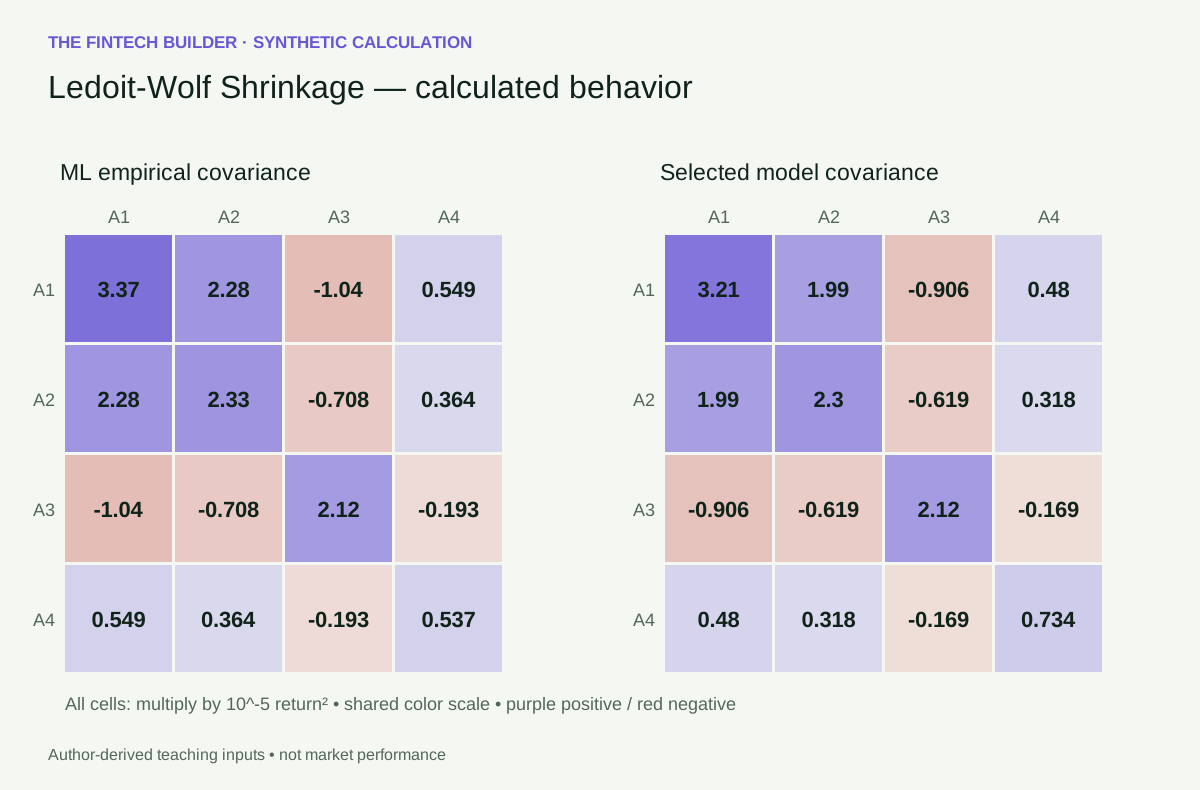
Open this figure at full size.
Freeze the matrix before shrinking it
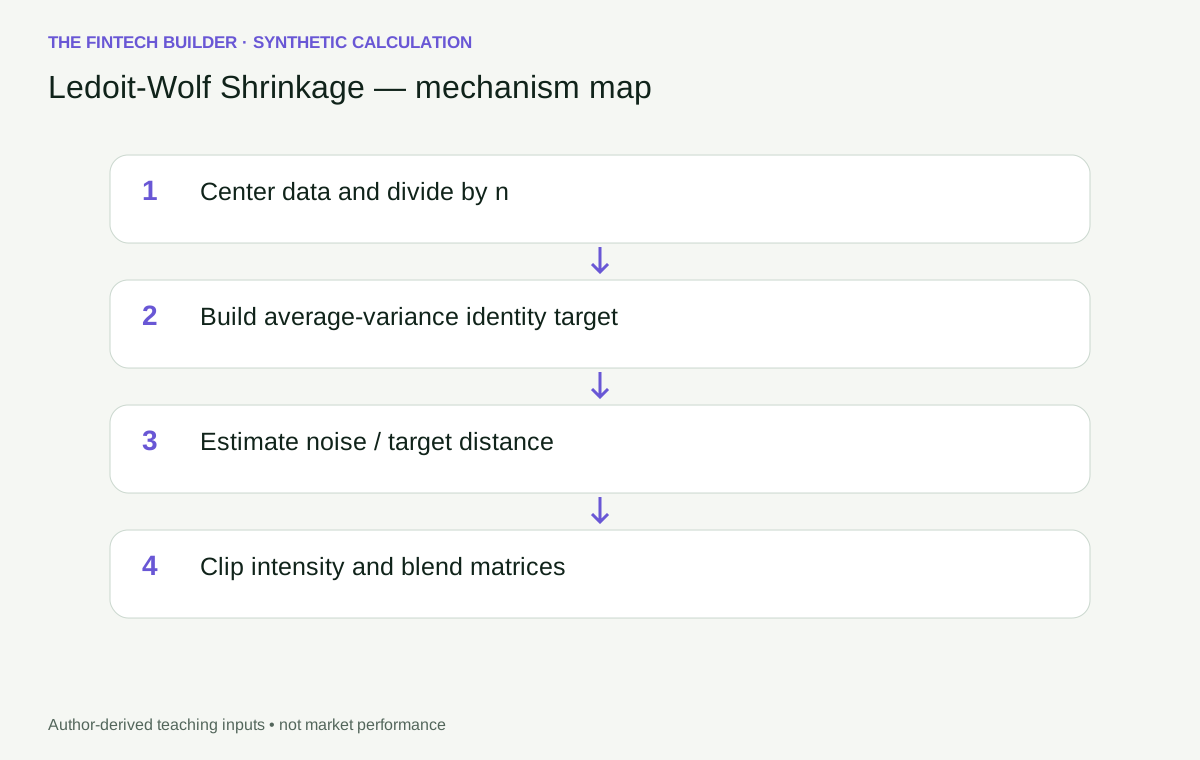
Center the n×p return panel to obtain z_t. Compute the ML covariance C=Σz_tz_tᵀ/n, not the n−1 sample covariance. Let μ=tr(C)/p, so the target μI has the same average variance but zero off-diagonal entries.
The estimate is C_hat=(1−ρ)C+ρμI, with 0≤ρ≤1. The Ledoit–Wolf technical reference documents this scaled-identity shrinkage estimator.
Atρ=0 you retain the empirical matrix. Atρ=1 every variance equals μ and every covariance is zero. Intermediate values move eigenvalues toward μ while preserving the empirical eigenvectors. That algebra explains stabilization, but it does not prove a particular downstream portfolio will perform better.
Estimate noise relative to distance from the target
Define Δ=||C−μI||_F², the squared distance from the empirical matrix to the target. Estimate the variability of observation-level outer products as
Thenρ=clip(B/Δ,0,1). The n² matters: there are n observation contributions, and their average uncertainty must be scaled for the covariance average. Dividing this sum by only n can drive the intensity toward one incorrectly.
If Δ=0, C already equals the target. This implementation reportsρ=0 because no change is needed; the resulting matrix is the same for any intensity. A zero matrix therefore returns a zero matrix, not NaN.
A fully shrunk small example
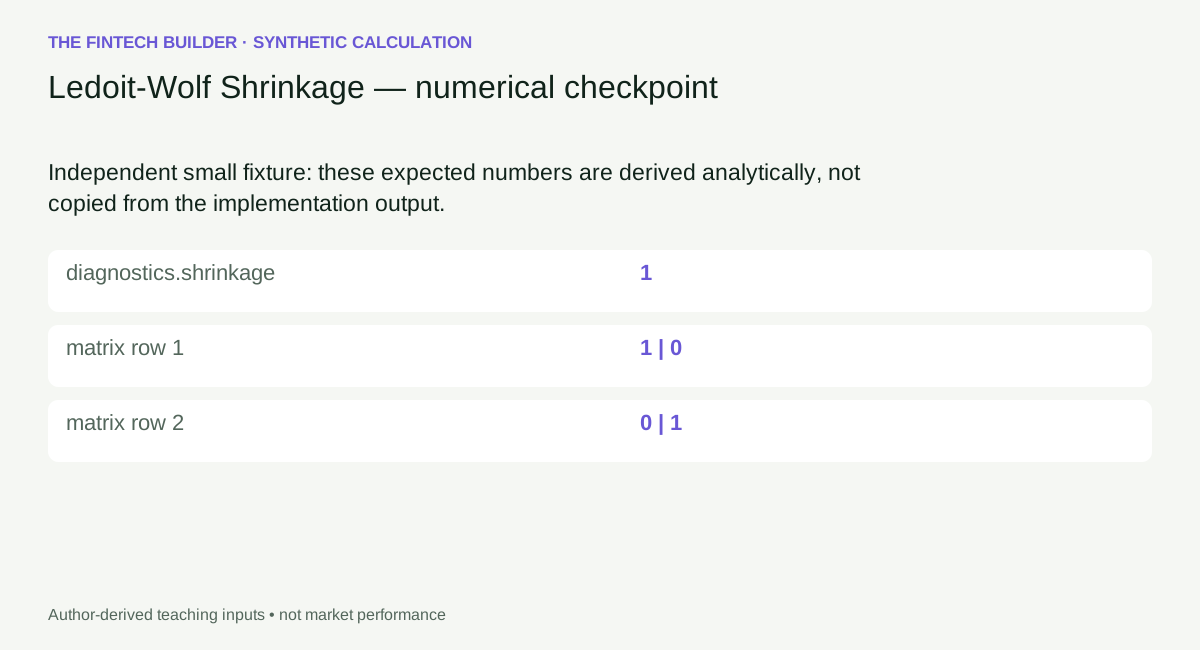
Use the four centered observations from the sample-covariance example: first column[1,1,−1,−1], second column 0.5 times the first plus √0.75 times[1,−1,1,−1]. Their ML covariance is [[1,0.5],[0.5,1]], μ=1 and Δ=0.5.
The sum of outer-product squared errors is 9. Dividing by n²=16 gives B=0.5625. B/Δ=1.125, so clipping gives ρ=1 and C_hat=I. The fixture independently checks that endpoint.
Full shrinkage is possible; it is not the default answer to every dataset. Independent seeded examples in the validation suite produce partial intensities, and the 64-observation lab exposes that behavior. This prevents a broken implementation that always returns the target from passing a single convenient example.
Open this figure at full size.
Download the exact worked input and expected values.
What the target assumes—and does not know
The target treats all assets symmetrically in covariance units. Different asset scales therefore matter. Standardizing assets, shrinking a correlation matrix and then restoring volatilities is a different procedure from directly shrinking their covariance toward μI.
Zero target covariances do not assert that the assets are economically unrelated. The target is a regularization structure. The final off-diagonal terms equal(1−ρ) times their empirical values; the estimator is intentionally reducing reliance on those measured relationships.
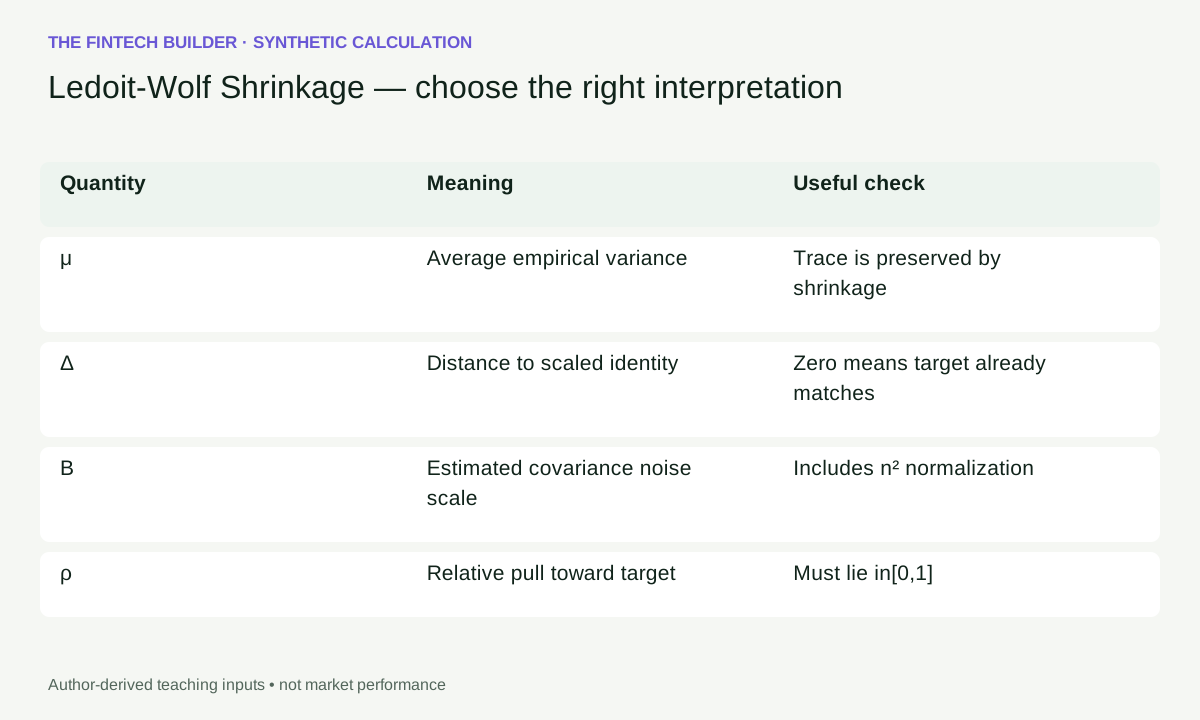
| Quantity | Meaning | Useful check |
|---|---|---|
| μ | Average empirical variance | Trace is preserved by shrinkage |
| Δ | Distance to scaled identity | Zero means target already matches |
| B | Estimated covariance noise scale | Includes n² normalization |
| ρ | Relative pull toward target | Must lie in[0,1] |
Open this figure at full size.
Follow the matrix in the playground
Step adds a complete row to the synthetic panel, recalculating centering, C, B, Δ andρ for that endpoint sample. This is an endpoint estimator; earlier endpoint matrices are recomputed from their own prefixes rather than centered with future means.
Compare the empirical and shrunk heatmaps, then inspect their numeric cells. Increasing the sample prefix can change both the empirical covariance and the estimated intensity; do not attribute every matrix change toρ alone. The zero-data edge case tests the Δ=0 boundary without inventing a division result.
Open this figure at full size.
Open the standalone guided playground. The embedded playground and runnable code are available on this page. Download the 64-observation teaching input.
Implementation checks that catch plausible errors
The tests compare the result and intensity with an independent scikit-learn implementation on several sample sizes and dimensions. They also check the full cross-language outputs, finite zero behavior, trace preservation and invalid inputs. Agreement between two copies of an incorrect formula would not be enough.
The input must be a complete finite aligned return panel. Missing-data estimation, outlier robustness and dynamic covariance forecasting are outside this variant. Shrinkage does not correct a split-adjustment error or a mislabeled asset column.
The direct implementation costs O(np²). It is useful as a transparent baseline when dimension and sample noise make raw covariance unstable. Compare OAS for a different intensity derivation, and judge downstream usefulness with chronological evidence rather than the word “optimal” detached from its estimation criterion.
Reproduce and inspect the calculation
The Python and TypeScript tabs contain standalone implementations, not imports into an unseen runtime. Both expose calculate(input_data). Feed the worked JSON's input object into that entry point. For the longer experiment, use the teaching-path JSON directly.
import json
from pathlib import Path
from ledoit_wolf_shrinkage import calculate

data = json.loads(Path("teaching-path.json").read_text())
result = calculate(data)
print(result["latest"])
import {calculate} from './ledoit_wolf_shrinkage.ts';
const result = calculate(inputData); // inputData is the downloaded JSON object
console.log(result.latest);
Place the downloaded input beside your script and the standalone source on its import path. The Python reference uses the standard library; the TypeScript reference has no external runtime dependency. Shared tests include independent numeric anchors, valid boundaries, rejected inputs and cross-language output comparisons. They establish arithmetic, not forecasting performance.
Evidence and scope
This article uses authored synthetic calculations and primary technical references, reviewed 2026-09-10. Historical market examples are deferred until identity, adjustment basis, chronology and redistribution rights can be verified. No personal trading history or search-ranking superiority is asserted.
ML denominator n, centered observations; scaled-identity target. Isotropic target equality returns rho=0, including zero matrix. This is not sample-denominator shrinkage.
Continue the investigation
- Sample Covariance: compare its assumptions and information boundary before comparing the numbers.
- Graphical-Lasso Covariance: compare its assumptions and information boundary before comparing the numbers.
Rendered from the canonical Mermaid sources linked by this article.
Ledoit-Wolf Shrinkage — calculation-flow
Ledoit-Wolf Shrinkage — decision-boundary
ReferencesPrimary sources and evidence notesExpand the source trail, evidence role, and limitations behind the engineering choices.
Expand the source trail, evidence role, and limitations behind the engineering choices.
Reviewed 2026-09-10. Primary technical documentation and papers; synthetic arithmetic is author-derived. This is a targeted source review, not a verified review of Google's top ten results and not a claim of ranking superiority.
- S1: scikit-learn — ledoit_wolf API and implementation notes — accessed 2026-09-10. Rolling official documentation snapshot; exact package versions used for numerical comparisons are recorded in the repair numeric-evidence.json. Supports the definition and declared convention, not investment performance. Jurisdiction: not applicable to this mathematical reference.
Scope of evidence
ML denominator n, centered observations; scaled-identity target. Isotropic target equality returns rho=0, including zero matrix. This is not sample-denominator shrinkage.
Historical case: deferred. No public provider dataset, historical performance claim, or personal trading anecdote is used. Synthetic examples demonstrate arithmetic, not market efficacy. Sources are not copied as article prose.
Accessed: 2026-09-10.
Supports: estimator definition and the explicitly declared variants.
Limitations: technical documentation does not verify a real market feed, author experience, forecast efficacy or search-result superiority. Original-paper access limitations are recorded in the repair report.
Full dependency-light reference implementations in both supported languages.
/** Standalone D10-F04-A03 reference. Generated from validated D10 v2 source. */
export class ContractError extends Error {}
type RecordValue=Record<string, any>;
type Matrix=number[][];
const sum=(x:number[]):number=>x.reduce((a,b)=>a+b,0);


function requireValue(ok: unknown, code: string, message: string): asserts ok {
  if (!ok) throw new ContractError(`${code}: ${message}`);
}

function finite(x: unknown, name: string): number {
  requireValue(typeof x === 'number' && Number.isFinite(x), 'NUMBER', `${name} must be a finite number`);
  return x;
}

function integer(x: unknown, name: string, minimum = 0, maximum = 10000): number {
  const v = finite(x, name);
  requireValue(Number.isInteger(v) && v >= minimum && v <= maximum, 'INTEGER', `${name} must be an integer in [${minimum}, ${maximum}]`);
  return v;
}

function param(p: RecordValue, key: string, fallback: number): number {
  return finite(Object.hasOwn(p, key) ? p[key] : fallback, key);
}

function option(p: RecordValue, key: string, fallback: any): any {
  return Object.hasOwn(p, key) ? p[key] : fallback;
}

function positive(p: RecordValue, key: string, fallback: number): number {
  const v = param(p, key, fallback);
  requireValue(v > 0, 'RANGE', `${key} must be positive`);
  return v;
}

function vector(value: unknown, name: string, minimum = 1): number[] {
  requireValue(Array.isArray(value) && value.length >= minimum, 'SHAPE', `${name} needs ${minimum} or more values`);
  return value.map((v, i) => finite(v, `${name}[${i}]`));
}

function matrix(value: unknown, name: string, minRows = 1, minCols = 1): Matrix {
  requireValue(Array.isArray(value) && value.length >= minRows, 'SHAPE', `${name}: too few rows`);
  const rows = value.map(row => vector(row, name, minCols));
  requireValue(rows.every(row => row.length === rows[0].length), 'SHAPE', `${name} must be rectangular`);
  return rows;
}

function eye(n: number, value = 1): Matrix {
  return Array.from({length: n}, (_, i) => Array.from({length: n}, (_, j) => i === j ? value : 0));
}

function psd(a: Matrix, name: string, strict = false): number | null {
  const n = a.length;
  requireValue(a.every(row => row.length === n), 'SHAPE', `${name} must be square`);
  const tolerance = 1e-12 * Math.max(...a.flat().map(Math.abs), 1e-300);
  requireValue(a.every((row, i) => row.every((v, j) => Math.abs(v - a[j][i]) <= tolerance)), 'PSD', `${name} must be symmetric`);
  const lower = eye(n), pivots: number[] = [];
  for (let j = 0; j < n; j++) {
    const pivot = a[j][j] - sum(pivots.map((v, k) => lower[j][k] ** 2 * v));
    requireValue(strict ? pivot > tolerance : pivot >= -tolerance, 'PSD', `${name} must be positive semidefinite (strict when requested)`);
    pivots.push(pivot > tolerance ? pivot : 0);
    for (let i = j + 1; i < n; i++) {
      const residual = a[i][j] - sum(pivots.slice(0, j).map((v, k) => lower[i][k] * lower[j][k] * v));
      requireValue(pivots[j] !== 0 || Math.abs(residual) <= tolerance, 'PSD', `${name} has invalid zero pivot`);
      lower[i][j] = pivots[j] ? residual / pivots[j] : 0;
    }
  }
  return strict ? sum(pivots.map(Math.log)) : null;
}

function inverse(a: Matrix): Matrix {
  const n = a.length, identity = eye(n), work = a.map((row, i) => [...row, ...identity[i]]);
  for (let j = 0; j < n; j++) {
    let k = j;
    for (let i = j + 1; i < n; i++) if (Math.abs(work[i][j]) > Math.abs(work[k][j])) k = i;
    [work[j], work[k]] = [work[k], work[j]];
    requireValue(work[j][j] !== 0, 'NUMERIC', 'singular inverse');
    const pivot = work[j][j];
    work[j] = work[j].map(v => v / pivot);
    for (let i = 0; i < n; i++) if (i !== j) {
      const factor = work[i][j];
      work[i] = work[i].map((v, l) => v - factor * work[j][l]);
    }
  }
  return work.map(row => row.slice(n));
}

function glassoCovariance(S: Matrix, alpha: number, maxIter = 200, tol = 1e-8): [Matrix, RecordValue] {
  const n = S.length;
  requireValue(n >= 2 && n <= 12 && alpha > 0 && Math.min(...S.map((row, i) => row[i])) > 0, 'RANGE', 'glasso needs 2..12 nonconstant assets and positive alpha');
  const scale = Math.max(...S.map((row, i) => row[i])), C = S.map(row => row.map(v => v / scale)), penalty = alpha / scale;
  // Dual-feasible SPD initialization; a diagonal start is not generally feasible.
  const maximumOff = Math.max(...C.flatMap((row, i) => row.filter((_, j) => i !== j).map(Math.abs)));
  const blend = maximumOff ? Math.min(.1, penalty / maximumOff) : .1;
  const W = C.map((row, i) => row.map((v, j) => i === j ? v : (1 - blend) * v)), history: RecordValue[] = [];
  for (let iteration = 0; iteration < maxIter; iteration++) {
    for (let j = 0; j < n; j++) {
      const indices = Array.from({length: n}, (_, i) => i).filter(i => i !== j), beta = indices.map(() => 0);
      for (let inner = 0; inner < 2000; inner++) {
        let change = 0;
        indices.forEach((i, k) => {
          const partial = C[i][j] - sum(indices.map((q, l) => l === k ? 0 : W[i][q] * beta[l]));
          const updated = Math.sign(partial) * Math.max(Math.abs(partial) - penalty, 0) / W[i][i];
          change = Math.max(change, Math.abs(updated - beta[k])); beta[k] = updated;
        });
        if (change < tol * 1e-5) break;
      }
      const values = indices.map(i => sum(indices.map((q, l) => W[i][q] * beta[l])));
      indices.forEach((i, k) => { W[i][j] = W[j][i] = values[k]; });
    }
    const logdet = psd(W, 'glasso covariance', true)!, precision = inverse(W);
    let residual = 0, trace = 0, l1 = 0;
    for (let i = 0; i < n; i++) for (let j = 0; j < n; j++) {
      const gradient = C[i][j] - W[i][j];
      const trial = precision[i][j] - gradient;
      const prox = Math.sign(trial) * Math.max(Math.abs(trial) - penalty, 0);
      const error = i === j ? Math.abs(gradient) : Math.abs(precision[i][j] - prox);
      residual = Math.max(residual, error); trace += C[i][j] * precision[j][i];
      if (i !== j) l1 += penalty * Math.abs(precision[i][j]);
    }
    const gap = trace - n + l1;
    history.push({iteration: iteration + 1, kkt_residual: residual, dual_gap: gap, objective: trace + logdet + l1 + n * Math.log(scale)});
    if (residual <= tol && Math.abs(gap) <= tol * Math.max(1, n)) return [W.map(row => row.map(v => v * scale)),
      {iterations: iteration + 1, converged: true, alpha, precision: precision.map(row => row.map(v => v / scale)), kkt_residual: residual, dual_gap: gap, history}];
  }
  throw new ContractError('CONVERGENCE: graphical lasso did not satisfy KKT and dual-gap tolerances; iteration budget exhausted');
}

function covariance(data: RecordValue, p: RecordValue, kind: string): RecordValue {
  if (kind === 'factor_covariance') {
    const B = matrix(data.loadings, 'loadings', 2), F = matrix(data.factor_covariance, 'factor_covariance'), D = vector(data.specific_variances, 'specific_variances');
    const assets = B.length, factors = B[0].length;
    requireValue(F.length === factors && D.length === assets, 'SHAPE', 'factor dimensions do not match');
    psd(F, 'factor_covariance'); requireValue(Math.min(...D) >= 0, 'RANGE', 'specific variances must be nonnegative');
    const common = B.map(row => B.map(other => sum(row.map((v, k) => sum(other.map((u, l) => v * F[k][l] * u))))));
    const result = common.map((row, i) => row.map((v, j) => v + (i === j ? D[i] : 0)));
    return {matrix: result, latest: result, ready: true, ready_at: 0, diagnostics: {common, specific_variances: D, assets, factors, causal: true}};
  }
  const X = matrix(data.returns, 'returns', 2, 2), n = X.length, dim = X[0].length;
  const means = X[0].map((_, j) => sum(X.map(row => row[j])) / n), Z = X.map(row => row.map((v, j) => v - means[j]));
  const C = X[0].map((_, i) => X[0].map((_, j) => sum(Z.map(z => z[i] * z[j])) / n));
  const diagnostics: RecordValue = {observations: n, assets: dim, means, causal: true, ml_covariance: C};
  let result: Matrix;
  if (kind === 'sample_covariance') { result = C.map(row => row.map(v => v * n / (n - 1))); diagnostics.denominator = n - 1; }
  else if (kind === 'ewma_covariance') {
    const decay = param(p, 'decay', .94);
    requireValue(decay > 0 && decay < 1, 'RANGE', 'decay must be in (0,1)');
    result = Object.hasOwn(data, 'initial_covariance') ? matrix(data.initial_covariance, 'initial_covariance') : eye(dim, 0);
    requireValue(result.length === dim, 'SHAPE', 'initial covariance dimensions mismatch'); psd(result, 'initial_covariance');
    const states: Matrix[] = [];
    for (const row of X) { result = result.map((old, i) => old.map((v, j) => decay * v + (1 - decay) * row[i] * row[j])); states.push(result); }
    Object.assign(diagnostics, {states, mean_convention: 'supplied zero-mean residuals', weight_mass: 1 - decay ** n, seed_weight: decay ** n});
  } else if (kind === 'graphical_lasso') {
    const solver = glassoCovariance(C, positive(p, 'alpha', .00002), integer(option(p, 'max_iter', 200), 'max_iter', 1, 2000), positive(p, 'tolerance', 1e-8));
    result = solver[0]; diagnostics.graphical_lasso = solver[1];
  } else {
    const trace = sum(C.map((row, i) => row[i])), mu = trace / dim, tr2 = sum(C.flat().map(v => v * v));
    const delta = sum(C.flatMap((row, i) => row.map((v, j) => (v - (i === j ? mu : 0)) ** 2)));
    let rho: number;
    if (kind === 'ledoit_wolf') {
      const noise = sum(Z.map(z => sum(C.flatMap((row, i) => row.map((v, j) => (z[i] * z[j] - v) ** 2))))) / n ** 2;
      rho = delta > 0 ? Math.min(1, Math.max(0, noise / delta)) : 0;
      Object.assign(diagnostics, {noise_estimate: noise, target_distance: delta});
    } else {
      const numerator = (1 - 2 / dim) * tr2 + trace * trace, denominator = (n + 1 - 2 / dim) * (tr2 - trace * trace / dim);
      rho = tr2 === 0 ? 0 : denominator > 1e-14 * tr2 ? Math.min(1, Math.max(0, numerator / denominator)) : 1;
      Object.assign(diagnostics, {numerator, denominator, variant: 'original finite-p OAS'});
    }
    result = C.map((row, i) => row.map((v, j) => (1 - rho) * v + (i === j ? rho * mu : 0)));
    Object.assign(diagnostics, {shrinkage: rho, target: mu});
  }
  return {matrix: result, latest: result, ready: true, ready_at: 0, diagnostics};
}
export function calculate(data: RecordValue): RecordValue {
  requireValue(data && typeof data === 'object' && !Array.isArray(data),'SHAPE','input must be an object');
  const p=Object.hasOwn(data,'parameters')?data.parameters:{};
  requireValue(p && typeof p === 'object' && !Array.isArray(p),'SHAPE','parameters must be an object');
  const result=covariance(data,p,"ledoit_wolf");
  function check(v:any):void {
    if(typeof v==='number')requireValue(Number.isFinite(v),'NUMERIC','nonfinite computed output');
    else if(Array.isArray(v))v.forEach(check);
    else if(v && typeof v==='object')Object.values(v).forEach(check);
  }
  check(result);
  return {topic_id:"D10-F04-A03",title:"Ledoit-Wolf Shrinkage",parameters:p,...result};
}
The embedded lab now expands to its full document height, keeping the article as the only scroll surface.