
 By Islam Baraka
Two analysts can run “the same” time-series diagnostic and obtain different answers without either making an arithmetic error. One centered an ACF with a common denominator; another used an adjusted denominator. One ADF regression included a trend; another included only a constant. The lesson is not to distrust diagnostics. It is to make the statistical question visible.
By the end, you will be able to compute biased Yule-Walker partial autocorrelations by Levinson-Durbin recursion, interpret each reflection coefficient as an incremental linear lag relationship, and explain why a changed result may reflect an analyst choice rather than a changed process.
The practical decision
Does lag k add linear information after lags 1 through k−1 are controlled? The method helps isolate each lag’s incremental linear association using the biased Yule–Walker equations. It does not choose a position, forecast a return, or establish a causal mechanism.
Prerequisites and scope
ACF, autoregressive lag notation, linear projection, and the idea that estimator choice changes finite-sample output.
This tutorial freezes {"max_lag": 12}. That choice is deliberately narrower than the alternatives documented by the official statsmodels PACF documentation. The source establishes library semantics; the fixture and displayed arithmetic are project-authored.
Start with the null and its direction
PACF bars are estimator outputs; the displayed band is a white-noise heuristic and model-order clues are not proofs. That sentence belongs beside the chart because a decision word by itself invites overclaiming.
The comparison is strict. Equality with the configured boundary does not reject. This detail sounds small, but an untested <= in place of < changes a boundary result and can quietly split Python and TypeScript behavior.
Intuition before notation
Use biased autocorrelations, then apply the Levinson-Durbin reflection-coefficient recursion.
The central mental model is: transform the same ordered sample, expose the intermediate evidence, normalize once under a declared convention, and only then apply the null-specific rule.
Formula and symbols
| Symbol | Meaning | Unit |
|---|---|---|
rho_k | selected biased sample ACF at lag k | unitless |
phi_kk | lag-k reflection coefficient / PACF | unitless |
phi_(k-1,j) | order k-1 recursion coefficient j | unitless |
v_k | normalized prediction-error variance after order k | unitless |
h | maximum requested lag | observations |
Material variants
| Variant | What changes | Main limitation |
|---|---|---|
| Biased Yule-Walker / Levinson-Durbin (selected) | Uses unadjusted autocovariances and recursive reflection coefficients. | Not the current statsmodels default. |
| Adjusted Yule-Walker | Changes autocovariance denominators by lag. | Can perform worse in finite samples and changes the recursion. |
| OLS | Regresses the series on its own lags. | Samples and bias adjustments differ across OLS variants. |
| Burg | Estimates reflection coefficients through forward/backward prediction errors. | A different estimator, not a computational shortcut for this contract. |
These variants are not spelling differences. They can change finite-sample values, reference distributions, and interpretation.
Walk the deterministic known-DGP fixture
Synthetic teaching input: the canonical ar1-stationary scenario contains 96 deterministic observations. For the AR(1) fixture, phi_11 = 0.664384737. At lag 2, rho_2 = 0.440770765 and the numerator rho_2 - phi_11*rho_1 is -0.000636314, giving phi_22 = -0.001139137 after division by v_1 = 0.558592921.
The reference implementation returns 0.664385 and state estimated. An independent NumPy/SciPy route reproduces the checkpoint without importing either reference implementation.
What to notice in the calculation visual: every displayed number is either a parameter, an intermediate author-derived value, or the final bounded state.
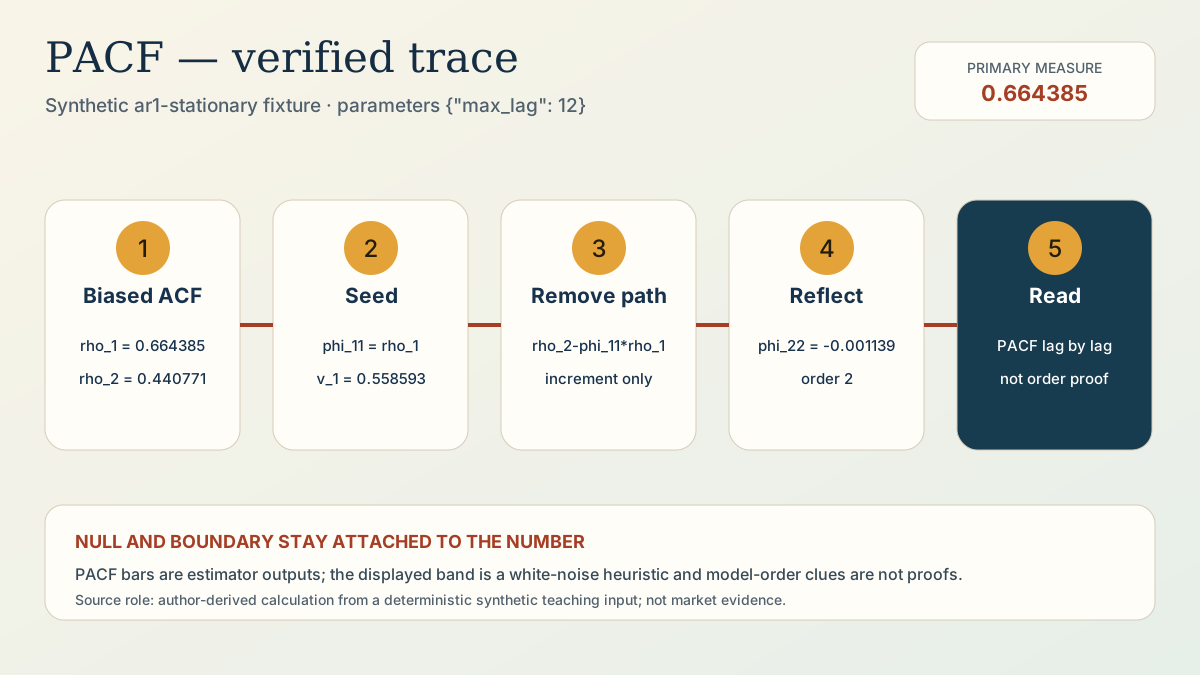
Open the full-size calculation visual.
Implementation walkthrough
The Python and TypeScript references follow the same explicit stages:
compute biased ACF through h
seed phi_11 = rho_1 and v_1 = 1-rho_1^2
for k from 2 through h:
    reflection = (rho_k - sum(phi_(k-1,j)*rho_(k-j))) / v_(k-1)
    update earlier coefficients symmetrically
    v_k = v_(k-1) * (1-reflection^2)
    fail if v_k is nonpositive
return each reflection coefficient
The APIs reject missing/non-finite input, impossible lag/trim settings, and singular states. They return intermediate terms for auditability instead of returning only a color or Boolean. The full family module is copied into each package intentionally so every tutorial is executable in isolation; the topic example calls only the selected method.
Testing the definition, not a screenshot
The canonical fixture is necessary but not sufficient. The family-scoped checks also cover:
- malformed and too-short input;
- the exact equality direction at the decision boundary;
- translation and nonzero-scale invariance where the formula implies it;
- a comparison scenario from another known generating process;
- Python/TypeScript value, state, and reason parity;
- an independent formula or OLS route.
Passing those checks proves implementation agreement with this contract. It does not prove that the diagnostic has economic value.
Compare nearby scenarios
The playground includes white noise, AR(1), AR(2), MA(1), seasonal AR(12), near-unit-root, random-walk, trend-stationary, and level-break cases. Each contains 96 points. That variety matters:
- AR and MA cases separate gradual decay from an approximate cutoff.
- Seasonal dependence can be invisible when the maximum lag is too short.
- A near-unit-root process is stationary by construction but can still produce an inconclusive finite-sample test.
- A deterministic trend can make a level-stationarity specification fail for the right reason.
- A level break can distort a no-break unit-root diagnosis.
Use the guided scenario laboratory to change one data-generating process or parameter preset at a time.
Read disagreements before chasing certainty
PACF removes the linear contribution of intervening lags, while ACF retains it. A disagreement between diagnostics may be the useful finding: the data may be near a boundary, trend-stationary rather than level-stationary, structurally broken, or underpowered at this sample size.
Use PACF after ACF. An AR(p) process may show a PACF cutoff near p, but finite samples, seasonality, and estimator choice prevent a mechanical order rule.
Failure modes and what the output cannot authorize
The result cannot prove independence, identify a causal mechanism, guarantee future stability, or justify a position. Window, lag, deterministic-term, and missing-data choices belong in the decision record. If those choices were selected after viewing results, treat the output as exploratory and validate on a later untouched window.
- Look-ahead: selecting a window or break narrative after observing future values turns confirmation into exploration.
- Revision: a revised macro series cannot be treated as the history available to an earlier decision.
- Missing periods: dropping a timestamp changes which values are lag neighbors.
- Multiple testing: trying many lags and reporting one attractive bar changes the error rate.
- Nonlinearity: zero linear autocorrelation does not establish independence or constant variance.
Historical-example decision — not-useful
A named security or famous event would add story value without revealing the true statistical process. The synthetic cases are preferable because their order, integration, seasonality, and break are known before calculation. Original papers supply methodological context; they do not turn this fixture into empirical market evidence.
Summary and handoff
You can now inspect the declared variant, reproduce the intermediate evidence, apply the strict null rule, and identify specification sensitivity. Continue to Augmented Dickey-Fuller, which answers a different question rather than replacing this result.
Rendered from the canonical Mermaid sources linked by this article.
PACF decision flow
Purpose: show the selected method’s exact calculation stages and the branch from arithmetic into bounded interpretation.
Takeaway: the result is valid only for the declared transform, parameters, null, and sample. The next method answers a different question.
ReferencesPrimary sources and evidence notesExpand the source trail, evidence role, and limitations behind the engineering choices.
Expand the source trail, evidence role, and limitations behind the engineering choices.
Last evidence review: 2026-07-27
SM-ACF — statsmodels.tsa.stattools.acf
- Organization or authors: statsmodels developers
- Source type: Official maintained technical documentation
- Publication or effective date: 2025-12-05
- Version: statsmodels 0.14.6
- URL or DOI: https://www.statsmodels.org/stable/generated/statsmodels.tsa.stattools.acf.html
- Accessed: 2026-07-27
- Jurisdiction / applicability: Methodology is not jurisdiction-specific; software semantics apply to statsmodels 0.14.6.
- Evidence role: Sourced fact for the method, null, estimator variants, or maintained-library semantics—not evidence for the synthetic fixture.
- Supports: ACF lag-zero convention, adjusted versus unadjusted denominators, missing-value choices, and confidence-band caveats.
- Limitations: This package implements a direct O(nh) estimator and one explicit missing-value policy; it does not reproduce every statsmodels option.
- Publication boundary: Link and paraphrase only; no restricted data payload is republished.
SM-PACF — statsmodels.tsa.stattools.pacf
- Organization or authors: statsmodels developers
- Source type: Official maintained technical documentation
- Publication or effective date: 2025-12-05
- Version: statsmodels 0.14.6
- URL or DOI: https://www.statsmodels.org/stable/generated/statsmodels.tsa.stattools.pacf.html
- Accessed: 2026-07-27
- Jurisdiction / applicability: Methodology is not jurisdiction-specific; software semantics apply to statsmodels 0.14.6.
- Evidence role: Sourced fact for the method, null, estimator variants, or maintained-library semantics—not evidence for the synthetic fixture.
- Supports: PACF estimator variants and the fact that Yule–Walker, OLS, Levinson–Durbin, and Burg are not interchangeable defaults.
- Limitations: The package freezes biased Yule–Walker/Levinson–Durbin rather than copying the documentation’s default adjusted estimator.
- Publication boundary: Link and paraphrase only; no restricted data payload is republished.
Evidence decisions
- Sourced fact: maintained documentation and original papers establish the method, null, and material variants.
- Implementation choice: denominator, estimator, deterministic terms, lag/bandwidth, trim, and any critical boundary are frozen by this package.
- Synthetic teaching input: all scenario values come from the archived deterministic generator; none is a provider observation.
- Author-derived calculation: expected outputs and worked arithmetic are calculated from those synthetic inputs and independently checked.
- Historical example — not-useful: a controlled known-DGP case reveals whether the diagnostic behaves as designed; a named market case cannot reveal the true process and would add selection and causal-storytelling risks.
Full dependency-light reference implementations in both supported languages.
export type DiagnosticResult = Record<string, unknown>;

const EPS = 1e-12;

function series(values: number[], minimum = 8): number[] {
  if (!Array.isArray(values) || values.length < minimum ||
      values.some((value) => !Number.isFinite(value))) {
    throw new Error(`values must contain at least ${minimum} finite observations`);
  }
  return values.map(Number);
}

function integer(name: string, value: number, low: number, high: number): number {
  if (!Number.isInteger(value) || value < low || value > high) {
    throw new Error(`${name} must be an integer in [${low}, ${high}]`);
  }
  return value;
}

function numberIn(name: string, value: number, low: number, high: number): number {
  if (!Number.isFinite(value) || value < low || value > high) {
    throw new Error(`${name} must be finite and in [${low}, ${high}]`);
  }
  return value;
}

export function acf(values: number[], maxLag = 12): DiagnosticResult {
  const x = series(values);
  integer("maxLag", maxLag, 1, x.length - 1);
  const mean = x.reduce((a, b) => a + b, 0) / x.length;
  const centered = x.map((value) => value - mean);
  const denominator = centered.reduce((sum, value) => sum + value * value, 0);
  if (denominator <= EPS) throw new Error("ACF is undefined for a constant series");
  const numerators = [denominator];
  const coefficients = [1];
  for (let lag = 1; lag <= maxLag; lag += 1) {
    let numerator = 0;
    for (let index = lag; index < x.length; index += 1) {
      numerator += centered[index] * centered[index - lag];
    }
    numerators.push(numerator);
    coefficients.push(numerator / denominator);
  }
  return {
    method: "acf", variant: "centered-unadjusted-direct", nobs: x.length,
    max_lag: maxLag, mean, denominator, numerators, coefficients,
    confidence_95: 1.96 / Math.sqrt(x.length), state: "estimated",
    reason: "finite centered series with nonzero variance",
  };
}

export function pacf(values: number[], maxLag = 12): DiagnosticResult {
  const x = series(values);
  integer("maxLag", maxLag, 1, Math.min(x.length - 1, Math.floor(x.length / 2)));
  const rho = acf(x, maxLag).coefficients as number[];
  const coefficients = [1, rho[1]];
  const recursion: Record<string, number>[] = [
    {lag: 1, reflection: rho[1], prediction_variance: 1 - rho[1] ** 2},
  ];
  let phi = [rho[1]];
  let innovation = 1 - rho[1] ** 2;
  if (innovation <= EPS) throw new Error("PACF recursion is singular at lag 1");
  for (let lag = 2; lag <= maxLag; lag += 1) {
    let numerator = rho[lag];
    for (let index = 1; index < lag; index += 1) {
      numerator -= phi[index - 1] * rho[lag - index];
    }
    const reflection = numerator / innovation;
    const updated = phi.map((value, index) => value - reflection * phi[lag - index - 2]);
    updated.push(reflection);
    innovation *= 1 - reflection ** 2;
    if (innovation <= EPS) throw new Error(`PACF prediction variance is nonpositive at lag ${lag}`);
    phi = updated;
    coefficients.push(reflection);
    recursion.push({lag, reflection, prediction_variance: innovation});
  }
  return {
    method: "pacf", variant: "biased-yule-walker-levinson-durbin",
    nobs: x.length, max_lag: maxLag, coefficients, acf_coefficients: rho,
    recursion, confidence_95: 1.96 / Math.sqrt(x.length), state: "estimated",
    reason: "positive prediction variance through requested lag",
  };
}

function inverse(matrix: number[][]): number[][] {
  const n = matrix.length;
  const a = matrix.map((row, i) => [...row, ...Array.from({length: n}, (_, j) => i === j ? 1 : 0)]);
  for (let column = 0; column < n; column += 1) {
    let pivot = column;
    for (let row = column + 1; row < n; row += 1) {
      if (Math.abs(a[row][column]) > Math.abs(a[pivot][column])) pivot = row;
    }
    if (Math.abs(a[pivot][column]) <= EPS) throw new Error("regression design is singular");
    [a[column], a[pivot]] = [a[pivot], a[column]];
    const scale = a[column][column];
    a[column] = a[column].map((value) => value / scale);
    for (let row = 0; row < n; row += 1) {
      if (row === column) continue;
      const factor = a[row][column];
      a[row] = a[row].map((value, j) => value - factor * a[column][j]);
    }
  }
  return a.map((row) => row.slice(n));
}

function ols(y: number[], design: number[][]) {
  const rows = design.length;
  const columns = design[0]?.length ?? 0;
  if (!rows || y.length !== rows || rows <= columns) throw new Error("invalid regression dimensions");
  const xtx = Array.from({length: columns}, (_, i) =>
    Array.from({length: columns}, (_, j) =>
      design.reduce((sum, row) => sum + row[i] * row[j], 0)));
  const xty = Array.from({length: columns}, (_, i) =>
    design.reduce((sum, row, r) => sum + row[i] * y[r], 0));
  const inv = inverse(xtx);
  const beta = inv.map((row) => row.reduce((sum, value, j) => sum + value * xty[j], 0));
  const residuals = y.map((actual, r) =>
    actual - design[r].reduce((sum, value, c) => sum + value * beta[c], 0));
  const sse = residuals.reduce((sum, value) => sum + value * value, 0);
  const df = rows - columns;
  const sigma2 = sse / df;
  const stderr = inv.map((row, index) => Math.sqrt(Math.max(0, sigma2 * row[index])));
  return {beta, stderr, residuals, sse, sigma2, df_resid: df, nobs: rows};
}

export function adf(values: number[], lags = 1, criticalValue = -2.86): DiagnosticResult {
  const x = series(values, 16);
  integer("lags", lags, 0, Math.min(12, Math.floor(x.length / 4)));
  numberIn("criticalValue", criticalValue, -20, -0.1);
  const differences = x.slice(1).map((value, index) => value - x[index]);
  const response: number[] = [];
  const design: number[][] = [];
  for (let time = lags + 1; time < x.length; time += 1) {
    response.push(differences[time - 1]);
    const laggedDifferences = Array.from({length: lags}, (_, index) =>
      differences[time - index - 2]);
    design.push([1, x[time - 1], ...laggedDifferences]);
  }
  const regression = ols(response, design);
  const statistic = regression.beta[1] / regression.stderr[1];
  const reject = statistic < criticalValue;
  return {
    method: "adf", variant: "constant-only-fixed-lag", nobs: x.length,
    regression_nobs: regression.nobs, lags, gamma: regression.beta[1],
    gamma_standard_error: regression.stderr[1], statistic,
    critical_value: criticalValue, reject_null: reject,
    state: reject ? "reject-unit-root" : "fail-to-reject-unit-root",
    reason: reject ? "statistic-below-boundary" : "statistic-not-below-boundary",
    coefficients: regression.beta, residual_sse: regression.sse, df_resid: regression.df_resid,
  };
}

export function kpss(values: number[], lags = 5, criticalValue = 0.463): DiagnosticResult {
  const x = series(values, 16);
  integer("lags", lags, 0, Math.min(12, x.length - 2));
  numberIn("criticalValue", criticalValue, 0.001, 10);
  const mean = x.reduce((a, b) => a + b, 0) / x.length;
  const residuals = x.map((value) => value - mean);
  let running = 0;
  const cumulative = residuals.map((value) => (running += value));
  const numerator = cumulative.reduce((sum, value) => sum + value * value, 0) / x.length ** 2;
  let longRunSum = residuals.reduce((sum, value) => sum + value * value, 0);
  const covarianceTerms: Record<string, number>[] = [];
  for (let lag = 1; lag <= lags; lag += 1) {
    let crossProduct = 0;
    for (let index = lag; index < x.length; index += 1) {
      crossProduct += residuals[index] * residuals[index - lag];
    }
    const weight = 1 - lag / (lags + 1);
    longRunSum += 2 * weight * crossProduct;
    covarianceTerms.push({lag, weight, cross_product: crossProduct});
  }
  const longRunVariance = longRunSum / x.length;
  if (longRunVariance <= EPS) throw new Error("KPSS long-run variance must be positive");
  const statistic = numerator / longRunVariance;
  const reject = statistic > criticalValue;
  return {
    method: "kpss", variant: "level-stationary-fixed-bartlett-bandwidth",
    nobs: x.length, lags, residual_mean: residuals.reduce((a, b) => a + b, 0) / x.length,
    partial_sum_numerator: numerator, long_run_variance: longRunVariance,
    covariance_terms: covarianceTerms, statistic, critical_value: criticalValue,
    reject_null: reject,
    state: reject ? "reject-level-stationarity" : "fail-to-reject-level-stationarity",
    reason: reject ? "statistic-above-boundary" : "statistic-not-above-boundary",
  };
}

function logGamma(value: number): number {
  const c = [0.99999999999980993, 676.5203681218851, -1259.1392167224028,
    771.32342877765313, -176.61502916214059, 12.507343278686905,
    -0.13857109526572012, 9.9843695780195716e-6, 1.5056327351493116e-7];
  if (value < 0.5) return Math.log(Math.PI) - Math.log(Math.sin(Math.PI * value)) - logGamma(1 - value);
  const z = value - 1;
  let total = c[0];
  for (let i = 1; i < c.length; i += 1) total += c[i] / (z + i);
  const t = z + 7.5;
  return 0.5 * Math.log(2 * Math.PI) + (z + 0.5) * Math.log(t) - t + Math.log(total);
}

function gammaQ(shape: number, value: number): number {
  if (value === 0) return 1;
  if (value < shape + 1) {
    let term = 1 / shape;
    let total = term;
    let ap = shape;
    for (let i = 0; i < 200; i += 1) {
      ap += 1; term *= value / ap; total += term;
      if (Math.abs(term) < Math.abs(total) * 1e-15) break;
    }
    const p = total * Math.exp(-value + shape * Math.log(value) - logGamma(shape));
    return Math.max(0, Math.min(1, 1 - p));
  }
  let b = value + 1 - shape;
  let c = 1 / 1e-300;
  let d = 1 / b;
  let h = d;
  for (let i = 1; i <= 200; i += 1) {
    const an = -i * (i - shape);
    b += 2; d = an * d + b; if (Math.abs(d) < 1e-300) d = 1e-300;
    c = b + an / c; if (Math.abs(c) < 1e-300) c = 1e-300;
    d = 1 / d;
    const delta = d * c; h *= delta;
    if (Math.abs(delta - 1) < 1e-15) break;
  }
  return Math.max(0, Math.min(1,
    Math.exp(-value + shape * Math.log(value) - logGamma(shape)) * h));
}

export function ljungBox(values: number[], lags = 12, modelDf = 0, alpha = 0.05): DiagnosticResult {
  const x = series(values, 16);
  integer("lags", lags, 1, Math.min(24, x.length - 1));
  integer("modelDf", modelDf, 0, lags - 1);
  numberIn("alpha", alpha, 0.0001, 0.5);
  const correlation = acf(x, lags).coefficients as number[];
  const terms = Array.from({length: lags}, (_, index) => {
    const lag = index + 1;
    return {lag, acf: correlation[lag], term: correlation[lag] ** 2 / (x.length - lag)};
  });
  const statistic = x.length * (x.length + 2) *
    terms.reduce((sum, item) => sum + item.term, 0);
  const degreesOfFreedom = lags - modelDf;
  const pValue = gammaQ(degreesOfFreedom / 2, statistic / 2);
  const reject = pValue < alpha;
  return {
    method: "ljung_box", variant: "demeaned-residual-portmanteau",
    nobs: x.length, lags, model_df: modelDf, degrees_of_freedom: degreesOfFreedom,
    terms, statistic, p_value: pValue, alpha, reject_null: reject,
    state: reject ? "reject-residual-whiteness" : "fail-to-reject-residual-whiteness",
    reason: reject ? "p-value-below-alpha" : "p-value-not-below-alpha",
  };
}

export function zivotAndrews(
  values: number[], lags = 1, trim = 0.15, criticalValue = -4.80,
): DiagnosticResult {
  const x = series(values, 32);
  integer("lags", lags, 0, Math.min(8, Math.floor(x.length / 6)));
  numberIn("trim", trim, 0.05, 0.30);
  numberIn("criticalValue", criticalValue, -20, -0.1);
  const differences = x.slice(1).map((value, index) => value - x[index]);
  const first = Math.max(lags + 3, Math.ceil(x.length * trim));
  const last = Math.min(x.length - lags - 3, Math.floor(x.length * (1 - trim)) - 1);
  const scan: Record<string, number>[] = [];
  for (let breakIndex = first; breakIndex <= last; breakIndex += 1) {
    const response: number[] = [];
    const design: number[][] = [];
    for (let time = lags + 1; time < x.length; time += 1) {
      response.push(differences[time - 1]);
      const lagged = Array.from({length: lags}, (_, index) => differences[time - index - 2]);
      design.push([1, time + 1, x[time - 1], time > breakIndex ? 1 : 0, ...lagged]);
    }
    const regression = ols(response, design);
    scan.push({
      break_index: breakIndex, statistic: regression.beta[2] / regression.stderr[2],
      gamma: regression.beta[2], gamma_standard_error: regression.stderr[2],
      level_shift: regression.beta[3], residual_sse: regression.sse,
    });
  }
  const selected = scan.reduce((best, item) =>
    item.statistic < best.statistic ? item : best);
  const reject = selected.statistic < criticalValue;
  return {
    method: "zivot_andrews", variant: "intercept-break-fixed-lag", nobs: x.length,
    lags, trim, candidate_start: first, candidate_end: last, scan,
    break_index: selected.break_index, statistic: selected.statistic,
    gamma: selected.gamma, gamma_standard_error: selected.gamma_standard_error,
    level_shift: selected.level_shift, critical_value: criticalValue,
    reject_null: reject,
    state: reject ? "reject-unit-root-with-break" : "fail-to-reject-unit-root-with-break",
    reason: reject ? "minimum-statistic-below-boundary" : "minimum-statistic-not-below-boundary",
  };
}

export function runDiagnostic(
  values: number[], method: string, params: Record<string, number> = {},
): DiagnosticResult {
  if (method === "acf") return acf(values, params.max_lag ?? 12);
  if (method === "pacf") return pacf(values, params.max_lag ?? 12);
  if (method === "adf") return adf(values, params.lags ?? 1, params.critical_value ?? -2.86);
  if (method === "kpss") return kpss(values, params.lags ?? 5, params.critical_value ?? 0.463);
  if (method === "ljung_box") return ljungBox(values, params.lags ?? 12, params.model_df ?? 0, params.alpha ?? 0.05);
  if (method === "zivot_andrews") return zivotAndrews(values, params.lags ?? 1, params.trim ?? 0.15, params.critical_value ?? -4.80);
  throw new Error(`unsupported diagnostic method: ${method}`);
}
The embedded lab now expands to its full document height, keeping the article as the only scroll surface.