
 By Islam Baraka
Extend a strict harami pair with a third-candle directional confirmation.
The decision this tutorial makes visible
Visual pattern names are ambiguous until body size, shadow size, gaps, containment, confirmation, context, and equality are converted into auditable comparisons.
The precise question is: Do three finalized OHLC candles satisfy the declared Three Inside Up/Down geometry and its required prior-trend context?
A practitioner needs to know what the diagnostic does and does not justify. A builder needs a contract that can be reproduced from the same point-in-time inputs in Python, TypeScript, a visual, and a browser lab.
Intuition before notation
Treat the pattern as a short state machine: validate scale and context, test each candle relationship in order, preserve every failed check, then emit geometry and context separately.
The result depends on the declared algorithm scope, input clocks, units, equality and rounding policies, and unsupported-state treatment. Change one of those and the output represents a different decision even when its field name is unchanged.
Scope and nearby methods
The canonical detector evaluates exactly three finalized candles using contained second body then confirmation past first open, prior median body/range scales, one tick as the minimum strict separation, and explicit trend context.
| Variant | Definition | Best use | Main limitation |
|---|---|---|---|
| Canonical scale-aware detector | contained second body then confirmation past first open | Transparent cross-language teaching and scanning | Thresholds require calibration before empirical use |
| TA-Lib CDL3INSIDE | Maintained library-specific candle settings and lookback | Compatibility with TA-Lib ecosystems | Does not verify prior trend for these functions |
| Discretionary chart reading | Visual judgment with flexible gaps and body labels | Human contextual review | Not reproducible without a written rubric |
What is sourced, selected, synthetic, and derived
| Role | Material claim | Evidence | Boundary |
|---|---|---|---|
| Sourced fact | TA-Lib documents a long body, a short contained body, and an opposite third candle closing past the first open, with signed bullish or bearish output. | S1 exact function page; S2 confirms the separate pattern-function taxonomy | The maintained library convention is a comparison, not the package specification. |
| Implementation choice | The canonical detector evaluates exactly three finalized candles using contained second body then confirmation past first open, prior median body/range scales, one tick as the minimum strict separation, and explicit trend context. | Frozen definition contract, canonical fixture, and cross-language tests | Thresholds and equality policies are repository choices. |
| Synthetic teaching input | Every OHLC value, prior scale sample, trend label, and scenario is repository-authored. | datasets/canonical-input.json and scenario-results.json | No displayed bar is a historical security observation. |
| Author-derived calculation | The synthetic canonical fixture satisfies the contained second body then confirmation past first open; median prior body is 2.0 price units, median prior range is 3.0, tick size is 0.1, and every emitted check plus required context passes. | Formula, independent arithmetic, expected output, and parity tests | A correct detector is not evidence of predictive or economic value. |
The authoritative sources support only the exact facts named in the claim ledger. They do not certify the synthetic numbers in this tutorial. The repository fixture is deliberately invented for auditability, and the displayed output is author-derived under the selected implementation choice.
Formula, symbols, and numerical policy
matched = all(geometry checks) and trend_context = required_context; body_scale = median(last 10 prior bodies); range_scale = median(last 10 prior ranges)
| Symbol | Meaning | Unit | Policy |
|---|---|---|---|
| B_i | real-body length of candle i | price | absolute close-open |
| S_B | prior body scale | price | median of latest ten eligible prior bodies |
| S_R | prior range scale | price | median of matching prior ranges |
| tau | tick size | price | minimum strict gap or confirmation step |
| rho | penetration fraction | ratio | canonical 0.50 |
- Prices, bodies, ranges, gaps, and tick size share one price unit and basis.
- Equality passes inclusive body-size, penetration, shadow, containment, and open-inside comparisons.
- Strict directional confirmation and gap separation require at least one tick where declared.
- No epsilon is hidden; upstream prices should already conform to the instrument tick table.
Read the formula in the same order as the algorithm. Validate identity, ordering, units, and supported state first. Apply the selected equality and window rules second. Calculate with unrounded numeric values. Round only at the declared presentation boundary, and preserve null as a diagnostic rather than coercing it to zero.
Build the algorithm
- Validate OHLC and one consistent price basis
- Build median prior-body and prior-range scales
- Evaluate candle directions and scale thresholds
- Evaluate gaps, containment, opens, shadows, or penetration
- Apply required trend context
- Return matched state and complete check ledger
Production-minded operational checklist
- Partition by instrument, interval, session, and price basis.
- Use only finalized bars and prior-only scale history.
- Compute or obtain causal trend context before evaluating the pattern.
- Persist thresholds, check ledger, direction, context, provider basis, and code version.
- Evaluate predictive usefulness separately with costs, bias controls, and out-of-sample data.
The checklist is intentionally strict: an explicit rejection is safer than a plausible output built from stale, malformed, or unsupported state.
Worked synthetic example
The canonical fixture is synthetic teaching data, not an observed control
event, customer order, or broker execution. Its primary author-derived output,
matched, is matched=true, direction bullish or bearish, with a complete check ledger. The complete input and output
are in datasets/canonical-input.json and datasets/expected-output.json.
The synthetic canonical fixture satisfies the contained second body then confirmation past first open; median prior body is 2.0 price units, median prior range is 3.0, tick size is 0.1, and every emitted check plus required context passes.
Counterfactual checkpoint
Three Inside Up/Down near miss. Move one candle exactly across the strict containment versus endpoint equality. The output changes because a named pattern must be a testable contract rather than an approximate drawing
The structured result retains state and diagnostics in addition to the primary number. That makes the calculation independently reviewable and prevents a partial, null, rejected, or venue-bounded outcome from being mistaken for an unqualified value.
Boundary and counterexample workbook
The playground computes every scenario at 61 deterministic parameter states.
The table uses the declared focus step and states whether that focus reproduces
the canonical fixture. The full state ledger and compressed transition
segments are in datasets/scenario-results.json.
| Scenario | Review focus | Purpose | State | Primary output | Diagnostic | Decision segments |
|---|---|---|---|---|---|---|
| Canonical confirmation sweep | Step 30 · canonical fixture | The final close moves around the canonical fixture; state 31 exactly reproduces expected output. | matched | 1.000 | bullish · 0 failed checks | 2 |
| Equality boundary | Step 30 · comparison focus | The decisive confirmation or penetration level is crossed one tick at a time. | matched | 1.000 | bullish · 0 failed checks | 2 |
| Trend-context gate | Step 30 · comparison focus | Identical candle geometry is evaluated under uptrend, sideways, and downtrend labels. | wrong-context | 1.000 | bullish · 0 failed checks | 2 |
| Warm-up history | Step 30 · comparison focus | Prior-only scale history grows from insufficient to ready without using the current candles. | matched | 1.000 | bullish · 0 failed checks | 2 |
| Opposite-direction comparison | Step 30 · comparison focus | A mirrored three-candle sequence exposes directional symmetry or a deliberate non-match. | matched | 1.000 | bearish · 0 failed checks | 1 |
| Structural boundary stress | Step 30 · canonical fixture | The topic's gap, containment, engulfing, open, or shadow boundary is stressed directly. | matched | 1.000 | bullish · 0 failed checks | 1 |
| Final-candle rejection | Step 30 · comparison focus | The third candle moves through neutral and opposite direction so rejection remains explicit. | not-matched | 0.800 | bullish · 1 failed checks | 2 |
These rows are not backtest observations. They are controlled counterexamples that expose how one driver changes the state, output, or reason code while the rest of the contract stays fixed.
Visualize the boundary
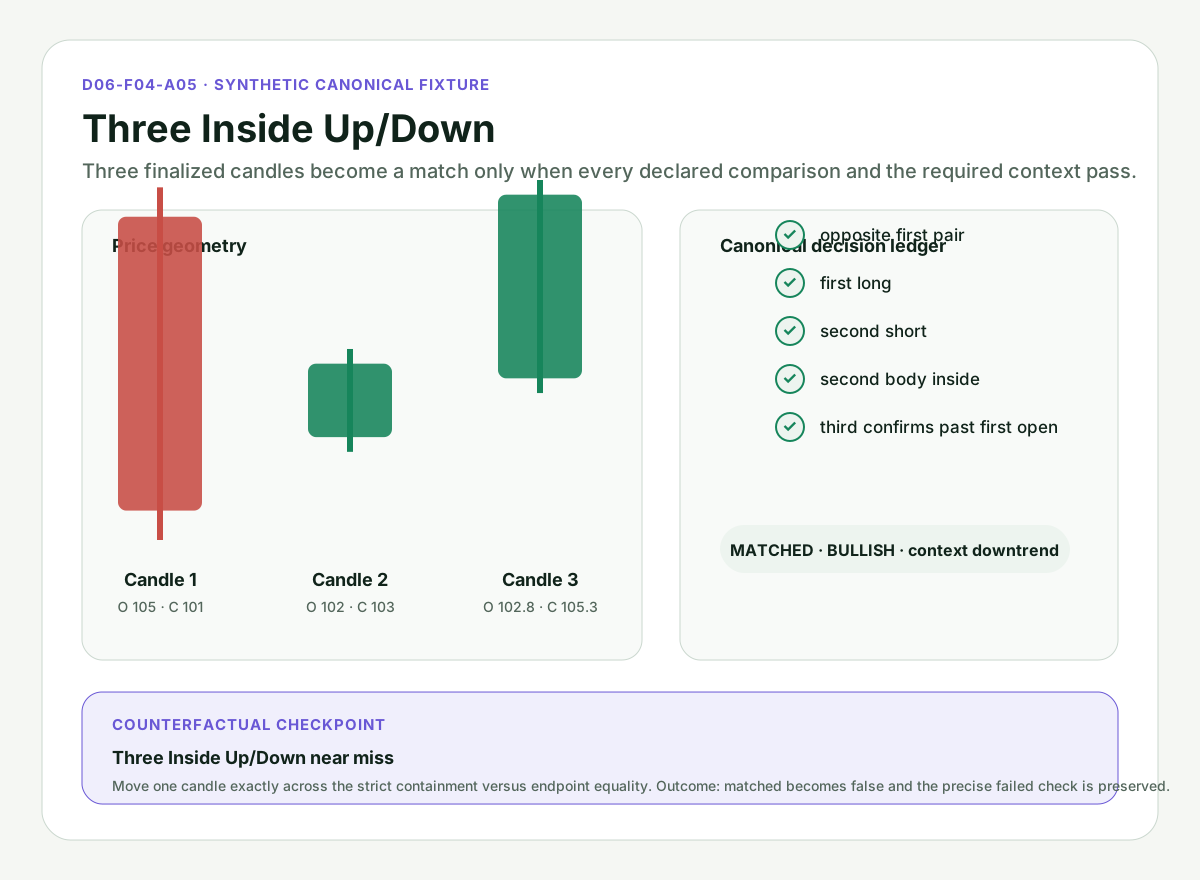
Open this SVG at full size, or use the guided playground to compare the seven topic-specific canonical, boundary, policy, and failure scenarios.
The Mermaid flow answers where the selected calculation sits in the processing sequence. The SVG keeps the formula, output, decision boundary, and invariant visible together. The lab lets the reader step through the same structured states without changing the underlying definition.
Implementation walkthrough
The Python and TypeScript references begin with the same validation contract, reject malformed and unsupported state before calculation, preserve declared ordering and rounding policies, and return structured diagnostics rather than one context-free number.
The main implementation branches are:
- Fewer than five prior observations — Return warmup, because Scale-aware thresholds are unavailable.
- Geometry passes but context differs — Return wrong-context, because A reversal label requires its declared prior trend.
- The strict containment versus endpoint equality fails — Return not-matched and name the failed check, because Near misses must remain auditable.
- Every check and context pass — Return matched with direction, because The complete frozen contract is satisfied.
Neither reference silently fetches data, mutates caller-owned inputs outside the declared engine behavior, guesses hidden state, or substitutes a provider default. Shared JSON fixtures make value, null, state, and reason-code drift visible across languages.
Testing and validation
Definition tests compare every canonical field, reject malformed state, and exercise the material boundary. Family validation recomputes every playground state from the reference function. Independent arithmetic is recorded beside the fixture rather than inferred only from implementation output.
The audit must preserve these invariants:
- Every check is emitted by name with pass/fail state.
- failed_checks preserves the exact rejected relationships.
- wrong-context separates valid geometry from an invalid reversal context.
- warmup never invents a scale or pattern match.
Passing definition and parity checks proves that the implementation matches the selected contract. It does not prove production performance, universal applicability, or a later market outcome.
Failure modes and misuse
- Pattern thresholds are implementation choices and may disagree with charting libraries or discretionary analysts.
- An explicit trend label can itself be wrong, stale, or produced by a different causal filter.
- Finalized OHLC discards intrabar path and order-flow information.
- A matched detector is not a forecast, entry, exit, or claim of economic value.
Debugging order
When a result looks surprising, inspect the state in this order:
- Confirm identifiers, scope, side, and decision clock.
- Confirm units, ordering, and point-in-time inputs.
- Confirm equality, rounding, null, and reset policies.
- Recalculate the invariant and declared scenario focus before changing code.
Evidence and historical boundary
Historical decision: not useful. A named chart occurrence would add story value but not improve the executable definition. Its classification would depend on provider identity, session calendar, adjusted or unadjusted basis, finalized OHLC, trend algorithm, threshold configuration, and point-in-time availability.
The primary sources are TA-Lib CDL3INSIDE, TA-Lib pattern-recognition index, Nison publisher record, NIST median guidance. They support the source roles listed in the research ledger, not a redistributable historical observation, a private participant decision, production conformance certification, execution-quality result, profitability claim, or prediction claim.
Summary and next topic
You can now implement and audit the Three Inside Up/Down detector without conflating recognition with a forecast. The learning flow is: Three Black Crows → Three Inside Up/Down → Three Outside Up/Down. Carry the result forward only with its scope, clock, state, and evidence label.
Rendered from the canonical Mermaid sources linked by this article.
Three Inside Up/Down calculation flow
This flow identifies the selected calculation stages and the structured output.
Takeaway: Three Inside Up/Down is a sequence of explicit comparisons, not a silhouette guessed from three colored bars.
ReferencesPrimary sources and evidence notesExpand the source trail, evidence role, and limitations behind the engineering choices.
Expand the source trail, evidence role, and limitations behind the engineering choices.
S1 — CDL3INSIDE function documentation
- Organization or authors: TA-Lib project
- Source type: Official maintained algorithm documentation
- Publication or effective date: Current page accessed 2026-08-01
- Version: Online definition updated 2026-07-27
- URL or DOI: https://ta-lib.org/functions/cdl3inside
- Accessed: 2026-08-01
- Jurisdiction: Library convention; not market-specific
- Supports: TA-Lib documents a long body, a short contained body, and an opposite third candle closing past the first open, with signed bullish or bearish output.
- Limitations: The repository declares different scale windows, thresholds, explicit context handling, output schema, and some stricter equality rules; it does not claim parity.
S2 — TA-Lib Pattern Recognition Functions
- Organization or authors: TA-Lib project
- Source type: Official maintained technical documentation
- Publication or effective date: Current page accessed 2026-08-01
- Version: Online function catalog updated 2026-07-31
- URL or DOI: https://ta-lib.org/functions/
- Accessed: 2026-08-01
- Jurisdiction: Library convention; not market-specific
- Supports: TA-Lib exposes distinct functions for all seven catalog topics and therefore treats these names as separate algorithm contracts.
- Limitations: The catalog does not make the package TA-Lib-compatible; exact defaults and lookbacks are implementation conventions.
S3 — Japanese Candlestick Charting Techniques, Second Edition
- Organization or authors: Steve Nison; Prentice Hall Press
- Source type: Authoritative book and publisher record
- Publication or effective date: Published 2001-11-01; record accessed 2026-08-01
- Version: Second edition; ISBN 9780735201811
- URL or DOI: https://www.penguinrandomhouse.com/books/350650/japanese-candlestick-charting-techniques-by-steve-nison/
- Accessed: 2026-08-01
- Jurisdiction: General market education
- Supports: Candlestick patterns are established technical-analysis vocabulary and are commonly combined with other context.
- Limitations: The publisher record is not an executable numerical specification and does not validate package thresholds or predictive value.
S4 — Measures of Location: Mean and Median
- Organization or authors: NIST/SEMATECH
- Source type: Authoritative statistical handbook
- Publication or effective date: Handbook page accessed 2026-08-01
- Version: e-Handbook of Statistical Methods
- URL or DOI: https://itl.nist.gov/div898/handbook/eda/section3/eda351.htm
- Accessed: 2026-08-01
- Jurisdiction: General statistical method
- Supports: The median is less affected than the mean by extreme tail observations, motivating the package's transparent prior-body and prior-range scales.
- Limitations: NIST does not prescribe candlestick thresholds or pattern definitions.
Evidence boundary
The sources establish the exact rule, interface, protocol, or research context named above. They do not verify the repository-authored synthetic fixture, thresholds, empirical usefulness, execution probability, or profitability. Package-selected choices remain labeled as implementation choices wherever they are used.
Full dependency-light reference implementations in both supported languages.
export type JsonObject = Record<string, any>;

const TITLES: Record<string, string> = {
  "D06-F04-A01": "Morning Star",
  "D06-F04-A02": "Evening Star",
  "D06-F04-A03": "Three White Soldiers",
  "D06-F04-A04": "Three Black Crows",
  "D06-F04-A05": "Three Inside Up/Down",
  "D06-F04-A06": "Three Outside Up/Down",
  "D06-F04-A07": "Abandoned Baby",
};

function finite(value: unknown, name: string): number {
  if (typeof value !== "number" || !Number.isFinite(value)) throw new TypeError(`${name} must be a finite number`);
  return value;
}

function positive(value: unknown, name: string): number {
  const result = finite(value, name);
  if (result <= 0) throw new RangeError(`${name} must be positive`);
  return result;
}

function fraction(value: unknown, name: string): number {
  const result = finite(value, name);
  if (result < 0 || result > 1) throw new RangeError(`${name} must be between 0 and 1`);
  return result;
}

function numbers(value: unknown, name: string): number[] {
  if (!Array.isArray(value)) throw new TypeError(`${name} must be an array`);
  const result = value.map((item, index) => finite(item, `${name}[${index}]`));
  if (result.some(item => item < 0)) throw new RangeError(`${name} cannot contain negative values`);
  return result;
}

function candle(value: unknown, name: string): JsonObject {
  if (value === null || typeof value !== "object" || Array.isArray(value)) throw new TypeError(`${name} must be an object`);
  const raw = value as JsonObject;
  const result = {open: finite(raw.open, `${name}.open`), high: finite(raw.high, `${name}.high`), low: finite(raw.low, `${name}.low`), close: finite(raw.close, `${name}.close`)};
  if (result.high < Math.max(result.open, result.close, result.low)) throw new RangeError(`${name}.high is below another OHLC value`);
  if (result.low > Math.min(result.open, result.close, result.high)) throw new RangeError(`${name}.low is above another OHLC value`);
  return result;
}

function anatomy(raw: JsonObject): JsonObject {
  const bodyHigh = Math.max(raw.open, raw.close), bodyLow = Math.min(raw.open, raw.close), body = bodyHigh - bodyLow;
  const direction = raw.close > raw.open ? "bullish" : raw.close < raw.open ? "bearish" : "neutral";
  return {...raw, body_high: bodyHigh, body_low: bodyLow, body, upper_shadow: raw.high - bodyHigh, lower_shadow: bodyLow - raw.low, range: raw.high - raw.low, direction};
}

function median(values: number[]): number {
  const ordered = [...values].sort((a, b) => a - b), middle = Math.floor(ordered.length / 2);
  return ordered.length % 2 ? ordered[middle] : (ordered[middle - 1] + ordered[middle]) / 2;
}

function base(data: JsonObject): JsonObject {
  if (!Array.isArray(data.candles) || data.candles.length !== 3) throw new RangeError("candles must contain exactly three OHLC candles");
  const candles = data.candles.map((item: unknown, index: number) => anatomy(candle(item, `candles[${index}]`)));
  const tick = positive(data.tick_size, "tick_size");
  const context = data.trend_context;
  if (!new Set(["uptrend", "downtrend", "sideways"]).has(context)) throw new RangeError("trend_context must be uptrend, downtrend, or sideways");
  const bodies = numbers(data.prior_bodies, "prior_bodies"), ranges = numbers(data.prior_ranges, "prior_ranges");
  if (bodies.length !== ranges.length) throw new RangeError("prior_bodies and prior_ranges must have equal length");
  if (bodies.some((body, index) => body > ranges[index])) throw new RangeError("a prior body cannot exceed its range");
  const count = bodies.length;
  return {candles, tick, context, bodyScale: count >= 5 ? median(bodies.slice(-10)) : null, rangeScale: count >= 5 ? median(ranges.slice(-10)) : null, count, penetration: fraction(data.penetration_fraction ?? 0.5, "penetration_fraction")};
}

function result(topicId: string, candles: JsonObject[], context: string, requiredContext: string | null, bodyScale: number | null, rangeScale: number | null, historyCount: number, direction: string, inputChecks: Record<string, boolean>, thresholds: JsonObject): JsonObject {
  let checks = inputChecks, state: string, matched: boolean;
  if (bodyScale === null || rangeScale === null) { checks = {minimum_history: false}; state = "warmup"; matched = false; }
  else {
    const geometry = Object.values(checks).every(Boolean);
    if (geometry && requiredContext !== null && context !== requiredContext) { state = "wrong-context"; matched = false; }
    else { matched = geometry; state = matched ? "matched" : "not-matched"; }
  }
  const failed = Object.entries(checks).filter(([, passed]) => !passed).map(([name]) => name);
  const score = Object.values(checks).filter(Boolean).length / Math.max(1, Object.keys(checks).length);
  const reason = failed.length ? `failed ${failed[0].replaceAll("_", " ")}` : "all declared checks pass";
  return {topic_id: topicId, pattern: TITLES[topicId], matched, state, direction, trend_context: context, required_context: requiredContext, history_count: historyCount, body_scale: bodyScale, range_scale: rangeScale, geometry_score: score, checks, failed_checks: failed, reason, thresholds, candles};
}

function star(topicId: string, data: JsonObject): JsonObject {
  const b = base(data), [a, middle, c] = b.candles, bullish = topicId === "D06-F04-A01", required = bullish ? "downtrend" : "uptrend";
  if (b.bodyScale === null || b.rangeScale === null) return result(topicId, b.candles, b.context, required, b.bodyScale, b.rangeScale, b.count, bullish ? "bullish" : "bearish", {}, {});
  const longFloor = 1.2 * b.bodyScale, shortCeiling = 0.6 * b.bodyScale;
  let penetrationPrice: number, checks: Record<string, boolean>;
  if (bullish) {
    penetrationPrice = a.close + b.penetration * a.body;
    checks = {first_bearish: a.direction === "bearish", first_long: a.body >= longFloor, second_short: middle.body <= shortCeiling, body_gap_down: middle.body_high <= a.body_low - b.tick, third_bullish: c.direction === "bullish", third_penetrates: c.close >= penetrationPrice};
  } else {
    penetrationPrice = a.close - b.penetration * a.body;
    checks = {first_bullish: a.direction === "bullish", first_long: a.body >= longFloor, second_short: middle.body <= shortCeiling, body_gap_up: middle.body_low >= a.body_high + b.tick, third_bearish: c.direction === "bearish", third_penetrates: c.close <= penetrationPrice};
  }
  return result(topicId, b.candles, b.context, required, b.bodyScale, b.rangeScale, b.count, bullish ? "bullish" : "bearish", checks, {long_body_floor: longFloor, short_body_ceiling: shortCeiling, penetration_price: penetrationPrice, minimum_gap: b.tick, penetration_fraction: b.penetration});
}

function soldiersOrCrows(topicId: string, data: JsonObject): JsonObject {
  const b = base(data), [a, middle, c] = b.candles, bullish = topicId === "D06-F04-A03", required = bullish ? "downtrend" : "uptrend";
  if (b.bodyScale === null || b.rangeScale === null) return result(topicId, b.candles, b.context, required, b.bodyScale, b.rangeScale, b.count, bullish ? "bullish" : "bearish", {}, {});
  const bodyFloor = 0.75 * b.bodyScale, shadowCeiling = 0.2 * b.rangeScale;
  const checks: Record<string, boolean> = bullish ? {
    three_bullish: b.candles.every((item: JsonObject) => item.direction === "bullish"), material_bodies: b.candles.every((item: JsonObject) => item.body >= bodyFloor), rising_closes: middle.close >= a.close + b.tick && c.close >= middle.close + b.tick, second_opens_in_prior_body: a.body_low <= middle.open && middle.open <= a.body_high, third_opens_in_prior_body: middle.body_low <= c.open && c.open <= middle.body_high, short_upper_shadows: b.candles.every((item: JsonObject) => item.upper_shadow <= shadowCeiling)
  } : {
    three_bearish: b.candles.every((item: JsonObject) => item.direction === "bearish"), material_bodies: b.candles.every((item: JsonObject) => item.body >= bodyFloor), falling_closes: middle.close <= a.close - b.tick && c.close <= middle.close - b.tick, second_opens_in_prior_body: a.body_low <= middle.open && middle.open <= a.body_high, third_opens_in_prior_body: middle.body_low <= c.open && c.open <= middle.body_high, short_lower_shadows: b.candles.every((item: JsonObject) => item.lower_shadow <= shadowCeiling)
  };
  return result(topicId, b.candles, b.context, required, b.bodyScale, b.rangeScale, b.count, bullish ? "bullish" : "bearish", checks, {body_floor: bodyFloor, shadow_ceiling: shadowCeiling, minimum_close_step: b.tick});
}

function inside(data: JsonObject): JsonObject {
  const topicId = "D06-F04-A05", b = base(data), [a, middle, c] = b.candles;
  const bullish = a.direction === "bearish" && middle.direction === "bullish", bearish = a.direction === "bullish" && middle.direction === "bearish";
  const direction = bullish ? "bullish" : bearish ? "bearish" : "none", required = bullish ? "downtrend" : bearish ? "uptrend" : null;
  if (b.bodyScale === null || b.rangeScale === null) return result(topicId, b.candles, b.context, required, b.bodyScale, b.rangeScale, b.count, direction, {}, {});
  const longFloor = 1.2 * b.bodyScale, shortCeiling = 0.6 * b.bodyScale;
  const contained = middle.body_low >= a.body_low && middle.body_high <= a.body_high && (middle.body_low > a.body_low || middle.body_high < a.body_high);
  const confirms = (bullish && c.direction === "bullish" && c.close >= a.open + b.tick) || (bearish && c.direction === "bearish" && c.close <= a.open - b.tick);
  return result(topicId, b.candles, b.context, required, b.bodyScale, b.rangeScale, b.count, direction, {opposite_first_pair: bullish || bearish, first_long: a.body >= longFloor, second_short: middle.body <= shortCeiling, second_body_inside: contained, third_confirms_past_first_open: confirms}, {long_body_floor: longFloor, short_body_ceiling: shortCeiling, confirmation_step: b.tick});
}

function outside(data: JsonObject): JsonObject {
  const topicId = "D06-F04-A06", b = base(data), [a, middle, c] = b.candles;
  const bullish = a.direction === "bearish" && middle.direction === "bullish", bearish = a.direction === "bullish" && middle.direction === "bearish";
  const direction = bullish ? "bullish" : bearish ? "bearish" : "none", required = bullish ? "downtrend" : bearish ? "uptrend" : null;
  const engulfed = middle.body_low <= a.body_low && middle.body_high >= a.body_high && middle.body > a.body;
  const confirms = (bullish && c.direction === "bullish" && c.close >= middle.close + b.tick) || (bearish && c.direction === "bearish" && c.close <= middle.close - b.tick);
  return result(topicId, b.candles, b.context, required, b.bodyScale, b.rangeScale, b.count, direction, {opposite_first_pair: bullish || bearish, second_body_engulfs: engulfed, third_confirms_beyond_second_close: confirms}, {confirmation_step: b.tick});
}

function abandoned(data: JsonObject): JsonObject {
  const topicId = "D06-F04-A07", b = base(data), [a, middle, c] = b.candles;
  const bullish = a.direction === "bearish" && c.direction === "bullish", bearish = a.direction === "bullish" && c.direction === "bearish";
  const direction = bullish ? "bullish" : bearish ? "bearish" : "none", required = bullish ? "downtrend" : bearish ? "uptrend" : null;
  if (b.bodyScale === null || b.rangeScale === null) return result(topicId, b.candles, b.context, required, b.bodyScale, b.rangeScale, b.count, direction, {}, {});
  const longFloor = 1.2 * b.bodyScale, dojiCeiling = 0.1 * b.rangeScale;
  let penetrationPrice = a.close, separated = false, penetrates = false;
  if (bullish) { penetrationPrice = a.close + b.penetration * a.body; separated = middle.high <= a.low - b.tick && c.low >= middle.high + b.tick; penetrates = c.close >= penetrationPrice; }
  else if (bearish) { penetrationPrice = a.close - b.penetration * a.body; separated = middle.low >= a.high + b.tick && c.high <= middle.low - b.tick; penetrates = c.close <= penetrationPrice; }
  return result(topicId, b.candles, b.context, required, b.bodyScale, b.rangeScale, b.count, direction, {opposite_outer_candles: bullish || bearish, first_long: a.body >= longFloor, middle_doji: middle.body <= dojiCeiling, full_range_isolation: separated, third_penetrates: penetrates}, {long_body_floor: longFloor, doji_body_ceiling: dojiCeiling, minimum_gap: b.tick, penetration_price: penetrationPrice, penetration_fraction: b.penetration});
}

export function calculate(topicId: string, inputs: JsonObject): JsonObject {
  if (inputs === null || typeof inputs !== "object" || Array.isArray(inputs)) throw new TypeError("inputs must be an object");
  if (["D06-F04-A01", "D06-F04-A02"].includes(topicId)) return star(topicId, inputs);
  if (["D06-F04-A03", "D06-F04-A04"].includes(topicId)) return soldiersOrCrows(topicId, inputs);
  if (topicId === "D06-F04-A05") return inside(inputs);
  if (topicId === "D06-F04-A06") return outside(inputs);
  if (topicId === "D06-F04-A07") return abandoned(inputs);
  throw new RangeError(`unsupported topic id ${topicId}`);
}

/*
 * Per-topic entry points.
 *
 * `calculate` stays the single dispatcher, so there is still one body and one
 * contract to keep in parity with the Python reference. These wrappers give each
 * published topic a function of its own, named for its article slug, so callers
 * never have to pass a topic id to reach one pattern.
 */
export function morningStar(inputs: JsonObject): JsonObject { return calculate("D06-F04-A01", inputs); }
export function eveningStar(inputs: JsonObject): JsonObject { return calculate("D06-F04-A02", inputs); }
export function threeWhiteSoldiers(inputs: JsonObject): JsonObject { return calculate("D06-F04-A03", inputs); }
export function threeBlackCrows(inputs: JsonObject): JsonObject { return calculate("D06-F04-A04", inputs); }
export function threeInsideUpDown(inputs: JsonObject): JsonObject { return calculate("D06-F04-A05", inputs); }
export function threeOutsideUpDown(inputs: JsonObject): JsonObject { return calculate("D06-F04-A06", inputs); }
export function abandonedBaby(inputs: JsonObject): JsonObject { return calculate("D06-F04-A07", inputs); }
The embedded lab now expands to its full document height, keeping the article as the only scroll surface.