
 By Islam Baraka
How does top-of-book queue imbalance shift a quote-based reference price inside the spread? The useful answer is not just a number. It is a number tied to one instrument, venue scope, sequence, session, clock, and declared measurement convention.
Start with the decision
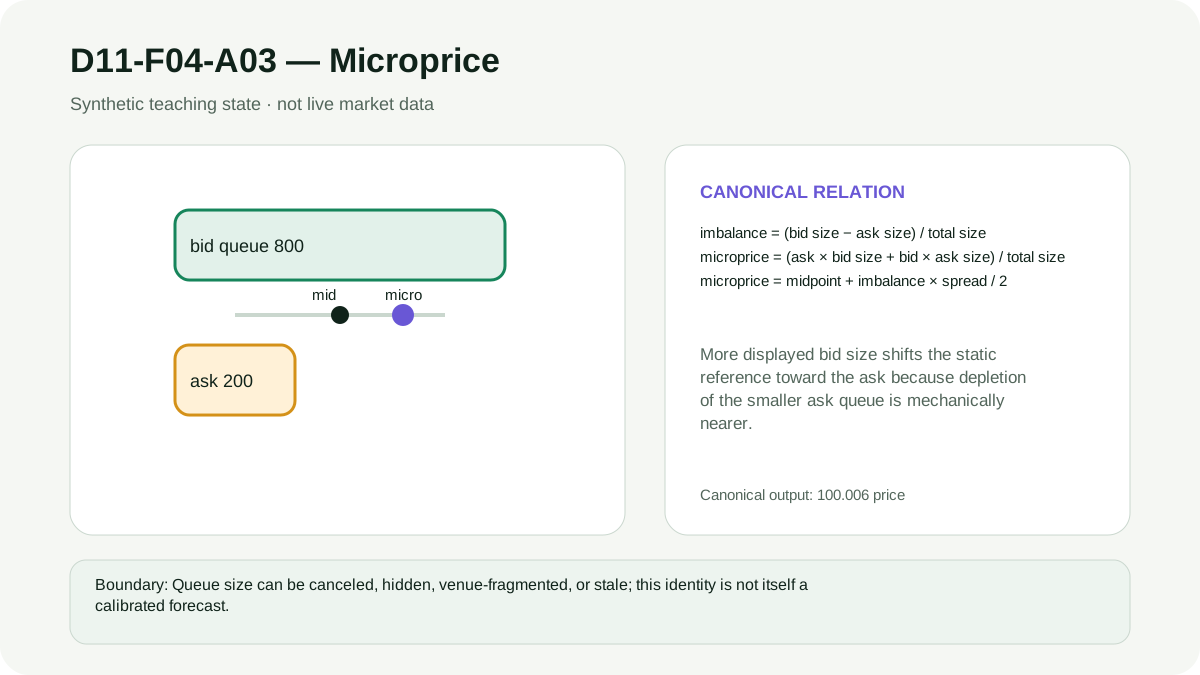
More displayed bid size shifts the static reference toward the ask because depletion of the smaller ask queue is mechanically nearer. This tutorial selects Static top-of-book weighted midprice using opposite-side queue weights; the full Stoikov microprice is a learned expected-price adjustment and remains a separate variant. The choice is explicit because similarly named book measures are often not interchangeable.
Choose the right variant
| Variant | Definition | Best use | Main limitation |
|---|---|---|---|
| Static weighted midpoint | Opposite-side top-queue weights | Mechanical imbalance diagnostic | No learned transition adjustment |
| Stoikov microprice | Expected future-midpoint limit with estimated states | Data-calibrated short-horizon reference | Requires training design and validation |
| Multi-level imbalance features | Use depth beyond the best queues | Richer predictive models | Not the canonical identity |
Define the measurement
The source method is documented by Stoikov, The Micro-Price. The exchange-data boundary is grounded in the NYSE Integrated Feed description. The fixture below is synthetic and the arithmetic is author-derived.
Work the canonical example
{
  "bid": 99.99,
  "bid_size": 800,
  "ask": 100.01,
  "ask_size": 200
}
- Top midpoint = (99.99 + 100.01) / 2 = 100.00.
- Queue imbalance = (800 − 200) / 1,000 = 0.60.
- Microprice = (100.01 × 800 + 99.99 × 200) / 1,000 = 100.006.
- Midpoint shift = 0.6 bps; identity error = 0.
See the state before the code
The visual connects the input state, active relationship, output, and the boundary that prevents a plausible but unsupported result.
Open the visual at full size · Open the guided playground
Implement the contract
- validate best quote and queue sizes
- calculate top midpoint and spread
- calculate normalized queue imbalance
- weight each quote by opposite-side size
- verify midpoint-shift identity
Python and TypeScript use the same JSON fixtures and matching error states. Production systems should add fixed-point prices, feed-gap recovery, sequence checks, timestamp normalization, market-status handling, and licensed source lineage.
Validate what the result means
The tests establish that the implementation matches the selected definition. They do not show that the statistic forecasts returns, improves fills, survives latency and fees, or satisfies best-execution duties.
| State | Decision boundary | Required response |
|---|---|---|
| Bid pressure | queue imbalance > 0 | Static reference lies above midpoint but below ask |
| Balanced | queue imbalance = 0 | Static reference equals midpoint |
| Prediction claim | future price performance is asserted | Require a learned model, holdout data, costs, and bias controls |
Compare neighboring methods
The ordinary midpoint ignores size; the selected depth-weighted midpoint uses same-side multi-level weights. A midpoint is a quote anchor, depth-weighted prices are window-dependent summaries, microprice uses imbalance, resiliency is a recovery path, and Hawkes intensity is a conditional event-rate model.
Evidence boundary
A historical case is deferred until instrument and venue identity, complete sequence, session, correction state, visible/hidden scope, timing basis, license, and redistribution permission are archived.
Summary and next topic
You can now calculate the top-of-book imbalance-weighted quote and verify its midpoint-shift identity, audit its assumptions, and route unsupported states rather than manufacturing precision. Continue with Order-Book Resiliency.
Primary references
Rendered from the canonical Mermaid sources linked by this article.
Microprice validation flow
This diagram separates feed reconstruction, calculation, and interpretation.
Takeaway: a calculation begins after data eligibility; it does not repair an unknown or stale book.
ReferencesPrimary sources and evidence notesExpand the source trail, evidence role, and limitations behind the engineering choices.
Expand the source trail, evidence role, and limitations behind the engineering choices.
Source 1 — Stoikov, The Micro-Price
- Organization or authors: Sasha Stoikov
- Source type: Original paper
- Publication or effective date: 2017-11-26
- Version: accessed 2026-07-29
- Accessed: 2026-07-29
- URL or DOI: https://doi.org/10.2139/ssrn.2970694
- Jurisdiction: method or venue specific as stated by the source
- Supports: microprice as a midprice adjustment using spread and imbalance
- Limitations: Supports the method family; package-specific fixtures and software choices are author-derived. The static weighted-midpoint identity is not the paper's full learned microprice.
Source 2 — NYSE Integrated Feed
- Organization or authors: NYSE
- Source type: Official exchange data-product documentation
- Publication or effective date: Current product page accessed 2026-07-29
- Version: accessed 2026-07-29
- Accessed: 2026-07-29
- URL or DOI: https://www.nyse.com/data-products/catalog/integrated-feed
- Jurisdiction: method or venue specific as stated by the source
- Supports: order-by-order depth, trades, imbalances, security status, and sequence-aware book reconstruction
- Limitations: Product documentation does not grant redistribution rights or validate the synthetic fixture.
Publication and data boundary
The worked example and playground data are synthetic teaching inputs. Exchange depth data are venue-, license-, sequence-, session-, and timestamp-specific. No market-data entitlement or redistribution permission is implied.
Full dependency-light reference implementations in both supported languages.
function numberValue(
  name: string,
  value: unknown,
  options: { positive?: boolean; nonnegative?: boolean } = {},
): number {
  if (typeof value !== "number" || !Number.isFinite(value)) {
    throw new Error(`${name} must be a finite number`);
  }
  if (options.positive && value <= 0) throw new Error(`${name} must be greater than zero`);
  if (options.nonnegative && value < 0) throw new Error(`${name} must be nonnegative`);
  return value;
}

function series(
  name: string,
  value: unknown,
  options: { minimum?: number; positive?: boolean; nonnegative?: boolean } = {},
): number[] {
  if (!Array.isArray(value)) throw new Error(`${name} must be an array`);
  const result = value.map((item, index) =>
    numberValue(`${name}[${index}]`, item, {
      positive: options.positive,
      nonnegative: options.nonnegative,
    }),
  );
  if (result.length < (options.minimum ?? 1)) {
    throw new Error(`${name} must contain at least ${options.minimum ?? 1} values`);
  }
  return result;
}

function bookSide(
  prices: unknown,
  sizes: unknown,
  side: "bid" | "ask",
  minimum = 1,
): [number[], number[]] {
  const priceValues = series(`${side}_prices`, prices, { minimum, positive: true });
  const sizeValues = series(`${side}_sizes`, sizes, { minimum, positive: true });
  if (priceValues.length !== sizeValues.length) {
    throw new Error(`${side}_prices and ${side}_sizes must have equal length`);
  }
  for (let index = 0; index < priceValues.length - 1; index += 1) {
    if (side === "bid" && priceValues[index] <= priceValues[index + 1]) {
      throw new Error("bid_prices must be strictly descending from the best bid");
    }
    if (side === "ask" && priceValues[index] >= priceValues[index + 1]) {
      throw new Error("ask_prices must be strictly ascending from the best ask");
    }
  }
  return [priceValues, sizeValues];
}

function validateBook(
  bidPrices: unknown,
  bidSizes: unknown,
  askPrices: unknown,
  askSizes: unknown,
  minimum = 1,
): [number[], number[], number[], number[], number] {
  const [bids, bidDepth] = bookSide(bidPrices, bidSizes, "bid", minimum);
  const [asks, askDepth] = bookSide(askPrices, askSizes, "ask", minimum);
  if (bids[0] >= asks[0]) throw new Error("best bid must be below best ask");
  return [bids, bidDepth, asks, askDepth, (bids[0] + asks[0]) / 2];
}

function cumulative(values: number[]): number[] {
  let total = 0;
  return values.map((value) => {
    total += value;
    return total;
  });
}

function naesSideSlope(
  prices: number[],
  sizes: number[],
  midpoint: number,
): [number, number[]] {
  const logDepth = cumulative(sizes).map(Math.log);
  const firstDistance = Math.abs(prices[0] / midpoint - 1);
  if (firstDistance <= 0) throw new Error("best quote must differ from midpoint");
  const local = [logDepth[0] / firstDistance];
  for (let index = 0; index < prices.length - 1; index += 1) {
    const priceChange = Math.abs(prices[index + 1] / prices[index] - 1);
    if (priceChange <= 0) throw new Error("adjacent price levels must differ");
    local.push((logDepth[index + 1] / logDepth[index] - 1) / priceChange);
  }
  return [local.reduce((sum, value) => sum + value, 0) / local.length, local];
}

export function orderBookSlope(
  bidPrices: unknown,
  bidSizes: unknown,
  askPrices: unknown,
  askSizes: unknown,
): Record<string, unknown> {
  const [bids, bidDepth, asks, askDepth, midpoint] = validateBook(
    bidPrices,
    bidSizes,
    askPrices,
    askSizes,
    2,
  );
  const [bidSlope, bidLocal] = naesSideSlope(bids, bidDepth, midpoint);
  const [askSlope, askLocal] = naesSideSlope(asks, askDepth, midpoint);
  const combined = (bidSlope + askSlope) / 2;
  const slopeTolerance = 1e-12 * Math.max(1, Math.abs(bidSlope), Math.abs(askSlope));
  const slopeDifference = bidSlope - askSlope;
  return {
    model: "naes-skjeltorp-snapshot-slope",
    level_count: bids.length === asks.length ? bids.length : null,
    bid_level_count: bids.length,
    ask_level_count: asks.length,
    midpoint,
    bid_cumulative_depth: cumulative(bidDepth),
    ask_cumulative_depth: cumulative(askDepth),
    bid_local_slopes: bidLocal,
    ask_local_slopes: askLocal,
    bid_slope: bidSlope,
    ask_slope: askSlope,
    order_book_slope: combined,
    slope_tolerance: slopeTolerance,
    state: Math.abs(slopeDifference) <= slopeTolerance ? "balanced" : slopeDifference > 0 ? "steeper-bid" : "steeper-ask",
  };
}

export function depthWeightedMidprice(
  bidPrices: unknown,
  bidSizes: unknown,
  askPrices: unknown,
  askSizes: unknown,
): Record<string, unknown> {
  const [bids, bidDepth, asks, askDepth, midpoint] = validateBook(
    bidPrices,
    bidSizes,
    askPrices,
    askSizes,
  );
  const bidTotal = bidDepth.reduce((sum, value) => sum + value, 0);
  const askTotal = askDepth.reduce((sum, value) => sum + value, 0);
  const weightedBid = bids.reduce((sum, price, index) => sum + price * bidDepth[index], 0) / bidTotal;
  const weightedAsk = asks.reduce((sum, price, index) => sum + price * askDepth[index], 0) / askTotal;
  const depthMidpoint = (weightedBid + weightedAsk) / 2;
  const shift = depthMidpoint - midpoint;
  return {
    model: "same-side-depth-weighted-midpoint",
    level_count: bids.length === asks.length ? bids.length : null,
    bid_level_count: bids.length,
    ask_level_count: asks.length,
    top_midpoint: midpoint,
    depth_weighted_bid: weightedBid,
    depth_weighted_ask: weightedAsk,
    depth_weighted_midprice: depthMidpoint,
    shift,
    shift_bps: (shift / midpoint) * 10_000,
    bid_total_depth: bidTotal,
    ask_total_depth: askTotal,
    state: shift > 1e-15 ? "above-top-mid" : shift < -1e-15 ? "below-top-mid" : "at-top-mid",
  };
}

export function microprice(
  bid: unknown,
  bidSize: unknown,
  ask: unknown,
  askSize: unknown,
): Record<string, unknown> {
  const bidValue = numberValue("bid", bid, { positive: true });
  const askValue = numberValue("ask", ask, { positive: true });
  const bidDepth = numberValue("bid_size", bidSize, { positive: true });
  const askDepth = numberValue("ask_size", askSize, { positive: true });
  if (bidValue >= askValue) throw new Error("bid must be below ask");
  const totalDepth = bidDepth + askDepth;
  const midpoint = (bidValue + askValue) / 2;
  const spread = askValue - bidValue;
  const imbalance = (bidDepth - askDepth) / totalDepth;
  const value = (askValue * bidDepth + bidValue * askDepth) / totalDepth;
  const shift = value - midpoint;
  return {
    model: "top-of-book-imbalance-weighted-quote",
    bid: bidValue,
    ask: askValue,
    bid_size: bidDepth,
    ask_size: askDepth,
    midpoint,
    spread,
    queue_imbalance: imbalance,
    microprice: value,
    shift,
    shift_bps: (shift / midpoint) * 10_000,
    identity_error: value - (midpoint + (imbalance * spread) / 2),
    state: imbalance > 1e-15 ? "bid-pressure" : imbalance < -1e-15 ? "ask-pressure" : "balanced",
  };
}

export function orderBookResiliency(
  timesSeconds: unknown,
  displacementBps: unknown,
  forecastSeconds: unknown,
): Record<string, unknown> {
  const times = series("times_seconds", timesSeconds, { minimum: 3, nonnegative: true });
  const gaps = series("displacement_bps", displacementBps, { minimum: 3, positive: true });
  if (times.length !== gaps.length) throw new Error("times_seconds and displacement_bps must have equal length");
  if (Math.abs(times[0]) > 1e-15) throw new Error("times_seconds must start at zero");
  for (let index = 0; index < times.length - 1; index += 1) {
    if (times[index] >= times[index + 1]) throw new Error("times_seconds must be strictly increasing");
  }
  const initialGap = gaps[0];
  if (gaps.slice(1).some((gap) => gap > initialGap * (1 + 1e-12))) {
    throw new Error("canonical exponential recovery requires displacement not to exceed its initial shock");
  }
  const forecast = numberValue("forecast_seconds", forecastSeconds, { nonnegative: true });
  const denominator = times.slice(1).reduce((sum, time) => sum + time * time, 0);
  const numerator = times.slice(1).reduce(
    (sum, time, index) => sum - time * Math.log(gaps[index + 1] / initialGap),
    0,
  );
  const rate = Math.max(0, numerator / denominator);
  const estimated = rate > 1e-12;
  const halfLife = estimated ? Math.log(2) / rate : null;
  const forecastGap = estimated ? initialGap * Math.exp(-rate * forecast) : initialGap;
  const fitted = times.map((time) => initialGap * Math.exp(-rate * time));
  const rmse = Math.sqrt(
    gaps.reduce((sum, value, index) => sum + (value - fitted[index]) ** 2, 0) / gaps.length,
  );
  return {
    model: "exponential-displacement-recovery",
    observation_count: times.length,
    initial_displacement_bps: initialGap,
    recovery_rate_per_second: rate,
    half_life_seconds: halfLife,
    forecast_seconds: forecast,
    forecast_displacement_bps: forecastGap,
    recovered_fraction: estimated ? 1 - forecastGap / initialGap : 0,
    fitted_displacement_bps: fitted,
    rmse_bps: rmse,
    state: estimated ? "estimated" : "not-recovering",
  };
}

export function hawkesOrderArrival(
  eventTimesSeconds: unknown,
  baselineIntensity: unknown,
  excitationJump: unknown,
  decayRate: unknown,
  evaluationTimeSeconds: unknown,
  horizonSeconds: unknown,
): Record<string, unknown> {
  const events = series("event_times_seconds", eventTimesSeconds, { minimum: 1, nonnegative: true });
  for (let index = 0; index < events.length - 1; index += 1) {
    if (events[index] >= events[index + 1]) throw new Error("event_times_seconds must be strictly increasing");
  }
  const mu = numberValue("baseline_intensity", baselineIntensity, { positive: true });
  const alpha = numberValue("excitation_jump", excitationJump, { nonnegative: true });
  const beta = numberValue("decay_rate", decayRate, { positive: true });
  const evaluationTime = numberValue("evaluation_time_seconds", evaluationTimeSeconds, { nonnegative: true });
  const horizon = numberValue("horizon_seconds", horizonSeconds, { positive: true });
  if (events[events.length - 1] >= horizon) throw new Error("all events must occur strictly before horizon_seconds");
  if (evaluationTime > horizon) throw new Error("evaluation_time_seconds must not exceed horizon_seconds");
  const branchingRatio = alpha / beta;
  const contributing = events.filter((event) => event < evaluationTime);
  const intensity = mu + contributing.reduce(
    (sum, event) => sum + alpha * Math.exp(-beta * (evaluationTime - event)),
    0,
  );
  const eventIntensities = events.map((event, index) =>
    mu + events.slice(0, index).reduce(
      (sum, earlier) => sum + alpha * Math.exp(-beta * (event - earlier)),
      0,
    ),
  );
  const compensator = mu * horizon + (alpha / beta) * events.reduce(
    (sum, event) => sum + 1 - Math.exp(-beta * (horizon - event)),
    0,
  );
  const logLikelihood = eventIntensities.reduce((sum, value) => sum + Math.log(value), 0) - compensator;
  const stationary = branchingRatio < 1;
  return {
    model: "univariate-exponential-hawkes",
    event_count: events.length,
    baseline_intensity: mu,
    excitation_jump: alpha,
    decay_rate: beta,
    branching_ratio: branchingRatio,
    stationary,
    expected_cluster_multiplier: stationary ? 1 / (1 - branchingRatio) : null,
    evaluation_time_seconds: evaluationTime,
    intensity_at_evaluation: intensity,
    event_intensities: eventIntensities,
    horizon_seconds: horizon,
    compensator,
    log_likelihood: logLikelihood,
    state: stationary ? "stationary" : "nonstationary-parameters",
  };
}

export function calculate(topicId: string, inputs: Record<string, unknown>): Record<string, unknown> {
  if (topicId === "D11-F04-A01") {
    return orderBookSlope(inputs.bid_prices, inputs.bid_sizes, inputs.ask_prices, inputs.ask_sizes);
  }
  if (topicId === "D11-F04-A02") {
    return depthWeightedMidprice(inputs.bid_prices, inputs.bid_sizes, inputs.ask_prices, inputs.ask_sizes);
  }
  if (topicId === "D11-F04-A03") {
    return microprice(inputs.bid, inputs.bid_size, inputs.ask, inputs.ask_size);
  }
  if (topicId === "D11-F04-A04") {
    return orderBookResiliency(inputs.times_seconds, inputs.displacement_bps, inputs.forecast_seconds);
  }
  if (topicId === "D11-F04-A05") {
    return hawkesOrderArrival(
      inputs.event_times_seconds,
      inputs.baseline_intensity,
      inputs.excitation_jump,
      inputs.decay_rate,
      inputs.evaluation_time_seconds,
      inputs.horizon_seconds,
    );
  }
  throw new Error(`unsupported topic_id: ${topicId}`);
}
The embedded lab now expands to its full document height, keeping the article as the only scroll surface.