
 By Islam Baraka
How far did a signed execution occur from the contemporaneous quote midpoint? The answer matters because a visible quote, a signed execution, a later midpoint, and a low-frequency proxy describe different objects. This tutorial gives practitioners a usable measurement and gives builders the data, clock, and validation contract needed to reproduce it.
Start with the decision
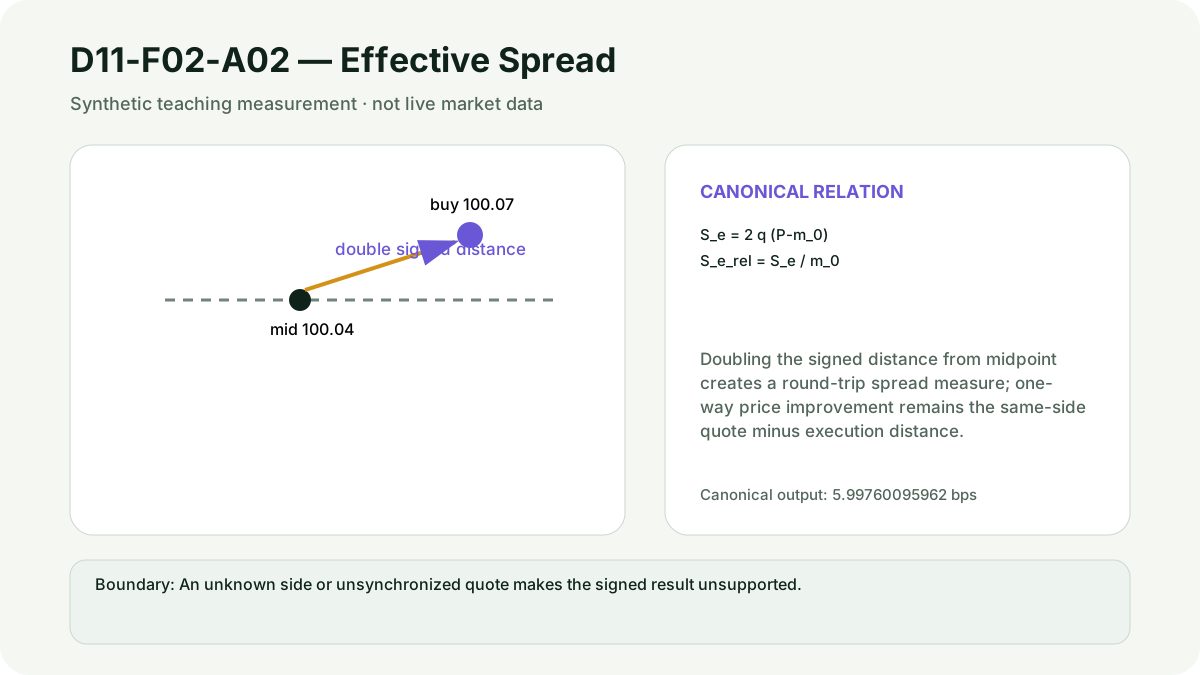
Doubling the signed distance from midpoint creates a round-trip spread measure; one-way price improvement remains the same-side quote minus execution distance. The canonical package selects Per-execution signed dollar spread using a synchronized quote-time midpoint; relative results divide by that midpoint. The primary SEC Rule 605 adopting release supports that definition. The numbers below are synthetic and the arithmetic is author-derived.
Choose the right variant
| Variant | Definition | Best use | Main limitation |
|---|---|---|---|
| Signed effective spread | 2q(P−m) | Execution diagnostics and decomposition | Can be negative after through-midpoint improvement |
| Absolute midpoint distance | 2 | P−m | |
| One-way price improvement | q(Q−P) | Per-share execution improvement | Exactly half the round-trip spread reduction under the same quote |
Evidence and applicability boundary
This package teaches one observation-level calculation. The 2024 Rule 605 Amendments and the SEC staff FAQ dated April 1, 2026 govern a broader U.S. reporting workflow; the FAQ is effective August 1, 2026 and has no legal force by itself. It identifies realized-spread horizons of 50 milliseconds, 1 second, 15 seconds, 1 minute, and 5 minutes.
Define the measurement
Every price must share one instrument, currency, adjustment basis, and declared quote scope. Intraday measures also need synchronized clocks and correction policy. Daily proxies need one trading calendar and corporate-action basis.
<!-- ENHANCEMENT:F02-TOPIC-SPECIFIC -->Choose the correct measurement variant
| Convention | Use when | What changes |
|---|---|---|
| Signed per execution | A defensible side is available | Preserves direction and diagnostics |
| Absolute effective spread | Side is unavailable but midpoint distance is still meaningful | Drops direction |
| Share-weighted average | Aggregating executions in one declared reporting cell | Weights by executed shares |
Nearest comparison: Quoted Spread is displayed cost; Realized Spread moves the benchmark to a future midpoint.
Do not substitute: It is not a post-trade dealer-revenue measure and does not isolate market impact.
Work the canonical example
Input: {"bid": 100.0, "ask": 100.08, "trade_price": 100.07, "side": "buy"}.
- The buy direction is q = +1 and the quote midpoint is 100.04.
- Signed distance = 100.07 − 100.04 = 0.03.
- Effective spread = 2 × 0.03 = 0.06; relative result = 5.99760095962 bps.
- One-way improvement is ask 100.08 minus execution 100.07 = 0.01 per share.
- The round-trip spread reduction is 0.08 minus 0.06 = 0.02; it is twice the one-way improvement.
See the state before the code
The annotated visual identifies the measurement anchors, active relationship, and failure boundary. Read the labels before comparing the highlighted output.
Open the annotated visual at full size · Open the guided playground
Implement the contract
- validate quote, trade, and side
- q ← +1 for buy else −1
- midpoint ← (bid + ask) / 2
- effective ← 2 × q × (trade − midpoint)
- compare effective with quoted spread
The Python and TypeScript references share the same synthetic JSON fixtures and error behavior. They keep raw precision until presentation. Production systems should add fixed-point/decimal prices, feed sequence handling, timestamp normalization, corrections, market-status filters, and licensed source lineage.
<!-- ENHANCEMENT:F02-INTERPRETATION -->Interpret before aggregating
Read the state before ranking or averaging the value:
| Check | Question |
|---|---|
| Side | Is the buy/sell sign observed, inferred, or unavailable? |
| Join | Was the midpoint eligible and knowable at the selected clock? |
| Benchmark | Is the result compared with quoted or realized spread on the same basis? |
A useful report names the measurement question, variant, scope, clock, unit, weighting rule, valid observation count, and unsupported states. A single headline value is not enough audit evidence.
Validate what the result means
The checks cover canonical arithmetic, a property, a boundary, an invalid state, and cross-language parity. An unknown side or unsynchronized quote makes the signed result unsupported. A successful calculation does not prove a profitable strategy, fair execution, or compliance.
| State | Decision boundary | Required response |
|---|---|---|
| Inside quote | round-trip reduction > 0 | Report positive one-way improvement |
| At quote | round-trip reduction ≈ 0 | Improvement is zero |
| Outside quote | round-trip reduction < 0 | Signed improvement is negative: price disimprovement |
Compare the neighboring methods
An execution inside the displayed quote can have a smaller effective than quoted spread. Quoted, effective, and realized spreads are direct intraday measurements when synchronized quote/trade data exist. Roll and Corwin–Schultz are low-frequency spread estimators with model assumptions. Amihud is a return-to-volume illiquidity proxy rather than a spread.
<!-- ENHANCEMENT:F02-VISUAL-SEQUENCE -->Use four additional audit views
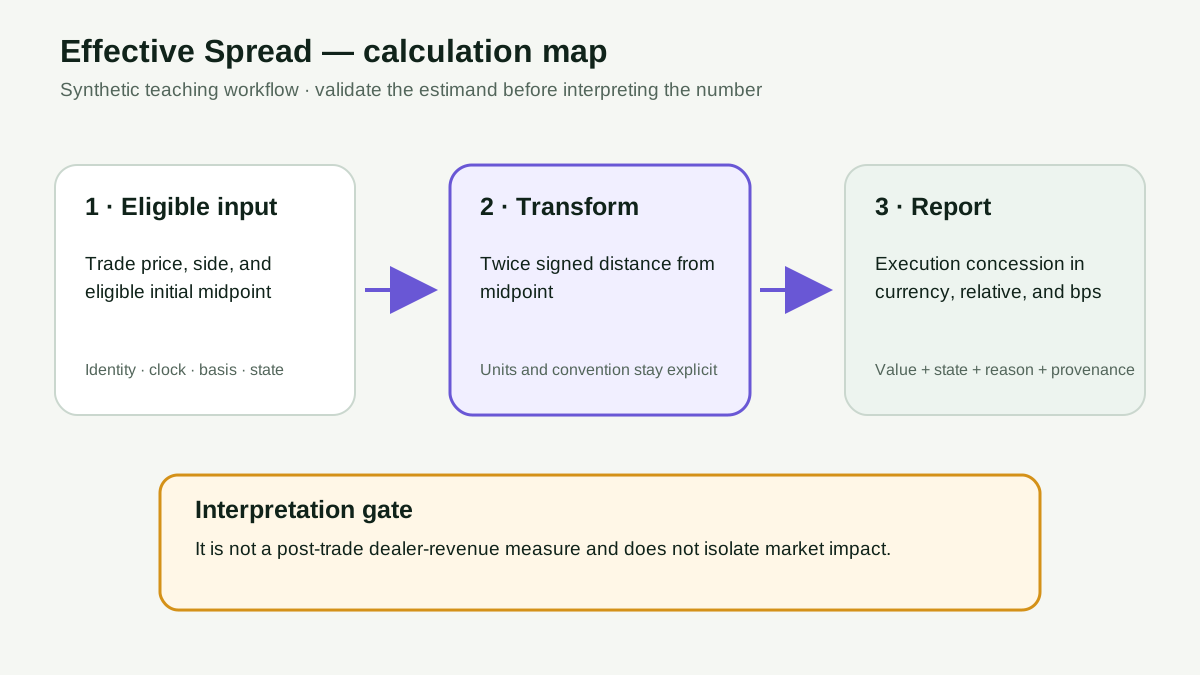
The map separates eligible evidence, transformation, and reason-bearing output.
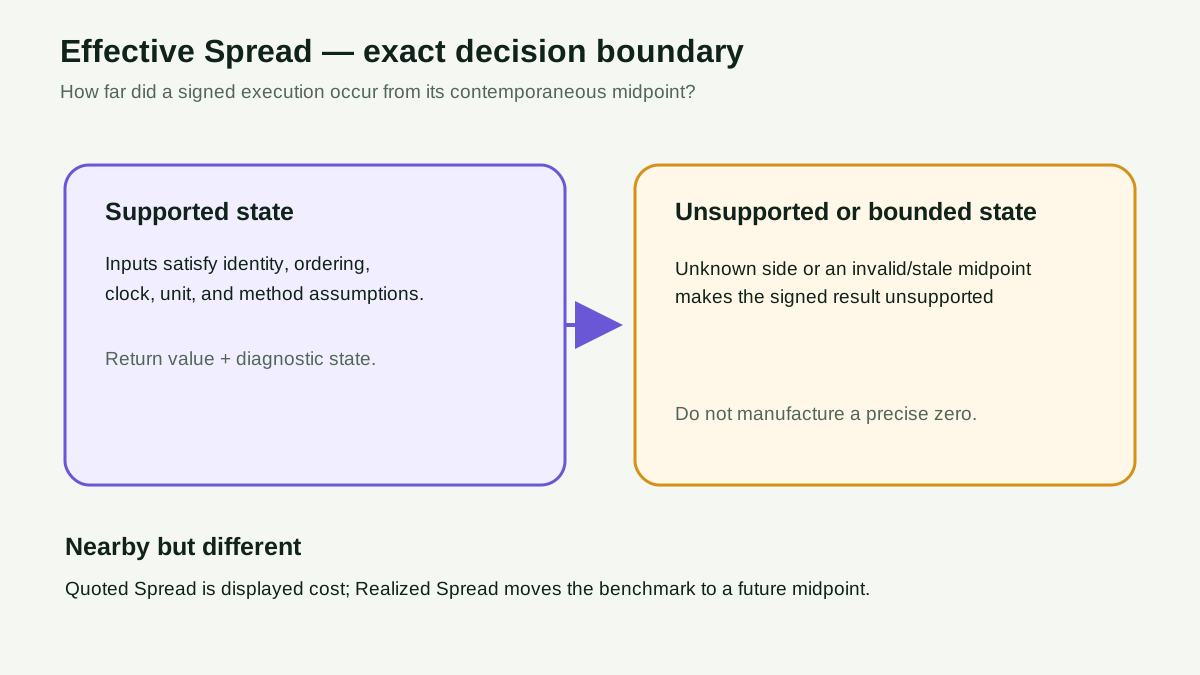
The boundary view shows when the method returns a supported value and when it must return an explicit unsupported or bounded state.
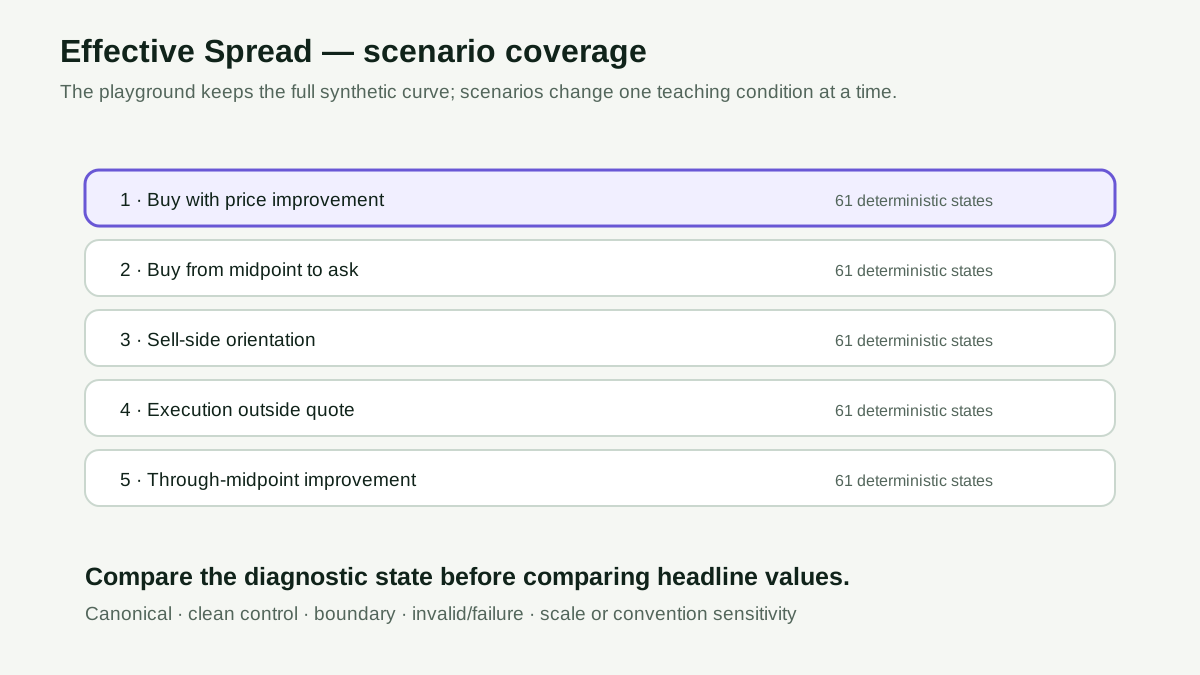
The matrix confirms that the playground retains five distinct scenarios and 61 deterministic states per scenario rather than relying on a tiny toy example.
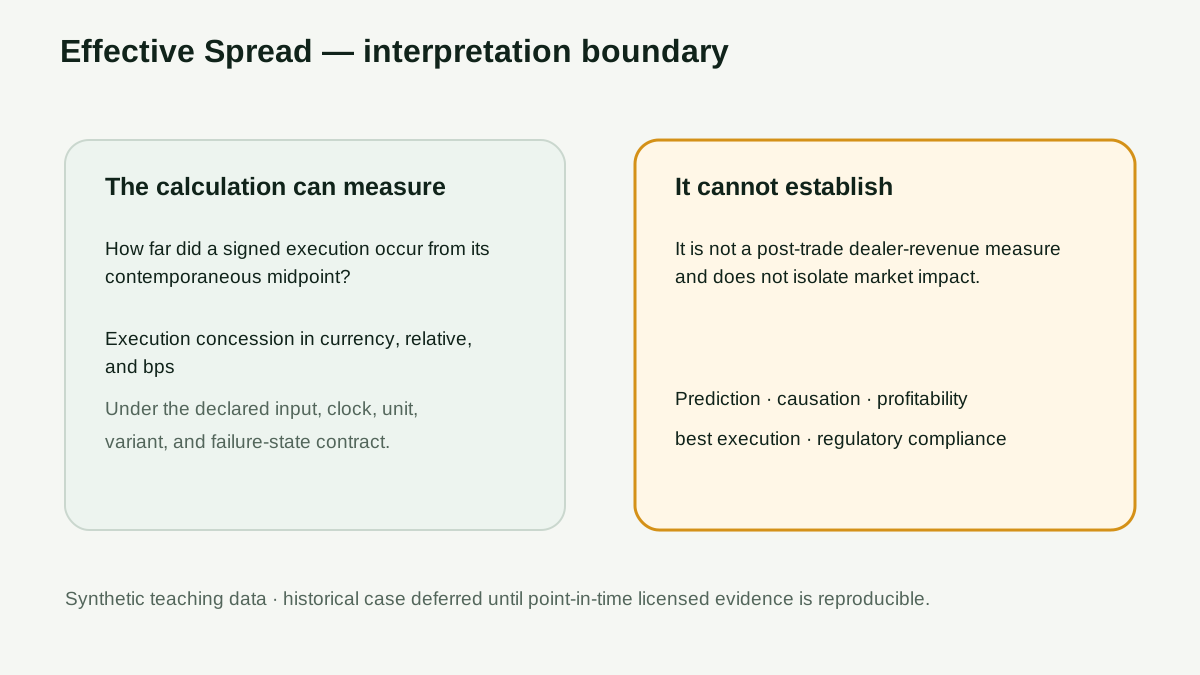
The final view separates what the calculation measures from causal, performance, identity, best-execution, and compliance claims it cannot prove.
<!-- ENHANCEMENT:SEC-605-TRANSITION -->Rule 605 temporal applicability
The SEC published its replacement Rule 605 staff FAQ on April 1, 2026. It states that the new FAQ becomes effective on August 1, 2026, the compliance date for the 2024 amendments. This package was reviewed on July 29, 2026. Accordingly, the amended definitions are presented as an imminent reporting context, not silently treated as already effective. The educational per-record formula remains separate from a complete regulatory aggregation engine.
Evidence boundary
A historical case is deferred until point-in-time identity, licensed source, conditions/corrections, session policy, corporate-action basis, and redistribution permission are archived. NYSE describes Daily TAQ as containing trades, quotes, NBBO, and administrative messages, but its data remain licensed.
Summary and next topic
You can now calculate signed effective spread, one-way price improvement per share, and the round-trip spread reduction for buy and sell executions, audit its assumptions, and distinguish it from nearby liquidity measures. Continue with Realized Spread.
Primary references
Rendered from the canonical Mermaid sources linked by this article.
Effective Spread validation flow
ReferencesPrimary sources and evidence notesExpand the source trail, evidence role, and limitations behind the engineering choices.
Expand the source trail, evidence role, and limitations behind the engineering choices.
Source roles are narrow. Primary sources support definitions and data requirements; all numerical fixtures in this package are visibly synthetic and author-derived.
SRC-01 — SEC Rule 605 adopting release
- Organization or authors: U.S. Securities and Exchange Commission
- Source type: Official rule or original peer-reviewed paper
- Publication or effective date: 2000-11-17
- Version: Source page or paper version at access
- URL or DOI: SEC Rule 605 adopting release
- Accessed: 2026-07-29
- Jurisdiction: U.S. equities / research model
- Supports: official side-aware effective-spread definition
- Limitations: Does not validate the repository's synthetic numbers or make the selected convention universal.
SRC-02 — NYSE Daily TAQ product description
- Organization or authors: New York Stock Exchange
- Source type: Official market-data product documentation
- Publication or effective date: Current product page; accessed 2026-07-29
- Version: Source page or paper version at access
- URL or DOI: NYSE Daily TAQ product description
- Accessed: 2026-07-29
- Jurisdiction: U.S. equities
- Supports: availability of consolidated trades, quotes, NBBO, and administrative messages needed for reproducible intraday measurement
- Limitations: Product access and redistribution are licensed; the page does not supply a free historical fixture.
SRC-03 — 2024 Rule 605 Amendments adopting release
- Organization or authors: U.S. Securities and Exchange Commission
- Source type: Official final rule release
- Publication or effective date: 2024-03-06; Federal Register publication 2024-04-15
- Version: Source page or paper version at access
- URL or DOI: 2024 Rule 605 Amendments adopting release
- Accessed: 2026-07-29
- Jurisdiction: U.S. NMS securities
- Supports: amended execution-quality scope, statistics, timing, and realized-spread horizons
- Limitations: A regulatory reporting framework is broader than this observation-level educational calculator.
SRC-04 — Rule 605 staff frequently asked questions
- Organization or authors: U.S. Securities and Exchange Commission, Division of Trading and Markets staff
- Source type: Official staff guidance without legal force or effect
- Publication or effective date: 2026-04-01; effective 2026-08-01
- Version: Source page or paper version at access
- URL or DOI: Rule 605 staff frequently asked questions
- Accessed: 2026-07-29
- Jurisdiction: U.S. NMS securities
- Supports: five realized-spread horizons, share-weighting, quote timing, partial execution, halt, and correction context
- Limitations: Staff views do not alter applicable law; applicability is date- and rule-specific.
SEC-2026 — Rule 605 staff FAQ transition
- Organization or authors: U.S. Securities and Exchange Commission, Division of Trading and Markets staff
- Source type: Official staff guidance; not a Commission rule or statement
- Publication or effective date: Published 2026-04-01; effective 2026-08-01
- Version: Frequently Asked Questions: Rule 605 of Regulation NMS (April 1, 2026)
- URL or DOI: https://www.sec.gov/rules-regulations/staff-guidance/trading-markets-frequently-asked-questions/frequently-asked-questions-rule-605-regulation-nms
- Accessed: 2026-07-29
- Jurisdiction: U.S. NMS stocks and the Rule 605 scope described by the source
- Supports: the amended reporting context, share weighting, and five realized-spread horizons
- Limitations: The FAQ states it has no legal force and becomes effective after this package’s access date. This package is educational, not a Rule 605 reporting engine.
Full dependency-light reference implementations in both supported languages.
export type TradeSide = "buy" | "sell";

function numberValue(name: string, value: unknown, positive = false): number {
  if (typeof value !== "number" || !Number.isFinite(value)) {
    throw new Error(`${name} must be a finite number`);
  }
  if (positive && value <= 0) throw new Error(`${name} must be greater than zero`);
  return value;
}

function sideDirection(side: unknown): number {
  if (side === "buy") return 1;
  if (side === "sell") return -1;
  throw new Error("side must be 'buy' or 'sell'");
}

function quoteValues(bid: unknown, ask: unknown): [number, number, number] {
  const bidValue = numberValue("bid", bid, true);
  const askValue = numberValue("ask", ask, true);
  if (askValue < bidValue) throw new Error("ask must be greater than or equal to bid");
  return [bidValue, askValue, (bidValue + askValue) / 2];
}

export function quotedSpread(bid: unknown, ask: unknown) {
  const [bidValue, askValue, midpoint] = quoteValues(bid, ask);
  const spread = askValue - bidValue;
  const relative = spread / midpoint;
  return {
    model: "quoted-spread",
    bid: bidValue,
    ask: askValue,
    midpoint,
    quoted_spread: spread,
    quoted_spread_relative: relative,
    quoted_spread_bps: relative * 10_000,
    state: spread === 0 ? "locked" : "two-sided",
  };
}

export function effectiveSpread(
  bid: unknown,
  ask: unknown,
  tradePrice: unknown,
  side: TradeSide,
) {
  const quote = quotedSpread(bid, ask);
  const trade = numberValue("trade_price", tradePrice, true);
  const direction = sideDirection(side);
  const effective = 2 * direction * (trade - quote.midpoint);
  const relative = effective / quote.midpoint;
  const quoteSidePrice = direction === 1 ? quote.ask : quote.bid;
  const priceImprovementPerShare = direction * (quoteSidePrice - trade);
  const roundTripSpreadReduction = quote.quoted_spread - effective;
  const tolerance = 1e-12;
  let state = "outside-quote";
  if (effective < -tolerance) state = "through-midpoint-improvement";
  else if (roundTripSpreadReduction > tolerance) state = "inside-quote";
  else if (Math.abs(roundTripSpreadReduction) <= tolerance) state = "at-quote";
  return {
    ...quote,
    model: "effective-spread",
    trade_price: trade,
    side,
    direction,
    effective_spread: effective,
    effective_spread_relative: relative,
    effective_spread_bps: relative * 10_000,
    quote_side_price: quoteSidePrice,
    price_improvement_per_share: priceImprovementPerShare,
    round_trip_spread_reduction: roundTripSpreadReduction,
    state,
  };
}

export function realizedSpread(
  bidAtTrade: unknown,
  askAtTrade: unknown,
  tradePrice: unknown,
  side: TradeSide,
  bidAfter: unknown,
  askAfter: unknown,
  horizonSeconds: unknown = 300,
) {
  const initial = effectiveSpread(bidAtTrade, askAtTrade, tradePrice, side);
  const [futureBid, futureAsk, futureMidpoint] = quoteValues(bidAfter, askAfter);
  const horizon = numberValue("horizon_seconds", horizonSeconds, true);
  const realized = 2 * initial.direction * (initial.trade_price - futureMidpoint);
  const priceImpact = 2 * initial.direction * (futureMidpoint - initial.midpoint);
  const relative = realized / initial.midpoint;
  const impactRelative = priceImpact / initial.midpoint;
  return {
    model: "realized-spread",
    side,
    direction: initial.direction,
    trade_price: initial.trade_price,
    midpoint_at_trade: initial.midpoint,
    midpoint_after: futureMidpoint,
    bid_after: futureBid,
    ask_after: futureAsk,
    horizon_seconds: horizon,
    effective_spread: initial.effective_spread,
    realized_spread: realized,
    realized_spread_relative: relative,
    realized_spread_bps: relative * 10_000,
    price_impact: priceImpact,
    price_impact_relative: impactRelative,
    price_impact_bps: impactRelative * 10_000,
    decomposition_error: initial.effective_spread - realized - priceImpact,
    state: realized < 0 ? "negative-realized" : "nonnegative-realized",
  };
}

function finiteSeries(name: string, values: unknown, minimum: number): number[] {
  if (!Array.isArray(values)) throw new Error(`${name} must be an array`);
  const result = values.map((value, index) => numberValue(`${name}[${index}]`, value, true));
  if (result.length < minimum) throw new Error(`${name} must contain at least ${minimum} observations`);
  return result;
}

function mean(values: number[]): number {
  return values.reduce((total, value) => total + value, 0) / values.length;
}

export function rollSpread(prices: unknown) {
  const priceValues = finiteSeries("prices", prices, 4);
  const changes = priceValues.slice(1).map((value, index) => value - priceValues[index]);
  const lagged = changes.slice(0, -1);
  const current = changes.slice(1);
  if (current.length < 2) throw new Error("prices must create at least two covariance pairs");
  const laggedMean = mean(lagged);
  const currentMean = mean(current);
  const covariance = lagged.reduce(
    (total, value, index) => total + (value - laggedMean) * (current[index] - currentMean),
    0,
  ) / (current.length - 1);
  const meanPrice = mean(priceValues);
  const covarianceTolerance = 1e-15;
  const spread = covariance < -covarianceTolerance ? 2 * Math.sqrt(-covariance) : null;
  const relative = spread === null ? null : spread / meanPrice;
  return {
    model: "roll-spread",
    observation_count: priceValues.length,
    change_count: changes.length,
    covariance_pair_count: current.length,
    lag1_price_change_covariance: covariance,
    covariance_tolerance: covarianceTolerance,
    mean_price: meanPrice,
    spread_estimate: spread,
    spread_estimate_relative: relative,
    spread_estimate_bps: relative === null ? null : relative * 10_000,
    state: spread === null ? "not-identified" : "estimated",
  };
}

export function amihudIlliquidity(
  closes: unknown,
  dollarVolumes: unknown,
  scale: unknown = 1_000_000,
) {
  const closeValues = finiteSeries("closes", closes, 2);
  const volumeValues = finiteSeries("dollar_volumes", dollarVolumes, 2);
  if (closeValues.length !== volumeValues.length) {
    throw new Error("closes and dollar_volumes must have equal length");
  }
  const scaleValue = numberValue("scale", scale, true);
  const returns = closeValues.slice(1).map((value, index) => value / closeValues[index] - 1);
  const ratios = returns.map((value, index) => Math.abs(value) / volumeValues[index + 1]);
  const raw = mean(ratios);
  return {
    model: "amihud-illiquidity",
    observation_count: closeValues.length,
    return_count: returns.length,
    returns,
    daily_illiquidity: ratios,
    illiquidity_per_currency_unit: raw,
    scale: scaleValue,
    illiquidity_per_scaled_volume: raw * scaleValue,
    state: "estimated",
  };
}

export function corwinSchultzSpread(
  highDay1: unknown,
  lowDay1: unknown,
  highDay2: unknown,
  lowDay2: unknown,
  clipNegative = true,
) {
  const h1 = numberValue("high_day_1", highDay1, true);
  const l1 = numberValue("low_day_1", lowDay1, true);
  const h2 = numberValue("high_day_2", highDay2, true);
  const l2 = numberValue("low_day_2", lowDay2, true);
  if (h1 < l1 || h2 < l2) throw new Error("each daily high must be greater than or equal to its low");
  const beta = Math.log(h1 / l1) ** 2 + Math.log(h2 / l2) ** 2;
  const gamma = Math.log(Math.max(h1, h2) / Math.min(l1, l2)) ** 2;
  const denominator = 3 - 2 * Math.sqrt(2);
  const alphaRaw = (
    (Math.sqrt(2 * beta) - Math.sqrt(beta)) / denominator
    - Math.sqrt(gamma / denominator)
  );
  const alpha = clipNegative ? Math.max(0, alphaRaw) : alphaRaw;
  const expAlpha = Math.exp(alpha);
  const spread = 2 * (expAlpha - 1) / (1 + expAlpha);
  return {
    model: "corwin-schultz-spread",
    beta,
    gamma,
    alpha_raw: alphaRaw,
    alpha_used: alpha,
    spread_estimate_relative: spread,
    spread_estimate_bps: spread * 10_000,
    clip_negative: clipNegative,
    state: clipNegative && alphaRaw < 0 ? "clipped-to-zero" : "estimated",
  };
}

export function calculate(topicId: string, inputs: Record<string, any>) {
  if (topicId === "D11-F02-A01") return quotedSpread(inputs.bid, inputs.ask);
  if (topicId === "D11-F02-A02") return effectiveSpread(inputs.bid, inputs.ask, inputs.trade_price, inputs.side);
  if (topicId === "D11-F02-A03") return realizedSpread(
    inputs.bid_at_trade,
    inputs.ask_at_trade,
    inputs.trade_price,
    inputs.side,
    inputs.bid_after,
    inputs.ask_after,
    inputs.horizon_seconds ?? 300,
  );
  if (topicId === "D11-F02-A04") return rollSpread(inputs.prices);
  if (topicId === "D11-F02-A05") return amihudIlliquidity(
    inputs.closes,
    inputs.dollar_volumes,
    inputs.scale ?? 1_000_000,
  );
  if (topicId === "D11-F02-A06") return corwinSchultzSpread(
    inputs.high_day_1,
    inputs.low_day_1,
    inputs.high_day_2,
    inputs.low_day_2,
    inputs.clip_negative ?? true,
  );
  throw new Error(`unsupported topic_id: ${topicId}`);
}
The embedded lab now expands to its full document height, keeping the article as the only scroll surface.