
 By Islam Baraka
An issuer offers one new share for every four existing shares. A developer sees four shares become five and restates every historical EPS denominator by .
That would be correct if the fifth share were free. Here, the shareholder pays USD 60 for it while an old share is worth USD 100. The issue is partly a cash-funded share issue and partly a bonus.
The accounting problem is to isolate the free part.
In our example, four old shares carry USD 400 of value. The new subscription contributes USD 60. After the issue, USD 460 is spread across five shares, giving a theoretical ex-rights price (TERP) of USD 92:
The retrospective bonus factor is not . It is:
That distinction—full share increase versus embedded bonus—is the whole topic.
Why a discounted rights issue affects historical EPS
A rights issue gives qualifying existing shareholders an opportunity to subscribe for new shares, usually in proportion to their holdings. When the subscription price is below fair value, part of the new share's value is transferred without equivalent consideration. That part resembles a bonus issue.
IAS 33 identifies the bonus element in a rights issue and, in Appendix A2, specifies the adjustment when the offer is made to all existing shareholders. Pre-rights shares used in Basic and diluted EPS are multiplied by fair value per share immediately before exercise divided by theoretical ex-rights fair value. IAS 33 paragraph 27 and Appendix A2
FASB Statement No. 128 paragraphs 55–56 use the corresponding logic under US GAAP: a below-fair-value rights issue contains a stock-dividend-like bonus element, and a qualifying all-stockholder offer produces a retrospective Basic and diluted EPS adjustment. FASB Statement No. 128
The adjustment preserves comparability. Historical EPS is expressed in share units comparable with post-rights units, but only for the value distributed without consideration.
The two effects hiding in one event
A rights issue creates two denominator effects:
- Retrospective bonus element. Eligible pre-rights denominators receive the fair-value-to-TERP factor.
- Actual new shares. The rights shares issued for cash enter the current-period weighted-average denominator from their issue or exercise date.
Collapsing those effects into one historical factor treats the entire paid share as free.
The visual makes the separation explicit:
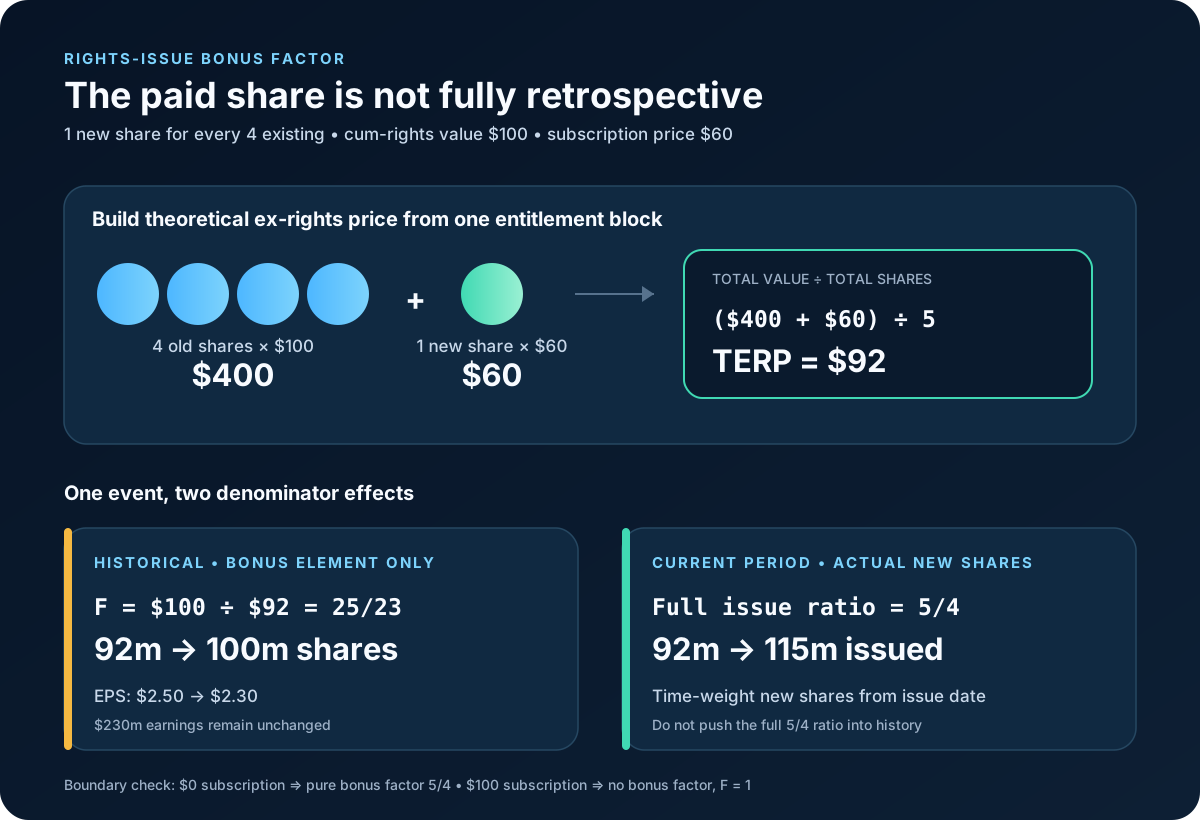
Accessible description: four old shares at USD 100 contribute USD 400 and one new share subscribed at USD 60 contributes USD 60. Dividing the USD 460 total by five gives a USD 92 TERP. The historical factor is USD 100 divided by USD 92, or , taking 92 million historical shares to 100 million and EPS from USD 2.50 to USD 2.30. The actual fully subscribed share count is separately shown as 115 million.
Build TERP from an entitlement block
Let:
- be existing shares in one entitlement block;
- be new rights shares in that block;
- be cum-rights fair value per old share immediately before exercise;
- be subscription price per new share;
- be theoretical ex-rights price.
The old shares contribute of value. Subscribers contribute of new consideration. The result is spread across shares:
This block formula is the proportional version of the standards' aggregate formulation:
Keep price currency and scale consistent. If is USD per share and is cents per share, a numerically valid calculation can still be wrong by a factor of 100.
Derive the bonus factor
When , divide the pre-exercise fair value by TERP:
The direction matters. The factor is , not . An SEC staff comment once called out this exact inversion in a registrant's disclosure. SEC correspondence on the factor direction
Because TERP is below the cum-rights fair value for a discounted offer, . The factor increases historical share units and reduces absolute EPS. The inverse would do the opposite.
For a completed pre-rights denominator and earnings :
Do not calculate the production result by dividing a rounded EPS display. Preserve the exact numerator and denominator.
Worked example
Assume:
- rights terms: one new share for every four existing shares;
- cum-rights fair value: USD 100 per share;
- subscription price: USD 60 per new share;
- historical earnings available to ordinary shareholders: USD 230 million;
- historical weighted-average ordinary shares: 92 million.
Step 1: Calculate TERP
Step 2: Calculate the exact factor
Avoid rounding the factor to 1.09 before applying it. The exact fraction gives a clean result.
Step 3: Restate the historical denominator
Step 4: Recalculate Basic EPS
Before adjustment:
After adjustment:
The earnings numerator is unchanged:
Step 5: Keep the actual share issue separate
If all rights are exercised:
Why did history reach only 100 million? Because captures only the embedded bonus. The difference between the 100 million restated historical units and 115 million actual post-issue shares reflects consideration-funded shares and current-period timing.
Boundary cases explain the formula
The formula becomes easier to trust when tested at its edges.
Free subscription:
The rights issue becomes a pure bonus issue. The bonus factor equals the full issue ratio.
Fair-value subscription:
There is no value transfer and no retrospective bonus adjustment. The new shares still enter the current-period weighted average from issue.
Discounted subscription:
The factor sits between no adjustment and a pure bonus issue.
Premium subscription:
The raw formula produces . Do not use it to shrink historical shares. This algorithm classifies the event as no_bonus_element and applies factor one; any other accounting consequences are outside this workflow.
Eligibility is part of the algorithm
The factor is not triggered merely because an offer is called a rights issue.
The cited IFRS and US GAAP formulations condition the canonical retrospective adjustment on an offer made to all existing shareholders or stockholders. A selective placement, employee offer, or jurisdictionally restricted transaction may need separate analysis rather than silent reuse of this method.
FASB Statement No. 128 also says that if exercise depends on a contingency beyond passage of time, the adjustment is made only when the contingency is resolved. Model that state explicitly:
offered_to_all_existing_shareholders = true
has_non_time_contingency = true
contingency_resolved = false
The result is “wait,” not a provisional factor applied to published history.
The price measurement date matters
Price inputs need lineage, not just decimals.
IAS 33 Appendix A2 and FASB Statement No. 128 paragraph 56 state that if rights trade separately from the shares before exercise, fair value for the calculation is measured at the close of the last day on which the shares trade together with the rights.
A robust event therefore stores:
- price value and currency;
- per-share scale;
- measurement date;
- source or valuation identifier;
- whether rights traded separately;
- the applicable measurement convention.
Do not accept “40% discount” as a substitute for and . A transaction announcement may quote a discount to closing price, TERP, or another reference price. The algorithm needs the actual price terms on a declared basis.
Basis dates prevent double application
Historical vendor data may already be adjusted. Attach a basis_date to each period row:
All qualifying rights-issue bonus factors effective on or before this date are already reflected.
Apply an event only when:
Equality means “already represented.”
Require basis_is_uniform=true. A transition-period denominator containing some pre-rights days and some post-rights days must be constructed from correctly adjusted time segments upstream. A completed-denominator factor is not a substitute for that schedule.
Calculation flow
Accessible description: the engine verifies an all-shareholder offer, resolved contingencies, and traceable price inputs before calculating TERP. A discounted issue receives ; an issue at or above fair value receives factor one. Historical adjustment and current-period time-weighting remain separate branches.
The reusable source is in visuals/mermaid/rights-bonus-flow.md.
Implementation sequence
- Validate framework, authorisation cutoff, policies, units, currency, and rounding.
- Validate unique, effective, chronological events.
- Require positive integer and , positive , and nonnegative .
- Require the canonical all-existing-shareholder condition.
- Block an unresolved non-time contingency.
- Validate price date and source, including the last-cum-rights rule when applicable.
- Calculate TERP without intermediate display rounding.
- If , calculate ; otherwise return factor one.
- Select events later than each uniform period basis.
- Multiply factors exactly, preserve earnings, restate shares, recalculate EPS, and round outputs only.
Useful output diagnostics include:
- event classification;
- TERP;
- factor numerator and denominator;
- full issue ratio;
- price measurement date and source;
- applied event IDs;
- source and target basis;
- original and restated shares;
- unchanged earnings;
- rounding flags and finality.
Testing and invariants
A useful test suite includes:
- the canonical USD 100/USD 60, 1-for-4 case;
- , matching a pure bonus issue;
- , producing factor one;
- , never applying a factor below one;
- profit, loss, and zero earnings;
- offer not made to all existing holders;
- resolved and unresolved contingencies;
- separately traded rights with supported and unsupported price dates;
- mismatched currency or scale;
- event on the basis date;
- multiple exact factors;
- declared display-rounding modes.
Before display rounding:
For :
These bounds catch price inversion, factor inversion, and an accidental full-ratio substitution.
A real filed example
National Grid completed a discounted rights issue in June 2024. Its filing states that the discount created a bonus element and that comparative Basic and diluted EPS weighted-average shares were adjusted by a factor of 1.0811. National Grid rights-issue disclosure
That example is useful because it shows the factor appearing in an actual EPS note. It is not the source of the rule, and its terms should not be transplanted into another issuer's calculation.
Failure modes
- Using retrospectively: counts the cash-funded share as free.
- Inverting the factor: makes historical EPS larger.
- Rounding TERP early: creates avoidable share-count drift at scale.
- Trusting a quoted discount: may use the wrong benchmark.
- Ignoring price lineage: loses the measurement convention and audit evidence.
- Applying before contingency resolution: records an adjustment too soon.
- Treating a selective offer as pro-rata: bypasses the eligibility condition.
- Applying twice: depresses a series already normalized by a vendor.
- Skipping transition-period weighting: confuses retrospective unit adjustment with actual time outstanding.
- Extending automatically to diluted EPS: ignores instrument-specific term changes and antidilution tests.
Practical use and limits
Correct rights-issue adjustment supports comparable EPS histories, filing controls, corporate-action data, normalized valuation series, and reproducible audit trails.
It does not measure whether shareholders created or lost wealth, predict the ex-rights market price, recommend exercising the rights, or replace professional accounting judgment. TERP is a theoretical allocation used inside the accounting adjustment.
Summary
Remember five rules:
- Build TERP from old-share value plus subscription proceeds.
- Divide cum-rights fair value by TERP; do not invert the factor.
- Apply only the embedded bonus retrospectively.
- Time-weight the actual new shares separately in the current period.
- Preserve eligibility, contingency, price, and basis evidence.
The next catalog topic, D46-F01-A08 — Basic EPS, uses the completed earnings numerator and weighted-average denominator to calculate the published per-share measure.
Executable reference package
This topic includes an exact rational/decimal reference calculation, a labeled synthetic accounting fixture, invalid-contract coverage, and Python/Node parity checks. The fixture is a teaching case, not issuer data. Run python tests/test_reference.py and node --experimental-strip-types tests/reference.test.ts.
Rendered from the canonical Mermaid sources linked by this article.
Rights-issue bonus-factor flow
Purpose: Show the eligibility gates, TERP calculation, bonus classification, basis filtering, and separate current-period treatment.
Accessible description: A rights event first passes the all-shareholder, contingency, and price-evidence gates. TERP is then calculated from old-share value plus subscription proceeds. A discount below fair value creates a bonus factor; otherwise the factor is one. The factor adjusts eligible pre-rights EPS history, while the actual new shares enter the current-period denominator separately from their issue or exercise date.
Takeaway: One event creates two different denominator effects: a retrospective bonus factor and a prospective time-weighted share issue.
ReferencesPrimary sources and evidence notesExpand the source trail, evidence role, and limitations behind the engineering choices.
Expand the source trail, evidence role, and limitations behind the engineering choices.
Last reviewed: 2026-07-19.
IFRS-IAS33 — IAS 33 Earnings per Share
- Organization: IFRS Foundation / International Accounting Standards Board.
- Source type: Official issued accounting standard.
- Publication represented: 2023 issued HTML edition.
- URL: IAS 33 Earnings per Share.
- Accessed: 2026-07-19.
- Jurisdiction: IFRS Accounting Standards; local endorsement may differ.
- Supports: Paragraph 27(b) for the bonus element in a rights issue; Appendix A2 for the all-shareholder eligibility condition, the fair-value-to-theoretical-ex-rights-price factor, the TERP formula, and the separate-rights price measurement convention; paragraph 64 for retrospective EPS adjustment and qualifying post-reporting-period events.
- Limitations: Production reporting must use the entity's current licensed and locally adopted standards and the specific rights terms.
FASB-FAS128 — Statement No. 128, Earnings per Share
- Organization: Financial Accounting Standards Board.
- Source type: Official historical FASB standard underlying ASC Topic 260.
- Publication date: February 1997, as hosted by FASB.
- URL: Statement of Financial Accounting Standards No. 128.
- Accessed: 2026-07-19.
- Jurisdiction: United States.
- Supports: Paragraphs 55–56 for a below-fair-value rights issue's bonus element, the all-existing-stockholder condition, retroactive Basic and diluted EPS adjustment, contingent-rights timing, the factor and TERP formulas, and the separate-rights price measurement convention.
- Limitations: Current US GAAP conclusions must be checked against the current ASC codification and entity facts.
SEC-NATIONAL-GRID-2024 — Filed rights-issue restatement example
- Organization: U.S. Securities and Exchange Commission EDGAR; National Grid plc registrant disclosure.
- Source type: Primary issuer filing, not accounting authority.
- Reporting period: Six months ended 30 September 2024.
- URL: National Grid rights-issue disclosure.
- Accessed: 2026-07-19.
- Jurisdiction: IFRS reporting by a foreign private issuer.
- Supports: A real filed example in which a discounted rights issue created a bonus element and comparative Basic and diluted EPS denominators were adjusted by a factor of 1.0811.
- Limitations: Illustrates application only; its terms and factor are not inputs to the synthetic worked example.
SEC-FACTOR-DIRECTION — SEC staff comment on factor direction
- Organization: U.S. Securities and Exchange Commission EDGAR.
- Source type: Primary regulatory correspondence.
- URL: SEC comment and registrant response on the rights factor.
- Accessed: 2026-07-19.
- Jurisdiction: United States.
- Supports: The direction of the factor: fair value immediately before exercise divided by theoretical ex-rights fair value, not the inverse.
- Limitations: Regulatory correspondence is contextual and does not replace the accounting literature.
Research limits
- “Rights issue,” “rights offering,” “pre-emptive offer,” and similar labels do not by themselves establish that every existing shareholder was eligible or that the subscription price was below fair value.
- The price measurement date, rights-trading facts, contingencies, legal effectiveness, and current reporting cutoff require entity-specific evidence.
- This package models the EPS bonus-factor adjustment. It does not determine proceeds accounting, legal entitlements, equity classification, or diluted-instrument term adjustments.
- All numerical examples are synthetic and carry no market-data license.
Full dependency-light reference implementations in both supported languages.
/** Exact dependency-free native TypeScript entry point for D46-F01-A07: Rights-Issue Bonus-Factor Adjustment. */
import { rightsIssueBonusFactorAdjustment as nativeRightsIssueBonusFactorAdjustment } from "../../../../../../shared/missing_152/typescript/epsRuntime.ts";

export const TOPIC_ID = "D46-F01-A07";
export const TITLE = "Rights-Issue Bonus-Factor Adjustment";

export function rightsIssueBonusFactorAdjustment(input: Record<string, unknown>): Record<string, unknown> {
  return nativeRightsIssueBonusFactorAdjustment(input);
}
The embedded lab now expands to its full document height, keeping the article as the only scroll surface.