
 By Islam Baraka
An issuer reports Basic earnings per share (EPS) of USD 3.00. Its convertible notes could create five million ordinary shares. A developer adds those shares to the denominator:
The arithmetic works. The diluted-EPS logic does not.
If the notes had been converted, the issuer would not have recognized the same debt-related interest expense. The assumed conversion changes the numerator as well as the denominator. After adding back USD 4.5 million of net after-tax expense, the correct candidate is:
Displayed to two decimals, that is USD 2.77—not USD 2.67.
This article teaches the two-sided bridge, its timing, and the exact test that decides whether the convertible debt belongs in diluted EPS.
Start from completed Basic EPS
The if-converted method is not a replacement for Basic EPS. It starts from Basic continuing-operations components that are already complete:
- earnings or loss attributable to ordinary shareholders;
- preference and participation adjustments;
- weighted-average ordinary shares;
- treasury-share exclusions;
- split, bonus-issue, and rights-issue restatements;
- explicit unit scales and finality.
Let:
where is the continuing-operations Basic numerator and is the restatement-complete Basic denominator.
Continuing operations matters because the accounting standards use it as the control number for dilution. An instrument is not included merely because it reduces some other EPS subtotal.
IAS 33 says potential ordinary shares are dilutive only when conversion would decrease EPS or increase loss per share from continuing operations. It also requires each issue or series to be considered separately and then sequenced from most dilutive to least dilutive. IAS 33 paragraphs 41–44
This topic handles one convertible-debt series. Later topics handle ordering and the final reconciliation.
The economic counterfactual
Convertible debt can participate in the issuer's results in one of two modeled forms:
- as debt, receiving interest and remaining outside ordinary shares; or
- as ordinary shares, participating through the EPS denominator after assumed conversion.
The if-converted method prevents the instrument from enjoying both forms simultaneously. If we assume the shares exist, we must also reverse the income effects that would not exist under that assumption.
IAS 33 paragraphs 31–35 require the numerator to be increased by the after-tax dividends and interest recognized for dilutive potential ordinary shares and adjusted for other conversion-driven income or expense changes. Expenses can include transaction costs and discounts recognized through the effective interest method. IAS 33 paragraphs 31–35
That is why “coupon × face amount” is not a safe universal numerator formula. The recognized income-statement effect can also include:
- debt discount or premium amortization;
- issue-cost amortization;
- changes in nondiscretionary profit-sharing or royalties;
- other conversion consequences;
- the related tax effect.
Store those effects as signed, sourced components. Do not hide them inside an unexplained effective tax rate.
The two-sided formula
Let:
- be the Basic continuing-operations numerator;
- be Basic weighted-average ordinary shares;
- be the net after-tax numerator change under assumed conversion;
- be ordinary shares issued on fixed conversion;
- be the period exposure weight;
- be weighted incremental shares.
Then:
where is the standalone if-converted candidate.
Build the numerator adjustment from signed components:
A positive component increases the numerator. A normal tax effect on an interest add-back is therefore negative.
Build the denominator adjustment:
The same reporting interval must govern both sides. Recognized interest may already be period-aligned, so multiplying it by again would double-weight the numerator.
Worked example
Assume a fixed-share convertible note was outstanding for the full year:
- Basic continuing-operations numerator: USD 120 million;
- Basic weighted-average shares: 40 million;
- interest and related expense recognized: USD 6 million;
- tax effect of removing the expense: USD (1.5) million;
- ordinary shares on conversion: 5 million;
- no other consequential income changes.
What should you notice in the visual? The debt disappears from the hypothetical capital structure, so one change moves up into earnings while another moves down into shares.
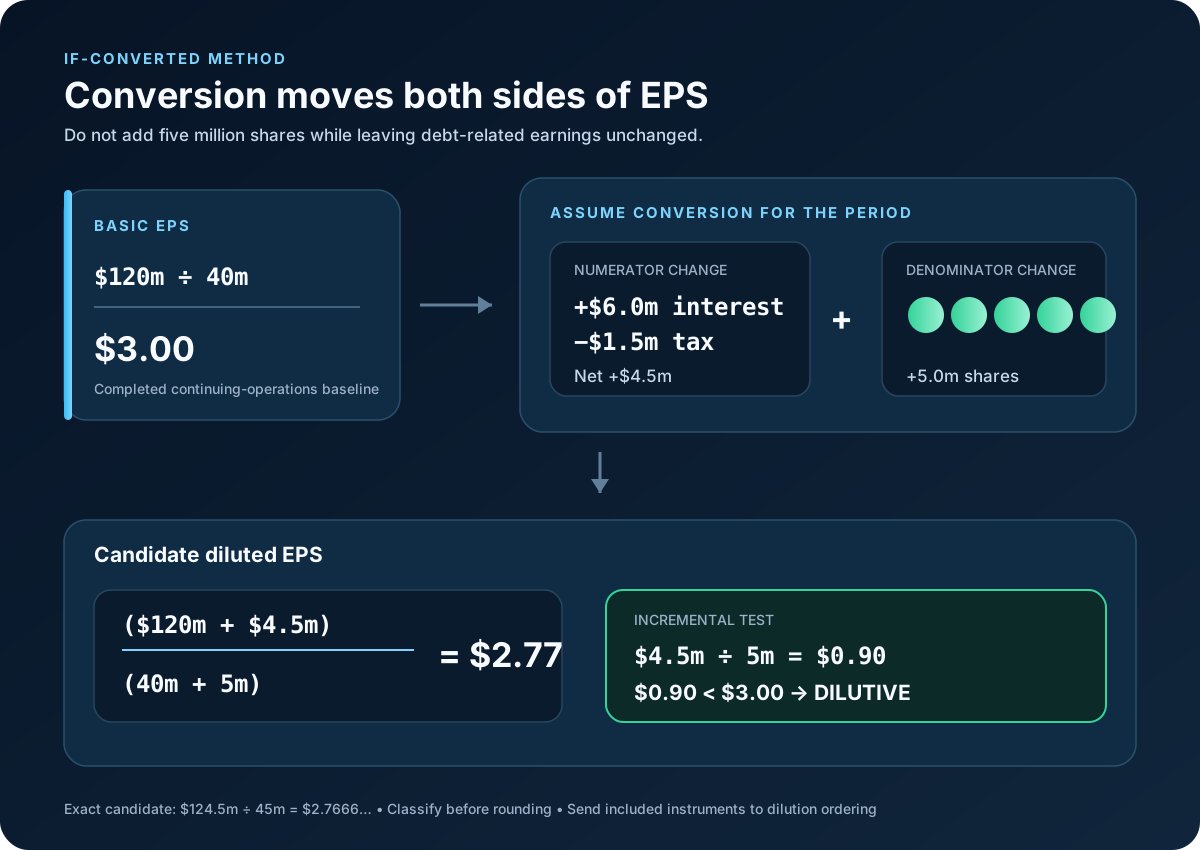
Accessible description: Basic EPS is USD 120 million divided by 40 million shares, or USD 3.00. Assumed conversion adds USD 6 million of interest and a USD (1.5) million tax effect, net USD 4.5 million, while adding five million shares. The candidate becomes USD 124.5 million divided by 45 million shares, or USD 2.7666…, displayed as USD 2.77. Incremental EPS is USD 0.90, below Basic EPS, so the instrument is dilutive.
Step 1: Verify Basic EPS
Step 2: Build the net numerator adjustment
This example uses an explicit USD (1.5) million tax effect. It happens to equal 25% of USD 6 million, but the implementation stores the tax amount rather than assuming every issuer can use a 25% rate.
Step 3: Weight conversion shares
The notes were outstanding for the full year:
Step 4: Calculate the exact candidate
Step 5: Check the bridge
Before display rounding:
The denominator-only shortcut produced USD 2.67 because it added the potential shares without removing the debt-related after-tax expense.
The incremental EPS test
For , define earnings per incremental share:
In the example:
Because USD 0.90 is below the USD 3.00 Basic control EPS, adding this instrument pulls the candidate downward.
For one fixed-share instrument:
if and only if:
This equivalence is useful for testing and ordering. Do not classify on rounded values. An exact USD 2.995 candidate and a USD 3.004 baseline might both display as USD 3.00, but the exact candidate is dilutive.
In a multi-instrument calculation, incremental EPS also determines sequence. Each series is tested against the running diluted result after more-dilutive instruments have been included. This topic returns the incremental pair; Dilutive-Instrument Ordering performs that later stage.
Timing is part of the method
IAS 33 paragraph 36 treats dilutive potential ordinary shares as converted at the beginning of the period or, if issued later, at the issue date. Paragraph 38 addresses lapse, cancellation, and actual conversion. IAS 33 paragraphs 36–39
The assumed-conversion interval begins at:
It ends at the earliest applicable boundary:
Use the same day-count convention as the Basic weighted-average share engine.
Mid-year issuance
If notes are issued on 1 April in a calendar year, potential shares did not exist in January through March. Weight the conversion shares from issuance. Use interest and related expense actually recognized for the aligned post-issue interval.
Actual conversion
Suppose the notes convert on 1 July:
- before 1 July, the diluted denominator contains potential shares under the if-converted assumption;
- from 1 July, the actual issued shares are already in Basic and diluted EPS;
- the numerator add-back includes only debt-related expense recognized before actual conversion.
Adding potential shares for the full year would double-count the second half.
Lapse, redemption, or extinguishment
Potential shares are included only while the instrument is outstanding. A legal event date and an accounting recognition date may require review; do not infer the endpoint from a status label alone.
Conversion terms need their own data contract
The shares on conversion should come from validated terms, not from a free-text field such as conversion_price: 50.
At minimum, preserve:
- instrument and series identifier;
- issue date and relevant event dates;
- conversion terms version date;
- fixed shares or the prepared variable-share result;
- settlement classification;
- whether principal must be paid in cash;
- contingency flags;
- whether the holder-advantageous conversion basis was selected;
- term source and review status;
- split and anti-dilution adjustment completeness.
IAS 33 paragraph 39 says that when more than one conversion basis exists, the calculation uses the rate or price most advantageous to the holder. This is a contract-analysis input, not a guess the EPS engine should make from incomplete terms.
The US GAAP cash-principal exception
Current US GAAP requires the if-converted method for convertible instruments after the amendments communicated by ASU 2020-06; the former treasury-stock method is no longer the general convertible-instrument method. FASB ASU 2020-06
There is a crucial refinement. ASC 260-10-45-40, as amended, says that when a convertible debt instrument's principal must be paid in cash, interest charges are not added back to the numerator. Only the conversion-premium share effect is reflected using the applicable variable-share rules.
So this input:
accounting_framework = US_GAAP
principal_must_be_paid_in_cash = true
must not flow through the canonical interest + tax bridge. Route it to the cash-principal conversion-premium calculation.
If the issuer can settle principal and conversion premium in shares or cash, the assumptions differ. Instrument names such as “net-share-settled note” are not a substitute for the actual settlement clauses.
Contingently convertible instruments
Under current US GAAP, a contingently convertible instrument subject only to a market-price trigger is included in diluted EPS when dilutive even if the trigger has not been met. ASU 2020-06 retains that rule. A substantive non-market contingency can change the conclusion.
Do not flatten all contingencies into one boolean. Useful fields include:
is_contingently_convertible
market_price_trigger_present
non_market_contingency_present
non_market_contingency_satisfied
This article does not implement every contingent conversion formula, but it makes the classification gate explicit so a simple note is not confused with a conditional instrument.
Calculation flow
Accessible description: completed Basic components and validated debt terms lead to a settlement branch. A US GAAP cash-principal instrument receives no interest add-back and routes to the conversion-premium calculation. The fixed-share path aligns the numerator and share intervals, calculates an exact candidate, and includes it only if continuing-operations EPS is reduced.
The reusable source is in visuals/mermaid/if-converted-flow.md.
Implementation sequence
- Validate entity, period, framework, currency, scales, and rounding.
- Require completed Basic continuing-operations components.
- Validate the instrument's dates, terms, settlement, contingencies, and sources.
- Establish the assumed-conversion interval.
- Confirm that recognized numerator components cover the same interval.
- Route the US GAAP cash-principal variant without interest add-back.
- Sum signed pretax, tax, and consequential components exactly.
- Time-weight fixed conversion shares.
- Calculate Basic control EPS, incremental EPS, and the candidate.
- Classify on exact continuing-operations values.
- Return lineage and the incremental pair for later ordering.
Useful diagnostics include:
- numerator component types, amounts, sources, and finality;
- gross and net adjustment totals;
- unweighted and weighted conversion shares;
- issue, event, and term-version dates;
- exact time weight;
- Basic, incremental, and candidate EPS;
- settlement and contingency classifications;
- inclusion result and reason codes.
Loss periods and equality
If continuing operations reports a loss and assumed conversion adds positive after-tax earnings while adding shares, the candidate normally becomes less negative:
That reduces the loss per share and is antidilutive. Exclude it.
The rule remains a numeric direction test:
Exact equality creates no dilution and is excluded.
Testing and failure modes
A serious test suite should cover:
- the USD 120m / 40m canonical example;
- the denominator-only incorrect result;
- missing or provisional tax assessment;
- coupon-only expense that omits effective-interest components;
- a mid-year issue;
- an actual mid-year conversion;
- a lapse or extinguishment;
- continuing-operations profit, loss, and zero;
- exact candidate equality;
- multiple conversion bases;
- restatement-incomplete conversion terms;
- US GAAP cash-principal settlement;
- market and non-market contingencies;
- currency and unit mismatches;
- display-rounding ties.
Core invariants include:
for the one-instrument fixed-share path.
Common failures are:
- adding shares without adjusting earnings;
- adding gross interest without tax;
- using contractual coupon instead of recognized expense;
- applying the period weight twice;
- double-counting potential and actual shares;
- using total profit instead of continuing operations as the control;
- testing rounded displays;
- aggregating multiple series before individual evaluation;
- applying the full-share formula to required-cash principal.
A real filed example
Apollo Commercial Real Estate Finance's 2022 annual report provides a clear application. Its diluted-EPS reconciliation added interest expense on convertible notes to diluted earnings and added weighted potentially issuable note shares to the denominator. It also disclosed that those potential shares were excluded in 2020 because the effect was antidilutive. Apollo 2022 annual report
The filing demonstrates the bridge and period-specific exclusion. The standards, not the filing, define the method.
Comparison with nearby methods
| Instrument | Numerator effect | Denominator effect | Main method |
|---|---|---|---|
| Fixed-share convertible debt | After-tax interest and consequential changes | Weighted conversion shares | If-converted |
| Convertible preference shares | Add back applicable preference dividends | Weighted conversion shares | If-converted |
| Options and warrants | Usually none | Incremental shares after assumed repurchase | Treasury-share method |
| Contingently issuable shares | Depends on instrument terms | Shares issuable under current condition status | Contingent-share rules |
| Required-cash principal convertible debt under US GAAP | No interest add-back for cash principal | Conversion-premium potential shares | Modified if-converted branch |
These are not interchangeable “fully diluted share count” shortcuts. Each produces a numerator-denominator pair and an instrument-specific inclusion test.
Practical use and limits
The method supports filing preparation, EPS reconciliations, XBRL controls, convertible-term data stores, vendor normalization, and audit trails.
It does not estimate the probability of conversion, value the note, forecast future dilution, or recommend whether an investor should convert. Diluted EPS is a standardized counterfactual presentation, not a probability-weighted forecast.
Summary and next topic
Remember five rules:
- Begin with completed Basic continuing-operations components.
- Reverse every relevant after-tax income effect of assumed conversion.
- Add conversion shares only for the period the instrument is potentially outstanding.
- Classify using exact EPS, not rounded displays.
- Preserve settlement terms because required-cash principal changes US GAAP treatment.
The next topic is D46-F02-A02 — If-Converted Convertible-Preference Dilution. It keeps the conversion-share logic but replaces debt interest and tax effects with preference-dividend numerator mechanics.
Executable reference package
This topic includes an exact rational/decimal reference calculation, a labeled synthetic accounting fixture, invalid-contract coverage, and Python/Node parity checks. The fixture is a teaching case, not issuer data. Run python tests/test_reference.py and node --experimental-strip-types tests/reference.test.ts.
Rendered from the canonical Mermaid sources linked by this article.
If-converted debt dilution flow
Purpose: Show the term, timing, numerator, denominator, and exact antidilution gates for one convertible-debt series.
Accessible description: The workflow begins with completed Basic continuing-operations components, validates the debt terms and timing, and separates US GAAP instruments whose principal must be paid in cash. The canonical branch sums the signed numerator changes and time-weights conversion shares over the same interval. The exact candidate is included only when it is below Basic continuing-operations EPS.
Takeaway: The calculation is two-sided and the inclusion decision is made after terms, timing, and exact antidilution testing.
ReferencesPrimary sources and evidence notesExpand the source trail, evidence role, and limitations behind the engineering choices.
Expand the source trail, evidence role, and limitations behind the engineering choices.
Last reviewed: 2026-07-20.
IFRS-IAS33 — IAS 33 Earnings per Share
- Organization: IFRS Foundation / International Accounting Standards Board.
- Source type: Official issued accounting standard.
- Publication represented: 2023 issued HTML edition; current IFRS overview also reviewed.
- URL: IAS 33 Earnings per Share.
- Accessed: 2026-07-20.
- Jurisdiction: IFRS Accounting Standards; local endorsement may differ.
- Supports: Paragraphs 31–39 for diluted-EPS numerator adjustments, weighted conversion shares, issue-date timing, actual-conversion timing, and holder-advantageous terms; paragraphs 41–44 for the continuing-operations control number, antidilution, separate-instrument evaluation, and sequencing; paragraphs 49–50 for convertible instruments and the interest-per-incremental-share test.
- Limitations: Production reporting must use the entity's current licensed and locally adopted standards. Instrument classification, settlement terms, tax effects, and consequential income changes require entity-specific analysis.
FASB-FAS128 — Statement No. 128, Earnings per Share
- Organization: Financial Accounting Standards Board.
- Source type: Official historical FASB standard underlying ASC Topic 260.
- Publication date: February 1997, as hosted by FASB.
- URL: Statement of Financial Accounting Standards No. 128.
- Accessed: 2026-07-20.
- Jurisdiction: United States.
- Supports: Paragraphs 13–16 for antidilution, separate series, sequencing, and continuing-operations control; paragraphs 26–28 for the if-converted numerator, tax and nondiscretionary adjustments, assumed-conversion timing, and weighting.
- Limitations: Statement 128 is historical. Current US GAAP conclusions must be checked against the current ASC Codification and subsequent amendments, including ASU 2020-06.
FASB-ASU2020-06 — Accounting for Convertible Instruments and Contracts in an Entity's Own Equity
- Organization: Financial Accounting Standards Board.
- Source type: Official Accounting Standards Update communicating amendments to the FASB Codification.
- Publication date: August 2020.
- URL: Accounting Standards Update 2020-06.
- Accessed: 2026-07-20.
- Jurisdiction: United States.
- Supports: The requirement to use the if-converted method for convertible instruments rather than the former treasury-stock method; ASC 260-10-45-40 amendments for interest, nondiscretionary, tax, and timing adjustments; the exception that interest is not added back when principal must be paid in cash; treatment of contingently convertible instruments.
- Limitations: An ASU communicates changes; the Codification is the authoritative source of US GAAP. Effective dates, transition, and the issuer's adopted policy must be verified.
SEC-APOLLO-2022 — Filed convertible-notes diluted-EPS example
- Organization: U.S. Securities and Exchange Commission EDGAR; Apollo Commercial Real Estate Finance, Inc. registrant disclosure.
- Source type: Primary issuer filing, not accounting authority.
- Reporting period: Year ended 31 December 2022.
- URL: Apollo Commercial Real Estate Finance 2022 annual report.
- Accessed: 2026-07-20.
- Jurisdiction: United States.
- Supports: A real filed reconciliation adding convertible-note interest to diluted earnings and adding weighted potentially issuable shares; disclosure that the same note shares were excluded in a prior period because they were antidilutive.
- Limitations: The filing illustrates one issuer's facts and adopted US GAAP. It does not replace the accounting guidance or supply inputs for the synthetic worked example.
Research limits
- “Convertible debt” is not a sufficient algorithmic classification. Cash-principal settlement, conversion-premium formulas, contingencies, embedded derivatives, multiple conversion bases, and actual conversions can change the computation.
- The tax effect is not safely inferred from a headline statutory or effective tax rate. The package requires an explicit, sourced tax adjustment.
- The canonical example is a synthetic, full-period, fixed-share conversion with no consequential income changes beyond interest and tax.
- This package prepares and screens one convertible-debt series. Final multi-instrument ordering, antidilution exclusion, and diluted-EPS reconciliation are separate catalog topics.
Full dependency-light reference implementations in both supported languages.
/** Exact dependency-free native TypeScript entry point for D46-F02-A01: If-Converted Convertible-Debt Dilution. */
import { ifConvertedConvertibleDebtDilution as nativeIfConvertedConvertibleDebtDilution } from "../../../../../../shared/missing_152/typescript/epsRuntime.ts";

export const TOPIC_ID = "D46-F02-A01";
export const TITLE = "If-Converted Convertible-Debt Dilution";

export function ifConvertedConvertibleDebtDilution(input: Record<string, unknown>): Record<string, unknown> {
  return nativeIfConvertedConvertibleDebtDilution(input);
}
The embedded lab now expands to its full document height, keeping the article as the only scroll surface.