
 By Islam Baraka
Your close checks pass. A late journal then commits through an older posting endpoint. The checklist still says complete, but it describes an earlier ledger head. How do you make the close and the admitted writers agree on what was actually closed?
We will build Period-Lock Control around one serialized ledger head, current evidence and governed reopen history. You will distinguish generation from close version, reject stale checks, and inspect real independent-session database races. All Cedar data and authority identities are synthetic. The browser model performs no durable writes; the separate PostgreSQL profile supplies actual transaction-boundary evidence.
Name the month and the captured head
The synthetic ledger CB-CLOSE-2026, entity CB-A, manages September 2026 as initially OPEN for this teaching profile. It is a separate branch; the earlier closed-September baseline is unchanged. Every close targets a booking month, which is separate from a journal's effective date.
The selected lifecycle is:
OPEN → CLOSING → CLOSED
           ↓         ↓
      cancel_close  reopen
           └──→ OPEN ←──┘
Begin close is allowed only after the month ends in UTC. It captures the independent global ledger/entity journal head under the same row lock used by posting. The head is read from the trusted ledger control, never inferred from a supplied array's length or maximum sequence.
During CLOSING, this authored Cedar policy blocks all new journals in that ledger/entity, including other booking months. That scope preserves the global frozen head. After CLOSED, only the closed booking month remains blocked; other OPEN months can post. This is an explicit throughput/policy choice, not a universal database requirement.
Period-end reporting also requires appropriate authorization and oversight. PCAOB AS2201, paragraphs 26–27 provide bounded audit context; the standard does not prescribe this lifecycle, our required-check list or a compliance opinion about the code.
Separate generation from close version
Generation identifies one attempt's evidence basis. Close version identifies a completed close. The model begins generation 1, close version 0. Successful close produces version 1. Governed reopen increments generation to 2 and keeps close version 1; fresh checks can later produce close version 2.
Notice that old checks remain historical while the new generation starts empty.
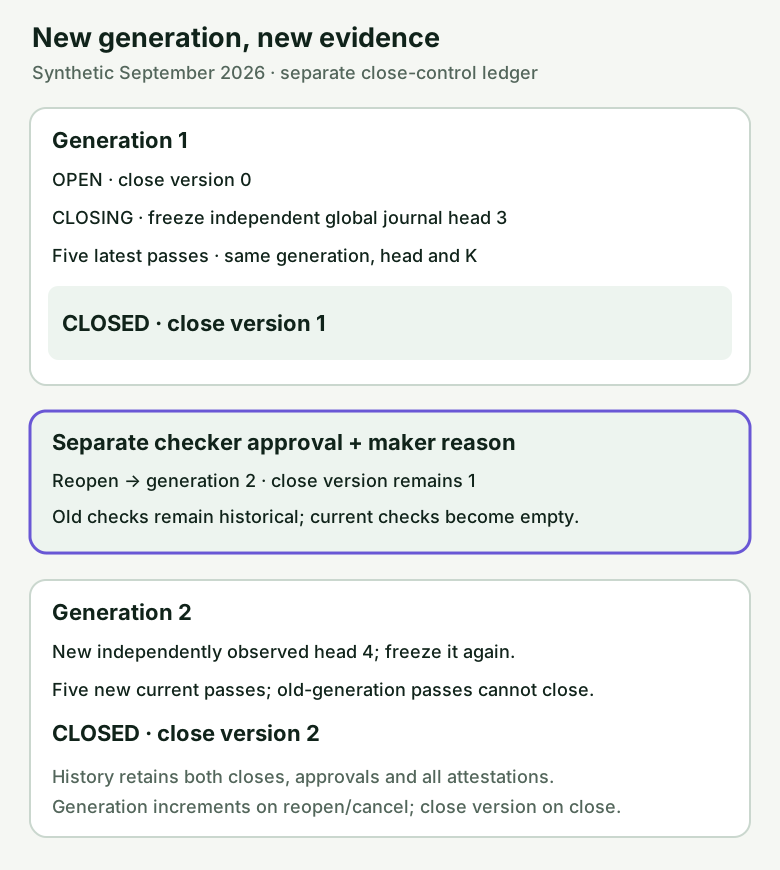
Open the full-size lifecycle diagram.
The canonical model freezes head 3 in generation 1. After reopen, a separately accepted journal advances the independently supplied head to 4. The model does not post that journal; it receives the resulting trusted head. Generation 2 freezes 4 and requires new checks. No old pass is copied into the current projection.
Cancellation is the remediation route from CLOSING back to OPEN. It also needs separate approval, a reason and a new generation. Otherwise a failed close would leave operators unable to post its correction. Both reopen and cancellation preserve every prior operation, receipt and completed close.
Define what a passed check means
This profile requires five kinds, in a fixed order:
| Required kind | What its trusted runner must establish |
|---|---|
| scheduler_due_complete | Every required due instruction is actually accepted under the captured head |
| trial_balance | Financial pass with every reported line matching, complete chart/genesis/source receipts, visible prefix = validated head = frozen head |
| intercompany_worksheet | All contributing member snapshots, refs and heads support the current group worksheet |
| fx_revaluation | Accepted linked revaluation/current carrying under this head, or a fresh zero-delta recalculation |
| balance_proof | The independently controlled balance bridge passes on complete current evidence |
A planned schedule is not accepted posting. A ready FX proposal is not a completed revaluation. Checking only the parent's head cannot establish a group worksheet's currentness when a contributing member changes.
The restricted runner executes the kernels, retains the artifacts and registers a strict attestation: its ID/kind, ledger/entity/month, generation, frozen head, knowledge cutoff K, validated_at, evidence_ref and status pass/fail/indeterminate. The period function does not accept an arbitrary algorithm JSON object as independent proof. Its opaque evidence ref is a trusted host binding, not cryptographic authentication.
The latest accepted registration for each kind is current. If a newer trial-balance result fails, an older pass cannot rescue the close. A new indeterminate result also withholds closure. Both are valid evidence records, even though they do not permit CLOSED.
Check time and freshness explicitly
For every newly registered check:
month end ≤ K
CLOSING recorded time ≤ K ≤ validated_at ≤ trusted processing now
Finalize names one common K. Every latest check must match that K, the current generation and frozen head, and must pass. Each receipt's age must be at most 300 seconds. Exactly 300.000 seconds is valid; 300.001 seconds is stale. This five-minute limit is an authored teaching policy.
Let H be the frozen head, G the generation and Aᵢ the latest receipt for required kind i. Closure requires current head = H and, for every i:
Aᵢ.generation = G
Aᵢ.head = H
Aᵢ.K = requested K
Aᵢ.status = pass
0 ≤ now − Aᵢ.validated_at ≤ 300 seconds
Integers are canonical strings, timestamps genuine UTC milliseconds. There is no monetary rounding in the controller. The host must still detect external basis changes and invalidate or rerun affected checks. Local head and timestamp tests cannot discover unseen outside-system changes.
Authorize before replay or new work
control_period(state, command, context) in Python and controlPeriod in TypeScript use strict exact fields. Commands carry scoped operation identity, action, expected version and actor. Begin adds the expected head; check registration adds its envelope; finalize adds common K; reopen/cancel adds approval ID and an already-trimmed reason.
The trusted context identifies the authenticated principal and scoped permissions. The actor must equal that principal. New reopen/cancel requires an approval bound to the exact semantic command, a different authorized checker and no reused approval. JSON role names supplied by a caller grant nothing.
An accepted exact operation returns its original result before today's phase, head, clock or capacity is rechecked. A changed accepted command conflicts. Current scope/action authority is still required before stored results are disclosed. Failures reserve no identity and append no half-transition.
The portable state retains every accepted command/result. Complete reconstruction rejects impossible phases, altered outputs and reused IDs. “Committed” in this API means a modeled accepted snapshot; it does not establish persistence or live concurrency protection.
Put the barrier beneath every writer
The actual PostgreSQL extension pins the earlier posting/correction SQL and reservation SQL unchanged. Its journal BEFORE INSERT trigger takes the same ledger_heads row lock and checks entity-wide CLOSING, the managed booking month and CLOSED. Legacy open_periods is kept consistent under that lock.
This matters because a corrected journal creates new reversal/replacement journals, and capture stages a hold update before calling posting. The new guard covers both existing paths. If it rejects the journal, the entire statement/transaction rolls back: no leaked counter, half-correction, hold version or capture event.
Hold-only reserve/release/expiry remains possible during CLOSING; it creates no journal. Capture remains atomic and blocked. An unspecified month is never auto-opened merely because a trigger ran or an application flag changed.
Period transitions also increment period_epoch on the locked ledger tuple. A writer using an older Repeatable Read snapshot then encounters a changed row and serialization failure, rather than relying on an unchanged tuple while missing the barrier. Actual tests observe SQLSTATE 40001. PostgreSQL documents the relevant row-lock behavior and transaction isolation semantics.
Restricted logins cannot update the control tables, disable the trigger, set owner role or forge runner checks. A separate checker login registers the exact reopen/cancel approval; the maker executes it with their own permission. Safe definer functions use trusted search paths with pg_temp last and no public execution of private helpers. PostgreSQL function guidance. Owner/superuser administration remains a trust boundary.
Observe the actual commit boundary
The function can return while its transaction is still open. The lock remains held, and another session cannot proceed past it until COMMIT or ROLLBACK. The live test profile observes that wait explicitly.
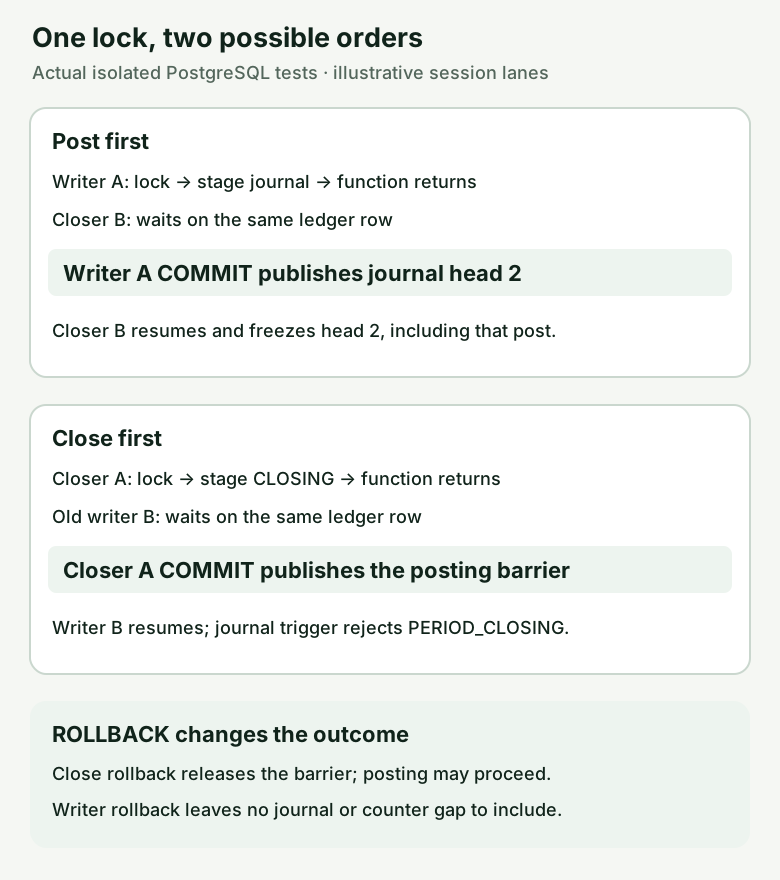
Open the full-size transaction-boundary diagram.
In the separate actual SQL race branch, funding is head 1. Posting first stages a second journal; close waits, then captures head 2 after that post commits. Close first stages CLOSING; the old writer waits and rejects after close commits. Close rollback removes the barrier, allowing the writer to proceed. Writer rollback leaves no journal or counter gap for the closer to include.
Recorded_at is a processing/recording clock, not physical COMMIT time. Neither an allocated number nor a returned function result is treated as a commit timestamp.
Preserve late-event meaning
A late journal cannot enter CLOSED September. If the host separately authorizes a prior-effective/current-open-booking adjustment, the existing posting rule can accept it in OPEN October after the entity barrier clears. Its effective date stays in September and its booking month stays October. The controller supplies no implicit adjustment permission and does not reopen September for that operation.
This distinction is covered by the actual database profile, alongside closed-month denial and the unmanaged-month guard.
Reproduce the checks and explore the lab
The portable oracle has 73 independently prescribed complete result/state cases, 20 accepted, including the exact freshness boundary, generation invalidation, replay at the 256-record cap and authority failures. Python and strict TypeScript compare whole outputs and retained history. The guided period lab bundles that exact TypeScript source and hash; its 18-attempt branch spans two closes, missing evidence, replay and conflicts. Other scenarios show latest failure/indeterminate, receipt age and cancellation.
The actual SQL receipt records restricted-role tests and real session barriers in a fresh PG18.1 loopback cluster. Its check envelopes are synthetic trusted-runner inputs used to test the controller; that harness does not claim the five accounting kernels executed. A separate aggregate integration receipt must support that broader claim.
Download the base posting SQL, reservation SQL, period extension, portable receipt, browser receipt, actual period history and validation report. The package's python tests/run_postgresql.py creates a fresh task-owned cluster on port 55432, verifies durable settings, then stops/removes it. It never accepts a production DSN or changes installed services. Controlled restart is not a hardware power-loss test.
Use this design to build a reviewable close workflow and a regression harness around admitted writers. The declared policy, authenticated authority, actual kernel execution, every source basis and additional posting paths still need host integration. Historical case: not useful without a complete reusable close/journal/approval chronology; all Cedar values here are synthetic.
Continue with Append-Only Journal Enforcement for the admitted-write controls below this lifecycle. Revisit Balance-Proof Algorithm, Trial-Balance Validation and Accrual/Reversal Scheduler to inspect what the runner must actually establish.
Rendered from the canonical Mermaid sources linked by this article.
Close only the captured generation and evidence basis
The runner is trusted to execute and retain all required accounting checks; a passed JSON flag alone is not independent proof.
All SQL transitions and writers share the same ledger-row serialization boundary; actual COMMIT publishes the transition.
ReferencesPrimary sources and evidence notesExpand the source trail, evidence role, and limitations behind the engineering choices.
Expand the source trail, evidence role, and limitations behind the engineering choices.
Accessed 25 October 2026. All Cedar data synthetic. Lifecycle, required-check list, role assignments, generation policy and 300-second limit are author choices, not universal legal requirements.
- PostgreSQL 18, Explicit Locking,13.3.2. Official documentation. Accessed: 25 October 2026. Supports: row-lock retention and changed-row behavior. Limitations: actual admitted writers and lock domain must still be verified; a generic application flag is insufficient.
- PostgreSQL 18, Transaction Isolation,13.2. Official documentation. Accessed: 25 October 2026. Supports: snapshot/updated-row semantics and serialization failures. Limitations: the exact old-path/epoch design is our implementation, tested separately.
- PostgreSQL 18, Transactions tutorial. Official documentation. Accessed: 25 October 2026. Supports: transactional all-or-nothing/visibility boundary. Limitations: recorded_at and function return are not physical commit timestamps; controlled restart is not power-loss evidence.
- PostgreSQL 18, Trigger Behavior. Official documentation. Accessed: 25 October 2026. Supports: validation in the writer transaction. Limitations: privileged administration remains trusted.
- PostgreSQL 18, CREATE FUNCTION, SECURITY DEFINER guidance. Official documentation. Accessed: 25 October 2026. Supports: secure search_path and restricted execution. Limitations: effective grants/memberships must also be tested.
- PCAOB AS2201, paragraphs 26–27 and 14. Official standard. Accessed: 25 October 2026. Supports: period-end journal authorization/processing, adjustments and oversight as audit context. Limitations: not our close software specification, a compliance opinion or a prescribed five-check list.
The frozen Stage 1/Stage 2 SQL profiles are pinned unchanged; actual role/race receipts are local implementation evidence. Generic trusted runner attestations are policy inputs; underlying kernel execution/basis artifacts require the separate shared aggregate integration. No full copyrighted accounting standard or confidential ledger is included. Historical case not useful without complete close/source/authority provenance.
Full dependency-light reference implementations in both supported languages.
/** Sequential close-policy model. `committed` is modeled acceptance, not persistence. */
type Obj = Record<string, any>;
export const REQUIRED_CHECKS = [
  "scheduler_due_complete",
  "trial_balance",
  "intercompany_worksheet",
  "fx_revaluation",
  "balance_proof",
];
const EXTRA: Record<string, string[]> = {
  begin_close: ["expected_head_sequence"],
  record_check: ["attestation"],
  finalize_close: ["knowledge_cutoff"],
  reopen: ["approval_id", "reason"],
  cancel_close: ["approval_id", "reason"],
};
const PERMISSION: Record<string, string> = {
  begin_close: "close",
  record_check: "attest",
  finalize_close: "close",
  reopen: "reopen",
  cancel_close: "reopen",
};
const COMMON = [
  "schema_version",
  "ledger_id",
  "entity_id",
  "booking_period",
  "operation_id",
  "action",
  "expected_version",
  "actor_id",
];
const CHECK = [
  "attestation_id",
  "check_kind",
  "ledger_id",
  "entity_id",
  "booking_period",
  "close_generation",
  "frozen_head_sequence",
  "knowledge_cutoff",
  "validated_at",
  "evidence_ref",
  "status",
];
const IDENT = /^[A-Za-z0-9][A-Za-z0-9._:-]{0,63}$/,
  NUMBER = /^(0|[1-9][0-9]{0,29})$/,
  STAMP = /^[0-9]{4}-[0-9]{2}-[0-9]{2}T[0-9]{2}:[0-9]{2}:[0-9]{2}\.[0-9]{3}Z$/,
  MONTH = /^[0-9]{4}-[0-9]{2}$/;
const EDGE_SPACE =
  /^[\u0009-\u000D\u001C-\u0020\u0085\u00A0\u1680\u2000-\u200A\u2028\u2029\u202F\u205F\u3000]+|[\u0009-\u000D\u001C-\u0020\u0085\u00A0\u1680\u2000-\u200A\u2028\u2029\u202F\u205F\u3000]+$/g;
class Invalid extends Error {
  constructor(
    code: string,
    public status = "rejected",
  ) {
    super(code);
  }
}
function need(ok: any, code: string, status = "rejected"): asserts ok {
  if (!ok) throw new Invalid(code, status);
}
function plain(v: any): boolean {
  return (
    v !== null &&
    typeof v === "object" &&
    !Array.isArray(v) &&
    Object.getPrototypeOf(v) === Object.prototype
  );
}
function exact(v: any, keys: string[], code = "INVALID_SCHEMA"): void {
  need(
    plain(v) &&
      Object.keys(v).length === keys.length &&
      keys.every((k) => Object.hasOwn(v, k)),
    code,
  );
}
function identifier(v: any): void {
  need(typeof v === "string" && IDENT.test(v), "INVALID_IDENTIFIER");
}
function number(v: any, positive = false): bigint {
  need(
    typeof v === "string" && NUMBER.test(v) && (!positive || v !== "0"),
    "INVALID_NUMBER",
  );
  return BigInt(v);
}
function timestamp(v: any): number {
  need(
    typeof v === "string" && STAMP.test(v) && v.slice(0, 4) !== "0000",
    "INVALID_TIMESTAMP",
  );
  const d = new Date(v);
  need(
    !Number.isNaN(d.getTime()) && d.toISOString() === v,
    "INVALID_TIMESTAMP",
  );
  return d.getTime();
}
function month(v: any): string {
  need(
    typeof v === "string" && MONTH.test(v) && v.slice(0, 4) !== "0000",
    "INVALID_PERIOD",
  );
  const d = new Date(v + "-01T00:00:00.000Z");
  need(
    !Number.isNaN(d.getTime()) && d.toISOString().slice(0, 7) === v,
    "INVALID_PERIOD",
  );
  need(v !== "9999-12", "UNSUPPORTED_PERIOD_END");
  d.setUTCMonth(d.getUTCMonth() + 1);
  return d.toISOString();
}
function semantic(v: any): string {
  return JSON.stringify(v, (_k, x) =>
    plain(x)
      ? Object.fromEntries(
          Object.keys(x)
            .sort()
            .map((k) => [k, x[k]]),
        )
      : x,
  );
}
function clone<T>(v: T): T {
  return JSON.parse(JSON.stringify(v));
}
function validateCommand(c: Obj): void {
  need(
    plain(c) && typeof c.action === "string" && Object.hasOwn(EXTRA, c.action),
    "INVALID_SCHEMA",
  );
  exact(c, [...COMMON, ...EXTRA[c.action]]);
  need(c.schema_version === "d30-period-command-v1", "UNSUPPORTED_SCHEMA");
  ["ledger_id", "entity_id", "operation_id", "actor_id"].forEach((k) =>
    identifier(c[k]),
  );
  month(c.booking_period);
  number(c.expected_version);
  if (c.action === "begin_close") number(c.expected_head_sequence);
  else if (c.action === "record_check") {
    const a = c.attestation;
    exact(a, CHECK);
    ["attestation_id", "ledger_id", "entity_id", "evidence_ref"].forEach((k) =>
      identifier(a[k]),
    );
    month(a.booking_period);
    number(a.close_generation, true);
    number(a.frozen_head_sequence);
    timestamp(a.knowledge_cutoff);
    timestamp(a.validated_at);
    need(
      REQUIRED_CHECKS.includes(a.check_kind) &&
        ["pass", "fail", "indeterminate"].includes(a.status),
      "INVALID_CHECK",
    );
  } else if (c.action === "finalize_close") timestamp(c.knowledge_cutoff);
  else {
    identifier(c.approval_id);
    need(typeof c.reason === "string", "INVALID_REASON");
    const chars = [...c.reason];
    need(
      c.reason === c.reason.replace(EDGE_SPACE, "") &&
        chars.length >= 1 &&
        chars.length <= 240 &&
        chars.every((ch) => {
          const n = ch.codePointAt(0)!;
          return !(n >= 0xd800 && n <= 0xdfff);
        }),
      "INVALID_REASON",
    );
  }
}
function initialView(): Obj {
  return {
    phase: "OPEN",
    generation: "1",
    close_version: "0",
    frozen_head_sequence: null,
    closing_at: null,
    closed_at: null,
    journal_head_sequence: "0",
    checks: [],
  };
}
function validateApprovalReceipt(c: Obj, ap: Obj | null, now: string): void {
  need(ap !== null, "APPROVAL_REQUIRED");
  exact(ap, ["approval_id", "maker_id", "checker_id", "approved_at"]);
  ["approval_id", "maker_id", "checker_id"].forEach((k) => identifier(ap[k]));
  timestamp(ap.approved_at);
  need(
    ap.approval_id === c.approval_id && ap.maker_id === c.actor_id,
    "APPROVAL_COMMAND_MISMATCH",
  );
  need(ap.maker_id !== ap.checker_id, "SELF_APPROVAL");
  need(ap.approved_at <= now, "FUTURE_APPROVAL");
}
function applyTransition(
  state: Obj,
  c: Obj,
  now: string,
  head: string,
  others: string[],
  approval: Obj | null,
): Obj {
  const records = state.records,
    view = records.length
      ? clone(records[records.length - 1].result)
      : initialView();
  need(c.expected_version === String(records.length), "VERSION_CONFLICT");
  need(number(head) >= number(view.journal_head_sequence), "HEAD_REGRESSION");
  if (records.length)
    need(
      now >= records[records.length - 1].result.recorded_at,
      "RECORDED_TIME_REGRESSION",
    );
  const action = c.action,
    allowed: Record<string, string> = {
      begin_close: "OPEN",
      record_check: "CLOSING",
      finalize_close: "CLOSING",
      reopen: "CLOSED",
      cancel_close: "CLOSING",
    };
  need(view.phase === allowed[action], "INVALID_TRANSITION");
  if (action === "begin_close") {
    need(now >= month(c.booking_period), "PERIOD_NOT_ENDED");
    need(!others.length, "LEDGER_CLOSING");
    need(c.expected_head_sequence === head, "HEAD_CONFLICT");
    Object.assign(view, {
      phase: "CLOSING",
      frozen_head_sequence: head,
      closing_at: now,
      closed_at: null,
      checks: [],
    });
  } else if (action === "record_check") {
    need(head === view.frozen_head_sequence, "FROZEN_HEAD_CHANGED");
    const a = c.attestation;
    need(
      ["ledger_id", "entity_id", "booking_period"].every((k) => a[k] === c[k]),
      "CHECK_SCOPE_MISMATCH",
    );
    need(a.close_generation === view.generation, "CHECK_GENERATION_MISMATCH");
    need(
      a.frozen_head_sequence === view.frozen_head_sequence,
      "CHECK_HEAD_MISMATCH",
    );
    need(
      a.knowledge_cutoff >=
        [month(c.booking_period), view.closing_at].sort().at(-1)!,
      "CHECK_KNOWLEDGE_TOO_EARLY",
    );
    need(a.validated_at >= a.knowledge_cutoff, "CHECK_CLOCK_ORDER");
    need(a.knowledge_cutoff <= now && a.validated_at <= now, "FUTURE_CHECK");
    need(
      records.every(
        (r: Obj) => r.command.attestation?.attestation_id !== a.attestation_id,
      ),
      "ATTESTATION_ID_CONFLICT",
    );
    const checks = new Map<string, Obj>(
      view.checks.map((v: Obj) => [v.check_kind, clone(v)]),
    );
    checks.set(a.check_kind, clone(a));
    view.checks = REQUIRED_CHECKS.filter((k) => checks.has(k)).map((k) =>
      checks.get(k),
    );
  } else if (action === "finalize_close") {
    need(head === view.frozen_head_sequence, "FROZEN_HEAD_CHANGED");
    need(
      view.checks.length === REQUIRED_CHECKS.length,
      "CHECKS_INCOMPLETE",
      "indeterminate",
    );
    for (const a of view.checks) {
      need(
        a.knowledge_cutoff === c.knowledge_cutoff,
        "CHECK_KNOWLEDGE_MISMATCH",
      );
      need(a.status !== "fail", "CHECK_FAILED");
      need(
        a.status !== "indeterminate",
        "CHECK_INDETERMINATE",
        "indeterminate",
      );
      need(a.validated_at <= now && a.knowledge_cutoff <= now, "FUTURE_CHECK");
      need(timestamp(now) - timestamp(a.validated_at) <= 300000, "CHECK_STALE");
    }
    Object.assign(view, {
      phase: "CLOSED",
      close_version: String(BigInt(view.close_version) + 1n),
      closed_at: now,
    });
  } else {
    validateApprovalReceipt(c, approval, now);
    need(
      records.every((r: Obj) => r.command.approval_id !== c.approval_id),
      "APPROVAL_ID_CONFLICT",
    );
    Object.assign(view, {
      phase: "OPEN",
      generation: String(BigInt(view.generation) + 1n),
      frozen_head_sequence: null,
      closing_at: null,
      closed_at: null,
      checks: [],
    });
  }
  return {
    operation_id: c.operation_id,
    action,
    actor_id: c.actor_id,
    recorded_at: now,
    version: String(records.length + 1),
    ...Object.fromEntries(
      [
        "phase",
        "generation",
        "close_version",
        "frozen_head_sequence",
        "closing_at",
        "closed_at",
      ].map((k) => [k, view[k]]),
    ),
    journal_head_sequence: head,
    checks: view.checks,
    approval_receipt: clone(approval),
  };
}
function validateState(state: Obj): void {
  try {
    exact(state, [
      "schema_version",
      "ledger_id",
      "entity_id",
      "booking_period",
      "records",
    ]);
    need(state.schema_version === "d30-period-state-v1", "INVALID_STATE");
    identifier(state.ledger_id);
    identifier(state.entity_id);
    month(state.booking_period);
    const records = state.records;
    need(Array.isArray(records) && records.length <= 256, "INVALID_STATE");
    const working = { ...state, records: [] as Obj[] },
      seen = new Set<string>();
    for (const record of records) {
      exact(record, ["command", "result"]);
      const c = record.command,
        r = record.result;
      validateCommand(c);
      need(
        ["ledger_id", "entity_id", "booking_period"].every(
          (k) => c[k] === state[k],
        ) &&
          !seen.has(c.operation_id) &&
          plain(r),
        "INVALID_STATE",
      );
      seen.add(c.operation_id);
      timestamp(r.recorded_at);
      number(r.journal_head_sequence);
      const approval = r.approval_receipt;
      need(
        (approval === null) === !["reopen", "cancel_close"].includes(c.action),
        "INVALID_STATE",
      );
      const expected = applyTransition(
        working,
        c,
        r.recorded_at,
        r.journal_head_sequence,
        [],
        approval,
      );
      need(semantic(r) === semantic(expected), "INVALID_STATE");
      working.records.push(record);
    }
  } catch {
    throw new Invalid("INVALID_STATE");
  }
}
function authorize(c: Obj, ctx: Obj): void {
  exact(
    ctx,
    [
      "principal_id",
      "authorized_permissions",
      "now",
      "ledger_head",
      "approval",
    ],
    "INVALID_CONTEXT",
  );
  need(
    plain(c) &&
      typeof c.action === "string" &&
      Object.hasOwn(PERMISSION, c.action),
    "INVALID_SCHEMA",
  );
  ["ledger_id", "entity_id", "operation_id", "actor_id"].forEach((k) =>
    identifier(c[k]),
  );
  identifier(ctx.principal_id);
  need(ctx.principal_id === c.actor_id, "ACTOR_MISMATCH");
  const permissions = ctx.authorized_permissions;
  need(
    Array.isArray(permissions) && permissions.length <= 1000,
    "INVALID_CONTEXT",
  );
  const seen = new Set<string>();
  for (const p of permissions) {
    exact(p, ["ledger_id", "entity_id", "permission"], "INVALID_CONTEXT");
    identifier(p.ledger_id);
    identifier(p.entity_id);
    need(
      ["close", "attest", "reopen"].includes(p.permission),
      "INVALID_CONTEXT",
    );
    const key = JSON.stringify([p.ledger_id, p.entity_id, p.permission]);
    need(!seen.has(key), "INVALID_CONTEXT");
    seen.add(key);
  }
  need(
    seen.has(JSON.stringify([c.ledger_id, c.entity_id, PERMISSION[c.action]])),
    "SCOPE_FORBIDDEN",
  );
}
function newContext(c: Obj, ctx: Obj): [string, string[], Obj | null] {
  timestamp(ctx.now);
  const h = ctx.ledger_head;
  exact(
    h,
    [
      "ledger_id",
      "entity_id",
      "head_sequence",
      "last_recorded_at",
      "other_closing_periods",
    ],
    "INVALID_CONTEXT",
  );
  identifier(h.ledger_id);
  identifier(h.entity_id);
  number(h.head_sequence);
  timestamp(h.last_recorded_at);
  need(
    h.ledger_id === c.ledger_id && h.entity_id === c.entity_id,
    "SCOPE_MISMATCH",
  );
  need(ctx.now >= h.last_recorded_at, "RECORDED_TIME_REGRESSION");
  const others = h.other_closing_periods;
  need(Array.isArray(others) && others.length <= 24, "INVALID_CONTEXT");
  others.forEach(month);
  need(
    new Set(others).size === others.length &&
      !others.includes(c.booking_period),
    "INVALID_CONTEXT",
  );
  let approval = ctx.approval;
  if (["reopen", "cancel_close"].includes(c.action)) {
    need(approval !== null, "APPROVAL_REQUIRED");
    exact(approval, [
      "approval_id",
      "maker_id",
      "checker_id",
      "approved_at",
      "command",
    ]);
    need(
      semantic(approval.command) === semantic(c),
      "APPROVAL_COMMAND_MISMATCH",
    );
    approval = Object.fromEntries(
      ["approval_id", "maker_id", "checker_id", "approved_at"].map((k) => [
        k,
        approval[k],
      ]),
    );
  } else need(approval === null, "INVALID_CONTEXT");
  return [h.head_sequence, others, approval];
}
export function controlPeriod(state: any, command: any, context: any): Obj {
  try {
    authorize(command, context);
    validateState(state);
    need(
      ["ledger_id", "entity_id", "booking_period"].every(
        (k) => command[k] === state[k],
      ),
      "SCOPE_MISMATCH",
    );
    const old = state.records.find(
      (r: Obj) => r.command.operation_id === command.operation_id,
    );
    if (old) {
      need(semantic(old.command) === semantic(command), "IDEMPOTENCY_CONFLICT");
      return {
        status: "replayed",
        code: "PRIOR_PERIOD_RESULT",
        result: clone(old.result),
        state: clone(state),
      };
    }
    validateCommand(command);
    need(state.records.length < 256, "STATE_CAPACITY");
    const [head, others, approval] = newContext(command, context),
      result = applyTransition(
        state,
        command,
        context.now,
        head,
        others,
        approval,
      ),
      after = clone(state);
    after.records.push({ command: clone(command), result: clone(result) });
    return {
      status: "committed",
      code: "PERIOD_TRANSITION_ACCEPTED",
      result,
      state: after,
    };
  } catch (error) {
    if (!(error instanceof Invalid)) throw error;
    return {
      status: error.status,
      code: error.message,
      result: null,
      state: clone(state),
    };
  }
}
The embedded lab now expands to its full document height, keeping the article as the only scroll surface.